
TL;DR:
- Contact an experienced Tampa truck accident attorney quickly after a crash to preserve vital evidence like logs and footage. Florida’s two-year limit and rapid record overwriting make timely legal action essential for fair compensation.
If a commercial truck injured you in Tampa, contact an experienced truck accident attorney immediately. Florida’s two-year statute of limitations for personal injury claims, effective for injuries accruing on or after March 24, 2023, means the clock is already running, and critical evidence like ELD logs and dashcam footage can disappear within days. Martin Hernandez, PA is a Tampa-based personal injury firm that handles truck accident claims on a contingency-fee basis, meaning you pay nothing unless your case is won. Free case reviews are available now.
Three things to do before you call counsel:
- Get medical care first, even if you feel fine. Adrenaline masks injuries, and a gap in treatment hurts your claim.
- Photograph everything at the scene: the truck, its markings, license plates, cargo, road conditions, and your injuries.
- Do not give a recorded statement to any insurance company until you have spoken with an attorney.
Florida Statute § 627.7415 sets commercial vehicle insurance minimums by gross vehicle weight, and interstate carriers must also meet federal financial responsibility rules under 49 C.F.R. part 387. Those insurance layers are what your attorney will pursue. Under § 768.81, Florida’s modified comparative fault rules make identifying every liable party early a legal and financial necessity.
How does a Tampa truck accident attorney build your claim?
Truck accident cases are not oversized car accident cases. They require a different investigative approach from the first hours, and the difference between a thorough early investigation and a delayed one can define the outcome.
The moment an attorney takes your case, the first priority is evidence preservation. That means sending a formal preservation and disclosure letter to the carrier demanding that ELD logs, the accident register, dashcam footage, driver qualification files, and maintenance records be held intact. Under 49 C.F.R. § 390.15, carriers must maintain an accident register for three years, but ELD data can be overwritten and dashcam footage reused in days. Waiting is not an option.
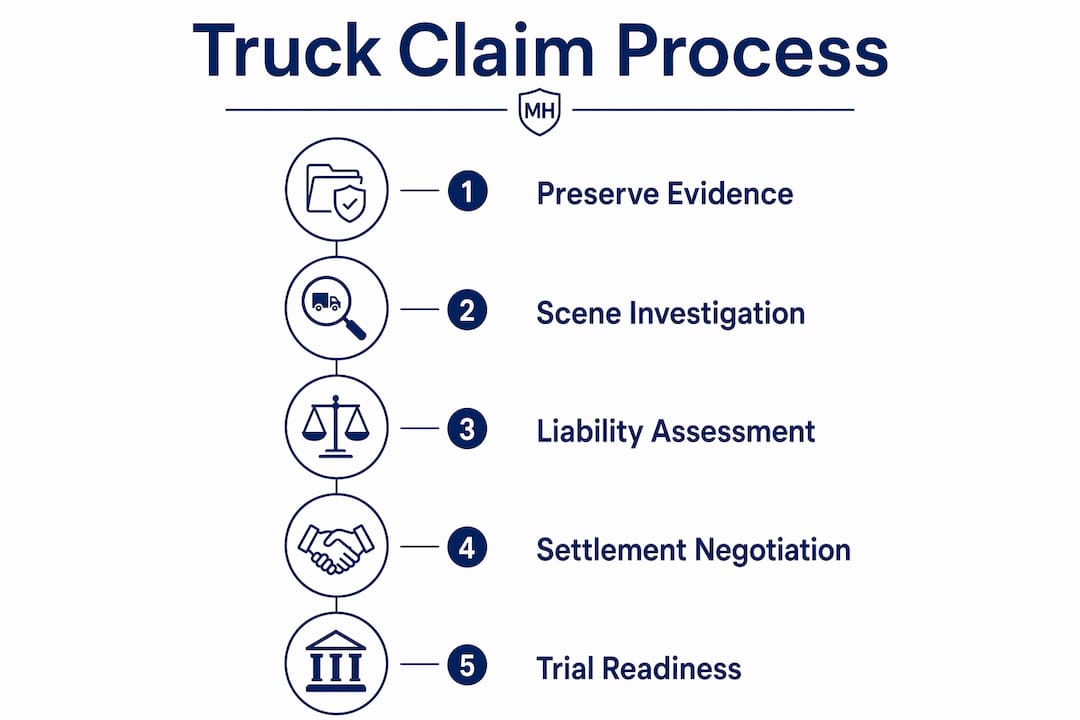
From there, the attorney coordinates scene investigation: photographs, measurements, witness interviews, and, when necessary, retaining a towing company to preserve the truck itself before repairs alter the physical evidence. Accident reconstruction specialists, trucking operations experts, and human-factors consultants are brought in to translate raw evidence into a coherent crash sequence.
Pro Tip: Ask your attorney whether they send a federal preservation demand letter within the first 48 hours. If they do not, critical carrier records may be gone before litigation begins.
Florida’s modified comparative fault rules add another layer of complexity. If fault is shared among multiple defendants, each party’s percentage determines their share of liability. Identifying every potentially responsible party early, including the carrier, the vehicle owner, the shipper, the maintenance provider, and any parts manufacturer, is not just thorough lawyering. It is the mechanism that accesses multiple insurance layers and prevents a single defendant from deflecting the entire loss onto your percentage of fault.
When insurers refuse to offer fair value, trial readiness changes the negotiation. Carriers and their insurers know which attorneys prepare cases for court and which ones settle under pressure. Local Tampa court experience and a demonstrated willingness to try cases is a concrete negotiating asset.
What should you do in the first hours after a truck crash?
If you’re reading this after a crash, here is the sequence that protects both your health and your legal rights.
- Move to safety and call 911. Get yourself and others out of traffic if you can do so without worsening injuries. Emergency services will document the scene.
- Get the incident report number. Ask the responding officer for the report number before you leave. You will need it.
- Document the scene. Photograph the truck’s DOT number, company name, license plates, cargo, skid marks, road conditions, traffic signals, and any visible damage to both vehicles.
- Gather witness information. Names and phone numbers from bystanders are often the only independent account of how the crash happened.
- Note the truck driver’s information. License number, insurance carrier, and employer name if visible on the cab or trailer.
- Seek medical attention the same day. Even if you feel okay, go to an emergency room or urgent care. Spinal injuries, concussions, and internal bleeding can present hours later. A same-day medical record ties your injuries to the crash.
- Follow up with every appointment. Gaps in treatment are used by insurance adjusters to argue your injuries were not serious.
- Call a truck accident attorney before speaking to insurers. The carrier’s insurer will contact you quickly. Their goal is a fast, low settlement or a recorded statement they can use against you later.
For a detailed post-crash legal checklist, Martin Hernandez, PA has published step-by-step guidance written specifically for Florida truck crash victims.
Time-sensitive evidence deserves special attention. ELD logs record hours of service in real time, but carriers can overwrite them. Dashcam footage on a loop gets reused. An attorney who moves fast can send a federal preservation demand before that window closes.
What types of truck crashes happen most often in Tampa, and why?
Tampa’s highway network, including I-4, I-75, I-275, and the Port of Tampa access routes, sees heavy commercial traffic daily. The crash types that appear most often each carry their own set of causes and evidence needs.
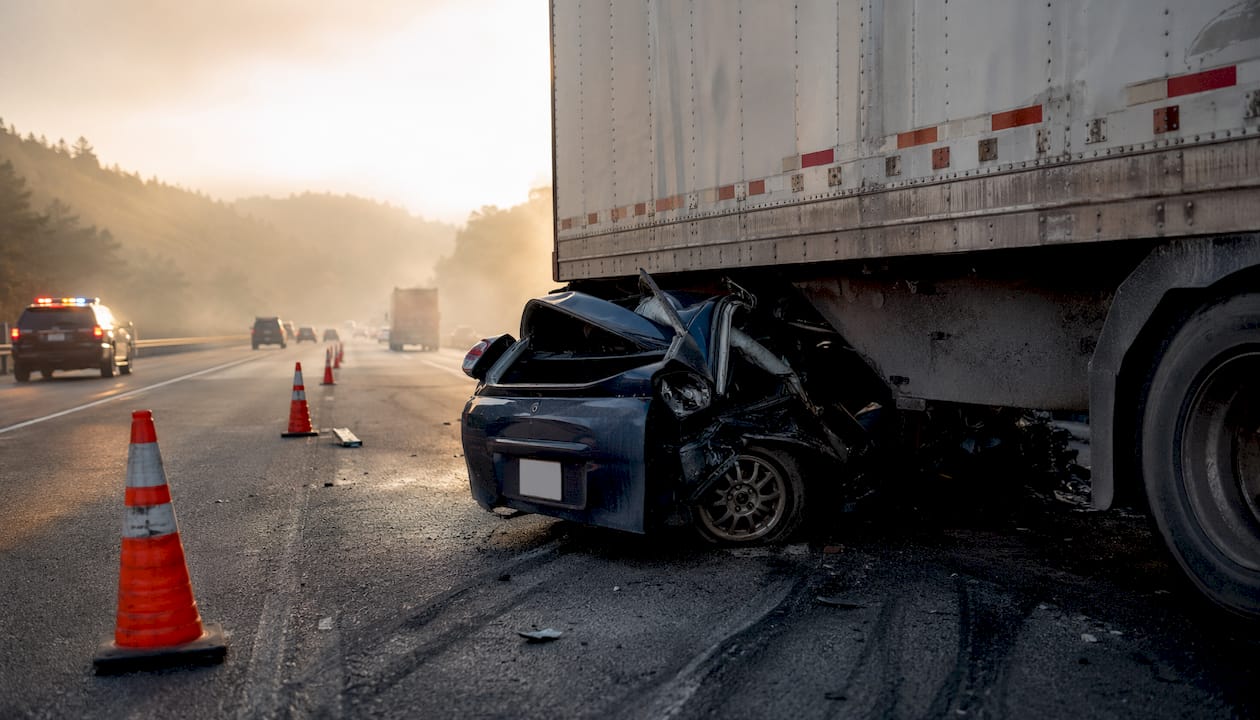
Underride crashes happen when a smaller vehicle slides under the rear or side of a trailer. These are often fatal or catastrophic. The key evidence is the underride guard itself: whether it was present, properly maintained, and met federal standards. Scene photographs and guard inspection records are critical.
Jackknife crashes occur when a trailer swings out at an angle to the cab, typically during hard braking or on wet roads. Driver fatigue, excessive speed, and brake maintenance failures are the most common contributing factors. ELD logs and maintenance records are the first documents an attorney will demand.
Rollovers often involve overloaded or improperly secured cargo shifting the truck’s center of gravity. Load manifests, weight tickets, and shipper records become central evidence.
Wide-turn and blind-spot collisions are common in Tampa’s urban intersections and on-ramps. These often involve driver inattention or inadequate mirrors, and they disproportionately injure cyclists and pedestrians alongside passenger vehicles.
Brake and equipment failures point directly to maintenance records. Under Florida Statute § 316.302, commercial motor vehicles operating on Florida highways are subject to federal safety regulations, which include mandatory inspection and maintenance requirements. A brake failure that could have been caught in a routine inspection is a maintenance-provider liability issue, not just a driver error.
FMCSA reportability thresholds apply to commercial vehicles above 10,000 pounds GVWR/GCWR, which covers virtually every tractor-trailer, box truck, and tanker on Tampa roads. If federal rules apply, so does the carrier’s record-retention obligation.
Who can be held legally responsible for a Tampa truck crash?
One of the most consequential decisions in a truck accident case is deciding who to name as a defendant. Getting this wrong, or stopping too early, can leave significant compensation on the table.
Potential liable parties include:
- The truck driver: Direct negligence, including speeding, distracted driving, hours-of-service violations, or impairment.
- The motor carrier: Vicarious liability for the driver’s actions, plus direct liability for negligent hiring, inadequate training, or pressure to violate hours-of-service rules.
- The vehicle owner or lessor: When the truck is leased, the owner may carry separate liability depending on the lease structure.
- The shipper or loader: Improperly loaded or overweight cargo that caused the crash creates liability for the party who loaded or certified the load.
- Maintenance and repair providers: A third-party shop that missed a brake defect or improperly repaired a component can be named directly.
- Parts manufacturers: A defective tire, brake component, or coupling device that failed creates a product liability claim against the manufacturer.
- Government entities: Poor road design, missing signage, or inadequate lighting on a Tampa or Hillsborough County road can bring a government agency into the case, but Florida Statute § 768.28 requires strict pre-suit notice and imposes monetary caps on those claims.
For a deeper look at liable parties in truck accidents, including how attorneys build the case against each type of defendant, Martin Hernandez, PA has published a detailed breakdown.
Under Florida’s modified comparative fault framework, each defendant pays according to their share of fault. Naming all of them is how you access every available insurance layer and prevent any single party from escaping meaningful accountability.
What damages can you recover in a Florida truck accident case?
Florida law allows truck accident victims to pursue both economic and non-economic damages. The scope of a claim depends on the severity of injuries, the impact on earning capacity, and whether the crash caused a fatality.
Economic damages are the measurable financial losses:
- Past and future medical expenses, including surgery, hospitalization, rehabilitation, and long-term care
- Lost wages from time missed at work during recovery
- Loss of future earning capacity if injuries are permanent or disabling
- Replacement services for household tasks you can no longer perform
- Funeral and burial expenses in wrongful death claims
Non-economic damages cover losses that do not come with a receipt:
- Physical pain and suffering, both past and ongoing
- Emotional distress and psychological trauma
- Loss of consortium, meaning the impact on a spouse or family relationship
Florida’s modified comparative fault rules under § 768.81 reduce your recovery by your percentage of fault. If you are found 20% at fault, you recover 80% of the total damages. Identifying and naming all liable defendants, rather than accepting a single-party settlement, is often what determines whether the final number reflects the full scope of your loss. For common Tampa traffic injuries and what they typically involve medically, that context matters when calculating future care costs.
What insurance and federal regulations apply to Tampa truck crash claims?
Florida and federal law create overlapping obligations for commercial carriers, and those obligations are what attorneys use to access records and coverage.
| Requirement | Source | Key Detail |
|---|---|---|
| Commercial vehicle insurance minimums (FL) | Fla. Stat. § 627.7415 | — |
| Federal financial responsibility (interstate) | 49 C.F.R. part 387 | Interstate carriers must meet federal minimums in addition to state requirements |
| Accident register retention | 49 C.F.R. § 390.15 | Carriers must keep accident registers for three years |
| FMCSA reportable crash threshold | FMCSA guidance | Applies to commercial vehicles above 10,000 lbs GVWR/GCWR |
| Government-entity claims | Fla. Stat. § 768.28 | Pre-suit notice required; monetary caps apply |

The accident register must contain the crash date, location, driver name, injury and fatality count, and whether hazardous materials were released. Carriers are required to produce this register on demand, but they are not required to produce internal insurance adjuster reports. Experienced counsel requests the specific records listed in federal regulations, not a general document dump that the carrier can selectively fulfill.
Pro Tip: A preservation and disclosure letter sent within 48 hours of the crash puts the carrier on formal notice that destroying or overwriting records may constitute spoliation of evidence. That letter alone can change how a carrier’s legal team responds.
How long do you have to file, and what does the process look like?
Florida’s two-year statute of limitations for personal injury claims applies to injuries accruing on or after March 24, 2023. Two years sounds like enough time, but the practical reality is that the first 90 days are when the most important evidence either gets preserved or disappears.
Claims against government entities move on a different track. Under Florida Statute § 768.28, you must provide pre-suit notice before filing, and the process has its own procedural timeline that can compress your window significantly.
| Phase | Typical Timeframe | What Happens |
|---|---|---|
| Investigation and demand | Up to 6 months | Evidence preservation, expert retention, demand package to insurer |
| Negotiation / pre-suit | 3 months | Insurer responds; settlement discussions or suit filed |
| Discovery and expert work | 6 months | Depositions, expert reports, motions |
| Mediation and trial prep | 12 months | Mediation required in Florida; trial if no resolution |
These ranges vary by case complexity. A straightforward liability case with clear carrier fault may resolve in pre-suit negotiations. A multi-defendant case involving a manufacturer and a government entity can take considerably longer. For a detailed look at personal injury lawsuit stages, the procedural steps are consistent regardless of case type.
Pro Tip: Do not wait until month 20 to contact an attorney. By then, the accident register may still exist, but witness memories fade, physical evidence is gone, and the carrier’s legal team has had nearly two years to build their defense.
How do you choose the right Tampa truck accident attorney?
Not every personal injury attorney is equipped to handle a commercial trucking case. The investigation is more technical, the defendants are better insured and better represented, and the federal regulatory layer requires specific knowledge.
When evaluating attorneys, prioritize these criteria:
- Truck-specific experience: Have they handled cases involving ELD data, accident registers, and FMCSA regulations? Ask directly.
- Trial experience in Tampa and Hillsborough County: Local court relationships and a demonstrated willingness to try cases matter. Insurers know which attorneys settle under pressure.
- Investigation resources: Do they retain accident reconstruction specialists and trucking operations experts, or do they rely solely on police reports?
- Bilingual staff: If Spanish is your primary language, confirm that the firm has fluent Spanish-speaking staff, not just a translation service.
- Transparent fee structure: Contingency fees are standard, but the percentage and how case expenses are handled vary. Get it in writing.
Questions worth asking in a free consultation: Who handles the investigation on my case? How do you preserve carrier records in the first 48 hours? What is your experience with cases that went to trial? How will you communicate with me, and how often?
Red flags to watch for: pressure to sign a release quickly, vague answers about how they preserve carrier records, no trial experience, or a fee agreement that does not clearly explain how expenses are handled. For a local hiring guide, finding the right truck accident attorney in Tampa walks through the evaluation process in detail.
What does hiring a truck accident attorney actually cost?
Truck accident attorneys in Tampa almost universally work on contingency, meaning you pay no attorney fees unless your case results in a recovery. The fee is a percentage of the settlement or verdict, and that percentage typically varies depending on whether the case resolves pre-suit or goes to trial.
Beyond the attorney fee, cases involve real expenses: accident reconstruction expert fees, medical record retrieval, deposition transcripts, filing fees, and costs for treating physicians to provide testimony. Most firms advance these costs on your behalf and recover them from the settlement proceeds if you win. If you do not recover, the handling of those expenses depends on the specific fee agreement, which is why reading it carefully matters.
Pro Tip: Before signing any fee agreement, ask for a plain-English explanation of how expenses are handled if the case does not settle, and ask how comparative fault could reduce your net recovery even after a successful verdict.
During your free consultation, ask the attorney to walk through a hypothetical: if your damages are $500,000 and you are found 15% at fault, what does the net recovery look like after fees and expenses? Any attorney worth hiring will answer that question directly.
Martin Hernandez, PA: trial-ready Tampa truck accident representation
When a commercial truck crash turns your life upside down, you need more than a law firm that files paperwork. You need a team that moves fast, knows the federal regulations, and is prepared to take your case to a Hillsborough County courtroom if that is what it takes to get you fair compensation.
Martin Hernandez, PA handles Tampa truck accident claims on a contingency-fee basis. No upfront costs. No attorney fees unless you win. The firm’s approach to truck cases includes immediate preservation demands to carriers, retention of accident reconstruction and trucking operations experts, and full trial preparation from day one. Spanish-speaking staff are available for every client interaction.
Whether your case involves a single carrier or a chain of defendants that includes a shipper, a maintenance provider, and a parts manufacturer, the firm builds the full picture before any settlement discussion begins. For a plain-English overview of how personal injury law works and what your rights are, that resource is a good starting point.
To schedule your free case review, contact Martin Hernandez, PA directly. The consultation is free, the fee structure is contingency-based, and the first call costs you nothing.
Key Takeaways
Florida’s statute of limitations and the rapid loss of carrier records make contacting a Tampa truck accident attorney within days of the crash the single most important step a victim can take.
| Point | Details |
|---|---|
| Act within days, not months | ELD logs and dashcam footage can be overwritten quickly; attorney preservation demands must go out fast. |
| Florida insurance minimums matter | Carriers above certain weight thresholds must carry state-mandated combined liability coverage under Fla. Stat. § 627.7415. |
| Name every liable party | Under Florida’s modified comparative fault rules, identifying all defendants accesses multiple insurance layers and protects your full recovery. |
| Two-year filing deadline | Florida’s statute of limitations for personal injury claims is two years for injuries accruing on or after March 24, 2023. |
| Martin Hernandez, PA | Handles Tampa truck accident claims on contingency, with immediate preservation demands, trial readiness, and Spanish-speaking staff. |
What truck accident victims in Tampa need to hear
Most people who contact me after a truck crash are dealing with something they never expected and do not fully understand yet. The injuries are serious, the insurance company is already calling, and the paperwork feels overwhelming. What I want you to know is this: the complexity of a truck case is exactly why you should not face it alone, and it is also why the firm you choose matters more than it would in a typical car accident claim.
Truck carriers and their insurers have experienced legal teams working from the moment a crash is reported. The only way to level that playing field is to have an attorney who moves just as fast, knows the federal regulations just as well, and is not afraid to take the case to trial if the insurer refuses to be reasonable. That is how this firm approaches every case we take.
If you were injured in a Tampa truck crash, call us for a free case review. There are no upfront fees, and you will not owe us anything unless we recover for you.
Useful sources
The following primary sources are cited throughout this article and are available for direct reference:
- Florida Statute § 627.7415: Commercial vehicle insurance minimums by gross vehicle weight
- Florida Statute § 768.28: Waiver of sovereign immunity; pre-suit notice and caps for government-entity claims
- Florida Statute § 768.81: Modified comparative fault rules
- Florida Statute § 316.302: Commercial motor vehicle safety regulations applicable in Florida
- 49 C.F.R. § 390.15 / Accident Register (FMCSA): Carrier accident register retention requirements
- FMCSA Reportable Crash Guidance (PDF): Thresholds and examples for FMCSA-reportable commercial crashes
- Florida Statute of Limitations Reference: Two-year limitation period for personal injury claims accruing on or after March 24, 2023
FAQ
How long do I have to file a truck accident lawsuit in Florida?
Florida’s statute of limitations for personal injury claims is two years for injuries accruing on or after March 24, 2023. Claims against government entities require pre-suit notice under Florida Statute § 768.28 and may have shorter procedural windows.
What makes a truck accident case different from a car accident claim?
Commercial truck cases involve federal regulations (FMCSA rules, ELD data, accident registers), multiple potential defendants, and significantly higher insurance limits. The investigation is more technical and time-sensitive than a standard auto claim.
Does Martin Hernandez, PA charge upfront fees for truck accident cases?
No. Martin Hernandez, PA handles truck accident claims on a contingency-fee basis, meaning you pay no attorney fees unless your case results in a recovery. Case expenses are typically advanced by the firm.
Who can be held liable in a Tampa commercial truck crash?
Potentially liable parties include the truck driver, the motor carrier, the vehicle owner or lessor, the shipper or loader, maintenance providers, parts manufacturers, and, in some cases, a government entity responsible for road conditions.
What records should an attorney demand immediately after a truck crash?
The most time-sensitive records are ELD logs, dashcam footage, the carrier’s accident register (required under 49 C.F.R. § 390.15), driver qualification files, and maintenance and inspection records. A preservation demand letter should go to the carrier within 48 hours of the crash.