
You’ve probably seen ads for a “truck accident settlement calculator” online. They promise a quick and easy answer to the biggest question on your mind: “What is my case worth?” These tools offer a ballpark figure by plugging your information into a basic formula, but it’s important to know what they are—and what they aren’t.
Think of an online calculator as a starting point. It’s a rough sketch, not the detailed final blueprint of your potential compensation. The reality of a Florida truck accident claim is far more complex than any automated tool can handle.
How a Settlement Calculator Actually Works
So, what’s happening behind the scenes when you plug your numbers into one of these online tools? It’s not pulling a number out of thin air. Instead, it’s running a simplified calculation based on two core concepts of personal injury law:
- Economic Damages: These are the straightforward, black-and-white costs. Every dollar you’ve lost or had to spend because of the accident falls into this bucket—medical bills, missed paychecks, and any other out-of-pocket expenses. They are tangible and have a paper trail.
- Non-Economic Damages: This is where things get more personal. This category attempts to put a value on the human suffering involved—the physical pain, the emotional trauma, and the way the accident has impacted your quality of life.
The Core Formula
At its most basic level, the calculator takes your hard financial losses and uses a “multiplier” to estimate your pain and suffering.
The most common formula is: (Total Economic Damages) x (Pain and Suffering Multiplier) = Estimated Settlement Value. The multiplier is the key variable here, typically ranging from 1.5 to 5, depending on how severe your injuries are.
This simple math is what drives the estimate you see on your screen.
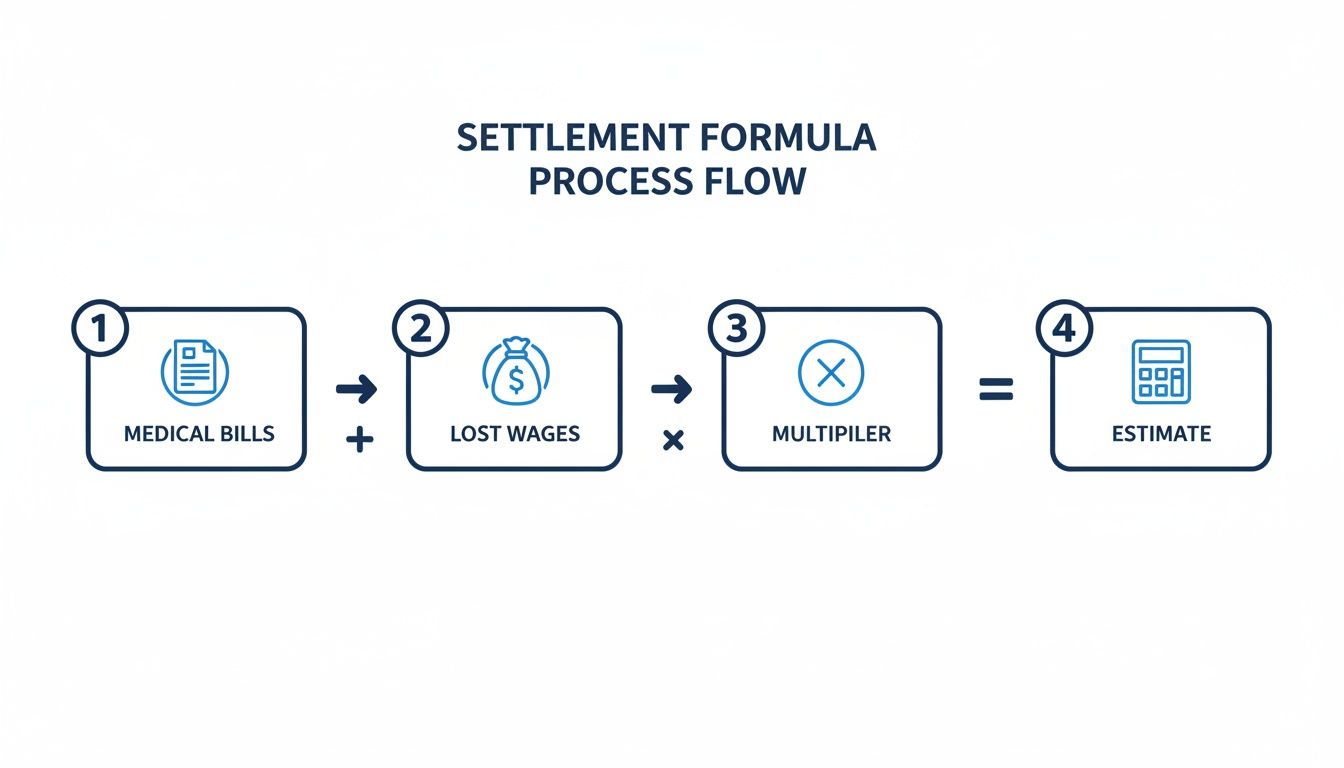
As you can see, the process takes your measurable costs (like doctor’s bills and lost income) and applies that subjective multiplier to arrive at a potential settlement figure.
Why This Formula Is Just the Beginning
Here’s the problem: a real truck accident claim is never that simple, especially in Florida. These cases are notoriously complicated. We’re dealing with federal trucking regulations, multiple liable parties (the driver, the trucking company, the cargo loader, the maintenance shop), and insurance companies that fight tooth and nail to pay as little as possible.
An online calculator can’t account for these critical details.
It can’t dig into the trucking company’s safety record, depose a negligent driver, or go head-to-head with an army of corporate lawyers. To get a better sense of all the moving parts, you can learn more about what goes into the average car accident settlement in Florida, and then imagine that complexity multiplied for a commercial truck case.
This guide will break down what truly goes into building a case value—all the essential factors these calculators miss—so you can understand what your claim is really worth.
Calculating Your Economic Damages After an Accident

Before any truck accident settlement calculator can give you a meaningful number, it needs a solid foundation of hard costs. We call these economic damages. Think of them as every single dollar the accident has cost you out of pocket.
These aren’t fuzzy numbers or estimates. They are the tangible, provable financial losses you’ve had to bear. Building this part of your claim starts with meticulous record-keeping. Every receipt, bill, and pay stub is a crucial piece of the puzzle, helping to paint the true financial picture of your recovery.
Cataloging Your Medical Expenses
The most immediate and often biggest piece of the economic puzzle is your medical costs. These expenses start racking up from the moment of the crash and can stretch on for months, or even years.
Let’s imagine a construction worker from Tampa is hit by a semi-truck on I-275. His medical expense journey kicks off with the ambulance ride and the initial emergency room visit. From there, the costs can spiral.
We’re talking about things like:
- Initial Hospitalization: The bill for the hospital stay itself, any emergency surgeries, diagnostic tests like MRIs or CT scans, and bills from every specialist who consulted on his case.
- Ongoing Treatment: This covers all follow-up doctor appointments, physical therapy sessions needed to get him back on his feet, and the cost of every prescription he needs to fill.
- Future Medical Needs: This is where things get more complex, but it’s absolutely critical. If his injuries will require another surgery down the road, long-term care, or even modifications to his home to make it accessible, those projected costs must be part of the settlement.
Every single bill becomes a piece of evidence. Together, they create a clear, documented total for all the medical care you’ve needed—and will need—because of the accident.
A truck accident settlement calculator is only as good as the information you feed it. These hard medical costs are the bedrock of the entire calculation, setting the baseline value before any other factors come into play.
Tallying Your Lost Income and Earning Capacity
The financial fallout from a serious truck wreck goes far beyond just medical bills. If you can’t work, you’re losing income, and that represents another massive economic loss that has to be carefully calculated.
This part of your claim is really broken into two pieces:
- Lost Wages: This is the simple part. It’s the direct income you’ve already missed out on while being unable to work. Your pay stubs and employment records provide clear, undeniable proof.
- Loss of Future Earning Capacity: This requires a bit more foresight. What if that Tampa construction worker suffers a permanent back injury and can never go back to his physically demanding job? His settlement needs to account for the massive difference between what he would have earned over his lifetime and what he can earn now in a less strenuous, and likely lower-paying, role.
Calculating this loss often requires bringing in vocational experts and economists to project the true lifetime financial impact.
To help you get a clearer picture, here’s a breakdown of the key inputs that form the foundation of your claim.
Key Inputs for Your Florida Truck Accident Claim
Meticulous documentation of all financial losses is non-negotiable for securing a fair valuation from insurance companies. Here are the core damages we track to build a strong case.
- Past Medical Bills: This includes everything from emergency room visits, hospital stays, and surgeries to diagnostics (MRIs, X-rays), ambulance transport, and specialist consultations. You’ll need invoices from hospitals, clinic bills, and pharmacy receipts.
- Future Medical Care: We calculate the estimated costs for ongoing physical therapy, future surgeries, long-term medication, and any necessary medical equipment. This is supported by written opinions from medical experts and life care plans.
- Lost Wages: This covers all income lost from the time of the accident until you return to work. Recent pay stubs, W-2 forms, and a letter from your employer are key documents here.
- Loss of Earning Capacity: If you can’t return to your previous job, this is the difference in your projected lifetime earnings. It’s proven with reports from vocational specialists, economists, and your employment history.
- Property Damage: This is the cost to repair or replace your vehicle and any personal items damaged in the crash. You will need auto body shop estimates, the vehicle’s Blue Book value, and receipts.
Understanding these categories is the first step. The more organized your documentation, the stronger the foundation of your claim will be.
It’s vital to grasp the full scope of these costs. You can learn more about the types of damages in personal injury cases to see how everything fits together. Given that large-truck crashes resulted in over 114,000 injuries in 2023 alone, the potential for life-altering financial loss is very real.
Understanding the Pain and Suffering Multiplier

Once we’ve tallied up the hard numbers—the medical bills, lost paychecks, and future expenses—we get to the most human part of the equation. It’s also the most subjective. How do you possibly put a dollar amount on physical pain, emotional trauma, or the simple inability to enjoy life like you used to?
This is where the pain and suffering multiplier comes in.
Think of it as a way to quantify the human cost of the accident. It’s a number, usually between 1.5 and 5 (though sometimes much higher), that gets multiplied by your total economic damages. The result is an estimate of your non-economic damages, and this is precisely where an online calculator falls short. It can’t grasp the personal story behind the numbers.
How the Multiplier Is Determined
That multiplier isn’t just pulled out of thin air. Attorneys and insurance adjusters use it as a starting point to gauge how severely the accident has impacted a person’s life. A lower multiplier is generally for injuries that, while painful, are expected to heal completely with a fairly predictable recovery.
A higher multiplier, however, is reserved for injuries that are catastrophic, permanent, or fundamentally change who you are and what you can do.
Let’s put it in real-world terms:
- A 1.5x Multiplier: Imagine a broken arm that heals up in eight weeks with some physical therapy. The accident was a major disruption, for sure, but the impact was temporary.
- A 5x (or higher) Multiplier: Now, consider a severe spinal cord injury that leads to permanent paralysis. This isn’t just a temporary setback; it’s a lifelong disability that brings constant pain and a total loss of your former life.
Ultimately, the multiplier is a tool used to translate the severity of your personal losses into a number the legal system can work with.
Key Factors That Influence the Multiplier
So, what pushes a multiplier from a 2 to a 5 or even higher? It’s never just one thing. It’s the whole picture of your suffering, and an experienced attorney knows how to build a powerful case around these specific elements.
Here are the critical factors that can justify a higher value:
- Severity of the Injuries: Are they permanent? Is there disfigurement or scarring? Traumatic brain injuries, amputations, and paralysis will always demand a much higher multiplier.
- The Recovery Journey: A long, grueling recovery filled with multiple surgeries, painful rehabilitation, and chronic pain tells a story that justifies a higher number.
- Impact on Daily Life: How has the crash changed your day-to-day existence? If you can no longer work in your chosen field, enjoy your hobbies, or even play with your kids, that loss has immense value.
- Emotional and Psychological Trauma: A documented diagnosis of PTSD, anxiety, or depression directly caused by the wreck is a major factor that significantly increases the multiplier.
For a deeper dive, you can learn more about how to calculate pain and suffering damages in our dedicated guide.
The pain and suffering multiplier is where a compelling human story, backed by solid evidence, can dramatically influence the final settlement amount. It transforms the cold, hard numbers into a figure that more accurately reflects your true losses.
The trucking industry’s own data shows why these multipliers are so critical. Settlements in serious truck accident claims are typically far larger than those for regular car accidents simply because a massive commercial truck causes much more devastating harm.
With large-truck collisions injuring roughly 153,000 people in 2023 alone, a large portion of those cases involve catastrophic injuries that justify multipliers ranging from 5x to 10x or even more, especially when permanent disability is involved.
What Online Calculators Can’t Tell You
A truck accident settlement calculator can give you a quick, ballpark figure, but it’s important to see it for what it is: a very rough starting point with some serious blind spots. These tools run on simple formulas, completely missing the real-world factors that can make or break a claim here in Florida. Relying on that online estimate alone can be a dangerously misleading move.
Think of it this way: the numbers you punch in are just the first chapter of a much longer story. The calculator can’t understand the nuances of Florida law, the specific tactics used by trucking company insurers, or the unique details of how your crash happened. It’s in these hidden variables where the true value of your case is actually determined.
Florida’s Strict Comparative Negligence Rule
One of the most critical factors a generic calculator can’t handle is Florida’s “modified comparative negligence” law. This isn’t just legal jargon; it’s a rule that directly controls how much money you can recover by assigning a percentage of fault to everyone involved. The concept is simple, but the consequences are huge.
Here’s a breakdown of how it plays out:
- If you’re found to be partially at fault for the crash, your total settlement is reduced by that percentage. Let’s say you’re awarded $100,000 but determined to be 20% responsible. You would walk away with $80,000.
- Here’s the real kicker: if a jury finds you are more than 50% at fault, you are completely barred from recovering any compensation. You get nothing.
An online tool just asks for your damages; it has no way of analyzing police reports, tracking down witnesses, or dissecting traffic camera footage to argue about fault. A skilled attorney, on the other hand, knows how to build a powerful case to minimize your assigned blame, protecting your right to a fair recovery.
The Maze of Commercial Trucking Insurance
Another massive blind spot for any online calculator is the tangled web of commercial insurance policies. A semi-truck crash isn’t like a typical car accident. You’re dealing with multiple layers of coverage that an online form could never uncover. A single trucking company might have a primary liability policy, an excess or umbrella policy, and separate coverage for the trailer and its cargo, often from different insurers.
The applicable insurance coverage is one of the most decisive inputs for any settlement calculation, as commercial policy limits set a practical ceiling on what can be recovered. Identifying every available policy is an investigation, not a simple data entry task.
Large commercial carriers often have primary liability policies of $1 million or more, but there can be additional layers of coverage worth millions. An experienced attorney’s job is to dig deep and find every single source of compensation, whether it’s from the trucking company, the shipper, the broker, or the maintenance shop. Uncovering these assets is a crucial strategy, especially in a freight-heavy state like Florida. You can learn more about how this evidence is found by reading about the importance of black box data in Florida truck accident investigations.
The Possibility of Punitive Damages
Finally, an online calculator will never, ever factor in punitive damages. These aren’t meant to cover your losses like medical bills or lost wages. Instead, they are designed to punish the defendant for truly outrageous behavior and send a message to prevent it from happening again.
In Florida, punitive damages might come into play if the trucking company or its driver showed gross negligence or intentional misconduct.
Some real-world examples include:
- Knowingly putting a driver with a history of DUIs behind the wheel of a semi.
- Intentionally faking maintenance logs to keep a dangerously unsafe truck on the highway.
- Forcing drivers to violate federal hours-of-service safety rules, which then leads to a fatigue-related crash.
These damages can dramatically increase a final settlement or verdict, but they are only awarded in the most severe cases and require clearing a very high legal bar. It’s a complex battle that a simple online tool is completely unequipped to handle. It’s these crucial elements—comparative fault, layered insurance, and punitive damages—that show exactly why a professional evaluation is absolutely essential.
Why You Need a Professional Case Evaluation
After playing around with an online truck accident settlement calculator, you’ve probably realized its limits. An algorithm just can’t see the full picture—the human side of a devastating crash.
The truth is, your case is a story, not a math problem. Florida’s complex laws, the hardball tactics of commercial insurance companies, and the very real, very personal nature of pain and suffering all require a seasoned expert’s eye. This is the moment to step away from the automated tools and get a professional evaluation of your case.
The Martin Hernandez P.A. Difference
At Martin Hernandez, P.A., we’re not just lawyers; we’re advocates for truck accident victims across the Tampa area. We know you’re not a statistic. You’re a person whose life has been thrown into chaos because of someone else’s carelessness, and we build our entire strategy around that fact.
From the moment we take your case, we prepare it for one place: the courtroom. This isn’t just a tactic; it’s our philosophy. It sends a powerful signal to the insurance giants that we’re not interested in a quick, lowball offer. They know we’ve built a case strong enough to win at trial and won’t back down.
This trial-ready approach is our biggest advantage in negotiations. When an insurance adjuster knows you have a lawyer who has meticulously prepared your case and is ready to face a jury, their settlement offers suddenly get much more serious.
It’s how we make sure your voice is heard and counter their attempts to downplay what you’ve been through.
A Personalized Approach to Your Claim
A calculator can’t sit across from you and understand how an injury has made it impossible to work, play with your kids, or simply live without pain. It can’t dig into a trucking company’s history of safety violations or hire the right experts to reconstruct the accident scene. We do all of that and more.
Our team dives deep into every detail, meticulously documenting:
- Your Full Financial Losses: We go beyond the initial hospital bill, tracking every lost paycheck, co-pay, and future medical need to paint a complete picture of the financial damage.
- The Human Cost: We work to build a powerful narrative around your pain, suffering, and emotional trauma to show what this crash has truly cost you.
- Clear Proof of Fault: We investigate everything from driver logs and maintenance records to black box data to hold every single negligent party accountable for their actions.
This kind of hands-on, human-centered investigation is the only way to figure out what your case is actually worth. After a wreck, a lot of people find themselves wondering about getting a lawyer after a car accident, and with a commercial truck claim, the stakes are simply too high to guess.
Take the Next Step with Confidence
You deserve to know your legal options without worrying about the cost. That’s why we offer a completely free, no-obligation consultation to talk about your accident. You’ll speak directly with our team, get straight answers to your questions, and walk away with a clear understanding of your claim.
Even better, we work on a contingency fee basis. It’s our simple promise to you: you pay absolutely nothing unless we win your case. No upfront retainers, no hidden charges. We only get paid if we secure a financial recovery for you, which means our goals are perfectly aligned with yours.
Don’t let an online calculator define your recovery. Contact Martin Hernandez, P.A. today and let’s find out what your case is truly worth.
Common Questions About Florida Truck Accident Claims
The moments after a truck accident are confusing and stressful. It’s only natural to have a flood of questions. Here, we’ll tackle some of the most common concerns we hear from our clients in Florida, giving you the straightforward answers you need to start moving forward.
How Long Do I Have to File a Claim in Florida?
This is one of the most critical questions, and the answer is dictated by Florida’s statute of limitations. Think of this as a countdown clock that starts the moment the accident happens. The law gives you a specific, limited amount of time to file a lawsuit for a personal injury.
If you let that clock run out, the courthouse doors will almost certainly be closed to you forever. You lose your right to seek any compensation. Acting fast isn’t just about meeting the legal deadline; it’s also about grabbing crucial evidence—like driver logs, black box data, and fresh witness testimony—before it’s lost for good.
Should I Accept a Quick Settlement from the Insurer?
Be incredibly wary of any early settlement offer dangled by the trucking company’s insurance adjuster. These offers are usually a tactic. They’re designed to get you to close your claim for pennies on the dollar before you truly know how serious your injuries are or what your future medical needs will look like.
A quick offer is almost never a fair offer. Once you accept it, you sign away your rights to pursue any more money, period. That’s true even if you later find out you need years of physical therapy or can’t return to your old job. Never sign anything without speaking to a lawyer first.
The insurance company’s job is to protect its profits, not your future. Their first offer isn’t a gesture of goodwill; it’s a strategic business move to pay out as little as possible.
Can I Still Recover Money if I Was Partially at Fault?
Yes, you often can. Florida operates under a modified comparative negligence rule. This legal doctrine looks at how much each person contributed to the accident and adjusts the compensation accordingly.
As long as you are not found to be more than 50% responsible for the crash, you can still recover damages. However, your final settlement will be reduced by your percentage of fault. For example, if your total damages are $200,000 but a jury decides you were 10% at fault, your award would be cut by that 10% ($20,000), meaning you’d receive $180,000. A skilled attorney will work to minimize any percentage of fault placed on you, protecting the full value of your claim.
An online calculator can’t navigate these legal minefields or build a winning strategy based on the nuances of Florida law. For a real, accurate evaluation of your truck accident claim, contact Martin Hernandez, P.A. today for a free, no-obligation consultation at https://injurylawyersoftampa.com.