
TL;DR:
- Truck accident cases require immediate evidence preservation and identifying multiple liable parties to maximize compensation. Courts expect detailed electronic and corporate records and firms maintain trial readiness from the start to build strong cases. Mediation is common, but thorough case preparation increases the chance of favorable trial outcomes.
Truck accident trial strategy is the legal preparation and execution plan used to prove liability and damages in court after a commercial vehicle collision. If you’re reading this after a crash involving an 18-wheeler or other large truck, understanding how these cases are built and fought gives you real power in the process. Plaintiffs must prove four elements: duty, breach, causation, and damages. Cases typically involve multiple defendants including motor carriers, freight brokers, and equipment manufacturers. Urban courts show case timelines of 24–36 months from filing to trial, with trials lasting 3–10 days.
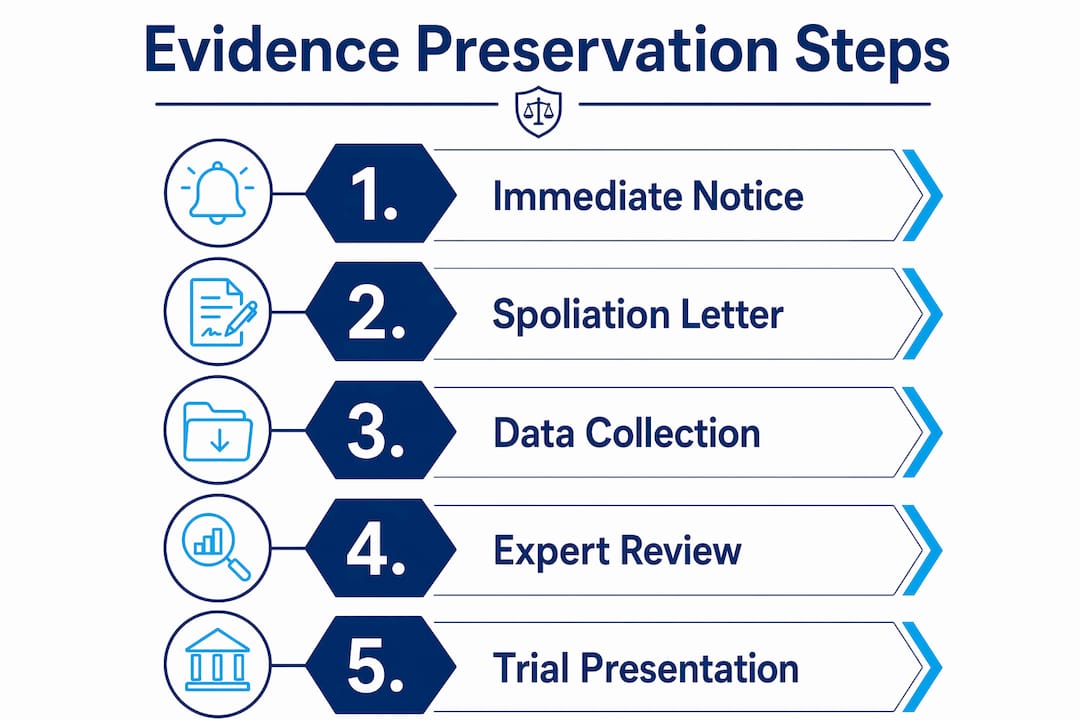
What are the critical steps for preserving evidence in truck accident trials?
Truck accident cases are evidence cases before they are injury cases. The physical and digital record of what happened matters more than any eyewitness account, and that record starts disappearing within hours of the crash.
Electronic Control Module (ECM) data and Electronic Logging Device (ELD) records are the most time-sensitive assets in any truck crash case. These systems capture speed, braking, throttle position, and hours of service, but their buffers overwrite critical data within 30 days. That window closes fast. Federal rules also require alcohol testing within 8 hours and drug testing within 32 hours after an accident. Missing those windows means losing evidence that could prove impairment.
A spoliation letter is the legal tool that puts the trucking company on notice to preserve all relevant records. Your attorney sends this immediately after the crash. Without it, the defense can claim records were routinely deleted, and courts may or may not penalize them for it.
The types of evidence your legal team should pursue include:
- ECM and ELD data capturing speed, braking, and hours of service
- Driver qualification files showing hiring standards and training history
- Maintenance and inspection records revealing known mechanical defects
- Dashcam and surveillance footage from the truck and nearby cameras
- Accident scene documentation including skid marks, debris fields, and road conditions
- Dispatch logs and trip paperwork confirming who controlled the driver at the time of the crash
Pro Tip: Coordinate with your attorney to send a spoliation letter within 24–48 hours of the crash. Pair it with a formal request for ECM data, ELD logs, and post-accident drug and alcohol test results. Courts have sanctioned trucking companies for destroying evidence after receiving notice, which can shift the entire case in your favor.
How do lawyers identify and target multiple liable parties in truck accident trials?
The truck logo on the side of the cab is not a reliable guide to who is legally responsible. Trucking operations involve layers of contracts, lease agreements, and subcontracting arrangements that deliberately obscure liability. Assuming the visible carrier is the only defendant is one of the most common and costly mistakes in truck crash litigation.
Careful investigation must verify the responsible motor carrier through trip paperwork, insurance filings, and dispatch logs. Many companies use complex lease agreements to shift legal exposure away from the entity with the deepest pockets. Your attorney’s job is to cut through that structure and identify every party with legal exposure.
Common liable parties in truck accident cases include:
- Motor carrier: The company that holds the operating authority and employs or contracts the driver
- Truck driver: Directly liable for negligent operation, fatigue, or impairment
- Freight broker: May share liability if they hired an unqualified carrier
- Shipper or loading company: Liable if improper loading caused cargo shift or instability
- Equipment manufacturer: Liable if a defective part, such as brakes or tires, contributed to the crash
- Maintenance contractor: Liable if outsourced repairs were performed negligently
Plaintiffs must prove duty, breach, causation, and damages by a preponderance of evidence, often naming 4–6 defendants to increase the total insurance coverage available. More defendants means more insurance policies in play, which raises the ceiling on what you can recover.
| Liable party | Typical role in liability |
|---|---|
| Motor carrier | Employer liability, hiring and supervision failures |
| Truck driver | Direct negligence, hours of service violations |
| Freight broker | Negligent selection of unqualified carrier |
| Shipper or loader | Improper cargo loading causing instability |
| Equipment manufacturer | Defective parts contributing to the crash |
| Maintenance contractor | Negligent repairs creating mechanical failure |
What do juries expect to see in truck accident trials?
Juries in truck accident cases do not accept “accidents happen” as an explanation. They arrive in the courtroom expecting hard data, and they treat their verdict as a message to the trucking industry about safety standards. Understanding this expectation shapes every decision your attorney makes about how to present your case.

Juries expect ECM telemetry, video footage, and safety compliance records as the foundation of proof. They discount eyewitness testimony when it conflicts with electronic data. They focus on corporate responsibility, not just driver error, and they reward cases that show a pattern of negligence rather than a single isolated mistake. This is why safety violation patterns matter so much in building your narrative.
Defense attorneys often try to shift focus onto the driver as an individual making a bad choice. This tactic is designed to minimize the company’s exposure. Plaintiffs counter it by showing the jury a pattern: the company knew about the driver’s history, ignored maintenance warnings, or pressured drivers to violate hours of service rules.
Plain language is the key to making technical evidence work in a courtroom. A jury of twelve people does not have engineering degrees. Your attorney must translate ECM data and federal safety regulations into clear, human terms that connect the technical failure to your injury.
Pro Tip: Build a timeline graphic that maps the accident moment against ELD data, dispatch logs, and maintenance records. Juries respond to visual evidence that shows a sequence of failures. It transforms abstract data into a story of corporate negligence that is hard to dismiss.
How does mediation fit within truck accident trial strategy?
About 95% of truck accident cases settle before reaching a jury, and mediation is the process that makes most of those settlements happen. That statistic does not mean you should plan to settle. It means that being fully prepared for trial is what produces a fair settlement offer in mediation.
Mediation happens after discovery, when both sides have exchanged evidence and taken depositions. At that point, both parties have roughly equal information about the strength of each side’s case. That information parity is what makes mediation effective. A trucking company’s insurer will not offer serious money until they understand exactly what a jury might see.
The mediation process works as follows:
- Both sides submit mediation briefs summarizing their evidence and legal arguments.
- A neutral mediator meets separately with each party to assess settlement positions.
- The mediator shuttles offers and counteroffers between the rooms.
- If both sides reach agreement, the case settles and a release is signed.
- If mediation fails, the case proceeds toward trial.
Going to trial makes sense when the defense refuses to offer fair compensation, when liability is clear and damages are severe, or when a verdict would send a public safety message. The threat of a nuclear verdict is real for trucking companies, and a well-prepared plaintiff’s team uses that threat as leverage throughout the entire process.
What does effective trial readiness look like in truck accident cases?
Trial readiness is not a phase you enter at the end of a case. It is the posture your legal team maintains from day one. Cases built for trial from the outset create pressure on the defense and strengthen your negotiation position at every stage. The defense knows when a plaintiff’s attorney is genuinely prepared to walk into a courtroom, and that knowledge changes their settlement calculations.
The 30(b)(6) corporate deposition is one of the most powerful tools in truck accident litigation. This type of deposition requires the company to produce a designated witness who speaks on behalf of the organization on specific topics. Corporate depositions lock in admissions about safety policies, driver supervision practices, and training standards. Once those admissions are on the record, the defense cannot later shift the story.
| Trial preparation activity | Objective |
|---|---|
| 30(b)(6) corporate depositions | Lock in company admissions on safety policies and supervision |
| Aggressive discovery requests | Obtain incident histories, maintenance logs, and safety audits |
| Expert witness preparation | Establish liability through accident reconstruction and industry standards |
| Timeline and exhibit development | Present complex data in clear, visual formats for the jury |
| Pretrial motions | Exclude damaging defense evidence and limit misleading arguments |
Expert witnesses are the architecture of a strong truck accident trial. An accident reconstruction expert explains how the crash happened. A trucking industry safety expert testifies about which federal regulations were violated. A medical expert connects the injuries to the crash. Together, they give the jury a complete picture that is difficult to challenge.
Key Takeaways
Winning a truck accident case requires building for trial from day one, preserving digital evidence immediately, and targeting every liable party with insurance exposure.
| Point | Details |
|---|---|
| Preserve evidence fast | ECM and ELD data overwrite within 30 days; send a spoliation letter within 48 hours. |
| Target multiple defendants | Naming 4–6 liable parties increases total insurance coverage and compensation potential. |
| Build for trial from day one | Trial readiness pressures the defense and produces stronger settlement offers at mediation. |
| Understand jury expectations | Juries reward patterns of corporate negligence, not just individual driver error. |
| Use 30(b)(6) depositions | Corporate depositions lock in admissions that prevent the defense from shifting blame later. |
What I’ve learned from handling truck accident cases
After years of handling truck accident litigation in Tampa and Hillsborough County, the single biggest lesson I can share is this: the cases that settle well are the ones that were prepared to go all the way. Clients sometimes ask me why we spend so much time on discovery and depositions when most cases settle. The answer is that the defense only offers fair money when they believe you are ready to take them to trial.
Juror expectations have shifted noticeably over the past decade. People arrive in the courtroom already skeptical of large trucking companies. They have seen news stories about fatigued drivers and overloaded trucks. They want to see the data that confirms what they already suspect. That means your case has to be built on ECM records, maintenance logs, and corporate policy documents, not just your account of what happened.
The multi-party liability piece is where I see clients most often underestimated. They assume the company whose name is on the truck is the only defendant. In reality, the freight broker who hired an unqualified carrier, the shipper who overloaded the trailer, and the maintenance contractor who ignored brake wear all carry legal exposure. Identifying and naming every responsible party is not aggressive lawyering. It is thorough lawyering, and it is what your case deserves.
If you are dealing with the aftermath of a truck crash, get experienced legal counsel early. The evidence window is narrow, and the trucking company’s legal team is already working. You need someone in your corner who is doing the same.
— Martin Hernandez
How Martin Hernandez, PA approaches truck accident cases
Truck accident litigation is not a process you should navigate alone, especially when the other side has a legal team preserving their position from the moment of the crash.

Martin Hernandez, PA handles truck accident cases in Tampa and Hillsborough County with the same trial-ready preparation described throughout this article. From sending spoliation letters within hours of a crash to deposing corporate witnesses and building expert witness teams, the firm treats every case as if it will go before a jury. That preparation is what produces real results, whether the case settles at mediation or goes to verdict. Understanding what negligence means in your case is the first step. Contact Martin Hernandez, PA for a free consultation, in English or Spanish, and find out exactly where your case stands.
FAQ
What is truck accident trial strategy?
Truck accident trial strategy is the legal plan used to prove liability and damages in court by preserving evidence, identifying all liable parties, and preparing for trial from the first day of the case.
How long does a truck accident lawsuit take to reach trial?
Urban courts show timelines of 24–36 months from filing to trial, with trials typically lasting 3–10 days and appeals adding additional time if needed.
Do most truck accident cases go to trial?
About 95% of truck accident cases settle before trial, most often through mediation after discovery. Settlement offers improve significantly when the plaintiff’s legal team is fully prepared for court.
Why is early evidence preservation so critical in truck accident cases?
ECM and ELD data can overwrite within 30 days, and federal rules require alcohol testing within 8 hours of an accident. Missing these windows permanently weakens your case.
How many defendants can be named in a truck accident lawsuit?
Plaintiffs commonly name 4–6 defendants, including the motor carrier, driver, freight broker, shipper, and equipment manufacturer, to maximize the total insurance coverage available for compensation.