
When you’ve just been hit by a driver who has no insurance, a wave of panic is completely understandable. Your mind immediately jumps to a dozen questions: Who pays for my medical bills? How will my car get fixed? The good news is that in Florida, your own insurance policy is designed to be your first line of defense.
This is exactly why you have Personal Injury Protection (PIP) and, hopefully, Uninsured Motorist (UM) coverage. These aren’t just add-ons; they are crucial safety nets for this precise, frustrating situation.
The Reality of Uninsured Drivers on Florida Roads
The moments after a car crash are jarring enough. But finding out the person who hit you is uninsured adds a whole new level of stress and financial worry. If this has happened to you here in Florida, you’re in an unfortunately large club. It’s a common problem on our roads, leaving responsible drivers like you to figure out a confusing and unfair claims process.
This guide is here to help you navigate that process. We’ll walk through the practical, step-by-step actions you need to take to protect yourself and your finances. What you do in the hours and days after the accident can make a huge difference in the outcome of your claim.
A Widespread Problem in the Sunshine State
Driving without insurance isn’t just a minor issue in Florida—it’s a massive problem. The statistics are genuinely shocking and highlight the risk we all face every time we pull out of the driveway.
Recent studies confirm what many of us have long suspected. Florida has the dubious distinction of being one of the riskiest states for encountering an uninsured driver. The data speaks for itself. The statistics drawn from national insurance industry research show just how much more prevalent this issue is in Florida compared to the rest of the country.
Florida Uninsured Driver Statistics at a Glance:
- Percentage of Uninsured Drivers in Florida: 20.4%
- National Average: 12.6%
- National Ranking: 2nd highest
- Likelihood of Encounter in Florida: Roughly 1 in 5 drivers
- Likelihood of Encounter Nationally: Roughly 1 in 8 drivers
As you can see, the chance of getting into an accident with an uninsured motorist in Florida is significantly higher than elsewhere. This isn’t just a number; it represents a real, daily risk for every driver on our roads.
The moments after an uninsured driver hits your car are critical. Your focus should immediately shift from the other driver’s lack of coverage to the benefits you have wisely secured in your own policy. This is precisely why coverages like UM exist.
Understanding this high-risk environment is the first step toward protecting yourself. Knowing that a collision with an uninsured driver is a very real possibility underscores just how vital it is to have the right coverage on your own policy. For those of us in Tampa and throughout Hillsborough County, this reality means it’s often wise to get expert guidance to make sure you’re using every available resource for your recovery.
The moments after a car crash are a blur of adrenaline and confusion. It’s tough to think clearly, but what you do right here, right now, is crucial. Your absolute first priority is safety. If you can, and if it’s safe, move your car out of the flow of traffic to the shoulder or a nearby parking lot. This helps prevent a secondary collision, which is the last thing you need.
Once you’re in a safer spot, your next move is to call 911. Don’t hesitate. Even if the crash seems minor and no one feels hurt, you need a police officer on the scene to create an official report. That report becomes a critical piece of evidence, especially when the other driver is uninsured. Let the dispatcher know where you are, what happened, and if anyone needs medical attention.
Gather the Essentials From the Other Driver
While you’re waiting for the police to arrive, you need to shift gears into information-gathering mode. Stay as calm as you can and methodically collect the other driver’s details, even if they’ve already told you they don’t have insurance.
Grab your phone or a pen and paper and make sure you get:
- The driver’s full name, address, and phone number.
- The make, model, color, and license plate number of their car.
- The exact location of the crash—mention cross-streets, landmarks, or anything that pinpoints the spot.
This isn’t the time to discuss who was at fault. Just stick to the facts. Getting this information is non-negotiable for your police report and any claim you might file later.
The official police report will be the foundation of your claim. If your accident happened locally, you can find out exactly how to get a copy by reading our guide on how to get Hillsborough County accident reports.
Document Everything: Your Phone is Your Best Tool
Think of yourself as a crime scene investigator, because, in a way, you are. Your smartphone is the most powerful tool you have at this moment. Use it to document everything.
Take way more photos and videos than you think you’ll need. You can always delete them later, but you can’t go back in time to get a shot you missed. Capture the scene from all angles.
Start with the damage to both cars. Get close-ups and wide shots. Snap a clear photo of the other driver’s license plate—it’s undeniable proof of who they are. Then, zoom out. Photograph the entire accident scene, including skid marks, debris on the road, traffic signals, and even the weather conditions. If you have any visible cuts or bruises, take pictures of those, too. Every photo creates a timestamped piece of evidence that tells the story of what really happened.
Using Your Florida Insurance After the Crash
When you find out the driver who hit you is uninsured, your focus has to pivot to your own insurance policy. It’s a frustrating situation, but this is the very reason you carry certain coverages in Florida. Your own policy is now your primary lifeline for covering everything from your medical bills to getting your car fixed.
Knowing how to navigate your own insurance is the most critical step you can take. In this scenario, you’ll rely heavily on two key parts of your policy: Personal Injury Protection (PIP) and Uninsured/Underinsured Motorist (UM/UIM) coverage. They exist specifically to protect you when the at-fault driver’s insurance doesn’t.
Before you even think about calling your insurance company, remember the basics of any accident scene.
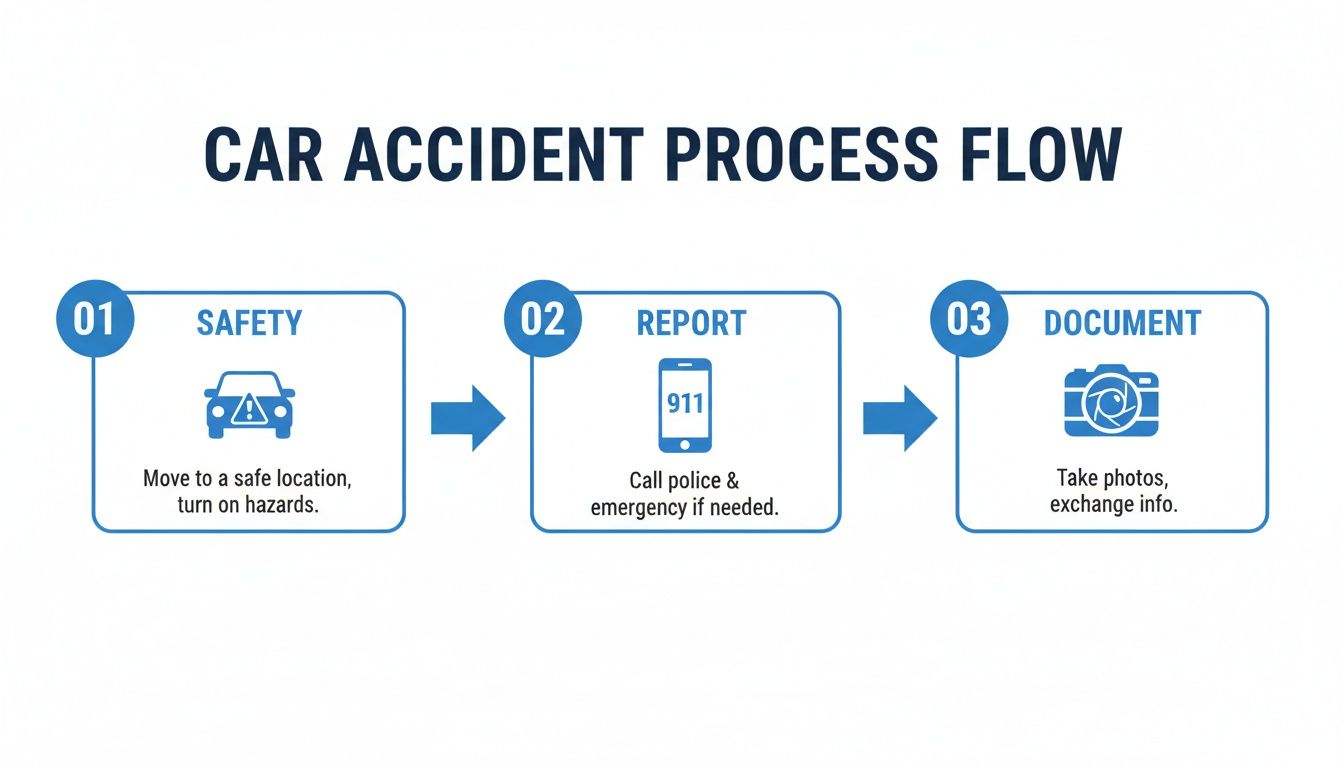
This process—staying safe, reporting the crash, and documenting everything—is the foundation for building a successful insurance claim later on.
Your First Line of Defense: Personal Injury Protection (PIP)
Here in Florida, every driver is required to carry a minimum of $10,000 in Personal Injury Protection, or PIP. I often tell my clients to think of PIP as their immediate medical safety net. Because it’s “no-fault” coverage, it pays out for your initial medical care and a portion of lost wages, no matter who caused the crash.
This is the first coverage you’ll tap into. Just remember the most important deadline: you have to get medical treatment within 14 days of the accident to be eligible for your full PIP benefits. Don’t wait.
Your PIP coverage is the foundation of your recovery, but it’s often not enough to cover all the costs from a serious accident. This is where your Uninsured Motorist coverage becomes absolutely vital.
It’s easy to burn through that $10,000 with just one trip to the emergency room, an MRI, and a few follow-up appointments. That’s why the next layer of protection on your policy is so important.
The Real Financial Lifesaver: Uninsured Motorist Coverage (UM)
I can’t stress this enough: Uninsured Motorist (UM) coverage is the single most important protection you can have on your policy when an uninsured driver is involved. It isn’t mandatory in Florida, but every insurer has to offer it, and it’s a non-negotiable part of any well-built auto policy.
Essentially, your UM coverage steps into the shoes of the at-fault driver’s missing insurance policy.
It’s designed to cover all the damages that go beyond what your PIP will pay, including:
- Additional medical bills: Everything beyond your $10,000 PIP limit.
- Lost wages: UM can cover the portion of your lost income that PIP doesn’t.
- Pain and suffering: This is huge. It’s the only way to get compensation for the physical pain and emotional trauma the crash caused you.
Without UM coverage, you could be stuck with tens of thousands of dollars in bills, all because someone else broke the law.
Reporting the Claim to Your Insurance Company
How you report the accident to your own insurer really matters. Your goal is to provide clear, objective facts and get the claim opened under the right coverages without saying anything that could hurt your case down the line.
When you make that call, stick to the facts and never guess or admit any fault. For a good overview of this process, this guide on how to file an auto insurance claim is a helpful resource. The language you use with the claims representative is key to protecting your rights.
I advise my clients to be direct and state clearly:
- “I’m calling to report an accident that was not my fault.”
- “The at-fault driver was uninsured, so I need to open a claim under my Uninsured Motorist coverage.”
- “I’ll also be opening a claim under my Personal Injury Protection for my medical expenses.”
Stick to the facts you know from the police report. Don’t speculate on your injuries or the accident details. Let the evidence you gathered at the scene do the talking and ensure you start your claim off on solid ground.
Handling a Hit and Run Accident
There’s a unique feeling of violation when the car that hits you just takes off. Beyond the shock of the crash, you’re left feeling helpless. This is a hit-and-run, which is a crime in Florida. It might seem like your chances of getting compensation just drove away with them, but that’s not the case. You still have options.
Your first thoughts in those chaotic seconds can make all the difference. Try to lock in any detail you can about the vehicle that fled, no matter how small it seems.
- The color, make, and model of the car. Was it a dark sedan? A white truck?
- Even a piece of the license plate number. Just two or three digits can be a huge break for investigators.
- Think about unique features—a dent in the bumper, a loud muffler, a distinctive roof rack.
It’s surprising how often these fragments help police. A partial plate combined with a good description can narrow the search down considerably.
This Is What Your UM Policy Is For
This exact situation is why Uninsured Motorist (UM) coverage exists. When the driver is a ghost, your insurance policy treats them as a “phantom”—an uninsured driver. Your UM policy is designed to step in and cover your expenses, including medical bills, lost income, and even pain and suffering.
But there’s a catch: you absolutely need a police report. This is the official proof that another vehicle was involved and fled the scene. Without it, your insurer could argue that you were in a single-car accident and deny your UM claim outright.
Building a Case When the Other Driver Is Gone
Since you can’t exchange information with a driver who isn’t there, your focus has to pivot to gathering evidence from the scene itself. Look around immediately. Did anyone see it happen? Check with people at nearby businesses, bus stops, or homes.
In the aftermath of a hit-and-run, it’s easy to feel overwhelmed. But your ability to collect clues on the spot is critical. Look for security cameras on storefronts or traffic cams at the intersection—they may have recorded the whole thing.
Your own documentation is also vital. For a more detailed look at what to collect, check out our guide on what evidence you should preserve after a car accident in Tampa. Taking photos of your car’s damage and the accident scene helps build a clear record of events, giving you a solid foundation for your claim, even when the other driver is nowhere to be found.
Why a Tampa Car Accident Attorney Is Essential
When an uninsured driver hits you, it’s natural to think your own insurance company will step up and take care of everything. After all, that’s why you pay for Uninsured Motorist (UM) coverage, right?
Unfortunately, it’s rarely that simple. Once you file a UM claim, you’re no longer just a policyholder; you’re a claimant. Your insurance company, the one you’ve paid faithfully for years, suddenly has an opposing interest. Their priority is to protect their bottom line by paying out as little as possible.
This is the moment a skilled Tampa personal injury attorney goes from being a good idea to an absolute necessity. Your lawyer’s first job is to step in and handle all communication with the insurance adjuster, acting as a buffer. Adjusters are professionals trained to get statements that can weaken your case, often getting you to downplay your pain or admit partial fault without you even realizing it. An attorney shields you from these tactics.
Calculating the True Value of Your Claim
A good lawyer does far more than just field phone calls. They immediately launch their own investigation, because the police report is just the starting point. They’ll dig for every piece of evidence—tracking down witnesses, pulling traffic camera footage, and even bringing in accident reconstruction experts to prove the other driver was 100% at fault.
This exhaustive evidence collection is crucial for one reason: to build a case that reflects the true value of your claim. It’s so much more than just your initial emergency room bill.
A comprehensive valuation will always include:
- Current and Future Medical Bills: This covers everything from that first ambulance ride to the physical therapy you’ll need months from now, or even a potential future surgery.
- Lost Wages and Earning Capacity: We calculate the income you’ve already lost from being out of work, plus what you might lose down the road if your injuries impact your career.
- Pain and Suffering: This is compensation for the very real physical pain, emotional trauma, and overall disruption the accident has inflicted on your life.
An experienced attorney will also know how to properly document and claim damages for common car accident injuries like whiplash, which often have delayed symptoms but can cause long-term problems. Without this kind of professional insight, it’s incredibly easy to accept a settlement that doesn’t even come close to what you’re owed.
When you file an uninsured motorist claim, your insurance company’s interests are no longer aligned with yours. An attorney levels the playing field, shifting the focus from the insurer’s profit margin to your complete recovery.
Local Knowledge and No Upfront Costs
There’s a huge advantage to hiring a local attorney. Someone based right here in Tampa knows the ins and outs of the Hillsborough County court system. They know the judges, the opposing counsel, and the specific strategies local insurance carriers use to fight these claims. That kind of insider knowledge can make all the difference.
For so many families in our community, a serious crash can be financially devastating. Having a lawyer who can front the costs of investigators and expert witnesses is a game-changer. They fight aggressively to make sure you’re not left holding the bag.
Best of all, you don’t need money in your pocket to get this kind of help. Reputable personal injury attorneys work on a contingency fee basis. What does that mean? Simple: you pay absolutely nothing upfront. The lawyer’s fee is just a percentage of the money they recover for you. If they don’t win your case, you owe them nothing. This system makes expert legal help accessible to everyone, regardless of their financial situation.
If you’re on the fence, it’s always worth learning more about when to hire a personal injury lawyer.
Common Questions After an Uninsured Driver Accident in Florida
When you’ve been hit by a driver who doesn’t have insurance, your mind is probably racing with questions and “what-ifs.” It’s a frustrating and overwhelming situation, but having clear, straightforward answers can make a world of difference. Based on my experience helping clients through this exact scenario, here are some of the most common questions that come up.
Will My Insurance Rates Go Up if I File a UM Claim?
This is easily one of the biggest worries people have. You pay your premiums diligently, and the last thing you want is to be punished for someone else’s mistake. Thankfully, Florida law is on your side here.
State law generally prohibits your insurance company from jacking up your rates or dropping your coverage simply for filing a claim when you weren’t at fault. The uninsured driver caused the crash, not you. Using your Uninsured Motorist (UM) coverage is just accessing a protection you wisely paid for.
Of course, it never hurts to double-check the fine print of your specific policy, but you shouldn’t be penalized for an accident you didn’t cause.
How Long Do I Have to File a Claim?
Time is critical after any car wreck. Florida has strict deadlines, called statutes of limitations, and missing them can unfortunately mean losing your right to compensation for good.
The timeline depends on the type of claim you’re filing:
- For a personal injury lawsuit directly against the at-fault driver, you now have just two years from the date of the accident to file. This was recently shortened, making it more important than ever to act quickly.
- For a claim against your own UM policy, you are generally bound by your insurance contract. This typically gives you five years from the accident date to file a lawsuit if your insurer isn’t paying what they should.
Even with that five-year window for a UM claim, waiting is a huge mistake. Over time, crucial evidence gets lost, witnesses’ memories get fuzzy, and the insurance company will look for any reason to argue that the delay hurt their investigation. Prompt action is always your best move.
Can I Sue the Uninsured Driver Personally?
Yes, you absolutely can. You have the legal right to sue the at-fault driver to recover all of your damages—medical bills, lost income, pain, and suffering. The real question isn’t can you sue, but is it worth it?
Winning a judgment in court is one thing; actually collecting the money is a completely different battle.
The hard truth is that people who drive without insurance often do so because they can’t afford it. This means they likely have no significant assets or money to pay a judgment, even if you win. It’s why your own UM coverage is so often the most reliable path to getting compensated. An attorney can run an asset check on the driver to see if a personal lawsuit is even a viable option. To get a better sense of your options, learn more about how uninsured motorist coverage in Florida works to protect you.
If you’ve been injured by an uninsured driver in the Tampa area, you don’t have to face the insurance companies alone. At Martin Hernandez, P.A., we fight to get you the full compensation you deserve. Contact us for a free, no-obligation consultation to discuss your case by visiting https://injurylawyersoftampa.com.