
Imagine you’re driving down a sunny Florida road, minding your own business, when another car blows through a red light and smashes into you. It’s clearly not your fault. But then comes the gut punch: the other driver doesn’t have a dime of insurance.
Suddenly, you’re left wondering who’s going to cover your medical bills, your time off work, and the damage to your car. This isn’t just a bad dream; it’s a harsh reality for too many drivers here in the Sunshine State.
Why Florida Drivers Can’t Afford to Ignore Uninsured Motorist Coverage
Dealing with the aftermath of a car accident is chaotic enough. But when the person at fault is uninsured, the financial fallout can be catastrophic. While Florida law makes you carry Personal Injury Protection (PIP) insurance, that coverage barely scratches the surface in a serious crash. PIP covers only a portion of your medical bills and lost wages, leaving you on the hook for the rest.
This is exactly why Uninsured Motorist (UM) coverage is so critical. Think of it as a financial safety net—a bodyguard for your bank account that steps in when the person who hurt you can’t pay.
The Alarming Reality on Florida Roads
The odds of getting hit by an uninsured driver in Florida are disturbingly high. For years, our state has had one of the worst uninsured motorist rates in the entire country. The Insurance Information Institute puts the number around 16%, but other studies suggest it could be as high as 26.7%.
Let that sink in. As many as one in every four drivers on the road with you might be breaking the law by driving without insurance. With 3,451 fatal accidents in Florida in 2021 alone, the stakes are incredibly high. The high probability of a collision with an uninsured driver makes having the right protection absolutely essential. You can learn more by exploring the challenges of navigating Florida’s high number of uninsured drivers.
Uninsured Motorist (UM) coverage isn’t just another box to check on your policy. It’s a critical shield protecting you and your family from the financial fallout of someone else’s irresponsibility.
How UM Coverage Protects You
Uninsured Motorist coverage is specifically designed to bridge the huge financial gap created by an at-fault driver who is uninsured or underinsured. It pays for the very things your own PIP policy won’t cover, letting you focus on getting better instead of worrying about going bankrupt.
Here’s a look at what UM coverage can handle:
- Medical Bills: It covers hospital stays, surgeries, physical therapy, and future medical care that goes far beyond your PIP limits.
- Lost Wages: If your injuries keep you out of work, UM is there to help replace that lost income.
- Pain and Suffering: This is a big one. Unlike PIP, UM coverage can compensate you for the physical pain and emotional trauma the accident has caused.
Without this crucial coverage, one bad accident could wipe out your savings, threaten your home, and put your family’s future in jeopardy. It’s your own private insurance policy against the unknown, ensuring another person’s mistake doesn’t completely derail your life.
Understanding Your Florida Auto Insurance Policy
To really get why uninsured motorist coverage is so important in Florida, you have to first wrap your head around our state’s unique and often confusing auto insurance laws. We operate under a “no-fault” system, but that name is a bit misleading. All it really means is that your own Personal Injury Protection (PIP) coverage is the first line of defense for your medical bills, no matter who caused the accident.
What’s truly startling is how little insurance Florida legally requires you to carry. To get behind the wheel, the mandatory minimum is just $10,000 in PIP and $10,000 in Property Damage Liability (PDL). Your PIP helps with your medical expenses, and the PDL pays for the car you hit.
The Critical Missing Piece
So, what’s glaringly absent from that short list? Bodily Injury (BI) liability coverage. That’s the part of an insurance policy that pays for the injuries you cause to other people. And in Florida, most drivers aren’t required to have it at all.
This single omission is the very reason why uninsured motorist coverage isn’t a luxury—it’s a financial lifesaver.
When a driver without BI coverage hits and injures you, they are, for all practical purposes, “uninsured” for the harm they’ve caused you. At that point, your only options are to sue them personally (a long shot if they don’t have money to begin with) or to make a claim on your own policy.
This is where your uninsured motorist coverage Florida policy steps up to the plate. It essentially fills the gap left by the at-fault driver, standing in for the BI coverage they should have had.
In Florida, the law doesn’t force other drivers to carry insurance that protects you. It’s up to you to purchase Uninsured Motorist coverage to protect yourself.
Uninsured vs. Underinsured Drivers
It’s helpful to know the difference between the two situations where this coverage kicks in. The terms are often lumped together, but they solve slightly different problems.
- Uninsured Motorist: This covers you when the at-fault driver has no Bodily Injury insurance at all. This also applies in frustrating hit-and-run situations where the other driver is never found.
- Underinsured Motorist: This applies when the at-fault driver has BI coverage, but their policy limits are too low to cover all your damages. For instance, if you have $100,000 in medical bills and lost wages, but they only carry a $25,000 BI policy, they are “underinsured.” Your coverage would then cover the remaining $75,000, up to your own policy limits.
Think of it this way: both parts of UM coverage work together to make sure you aren’t left holding the bag for massive bills just because another driver was irresponsible. To dive deeper, you can explore our complete guide to Florida’s no-fault insurance system.
Why You Must Reject UM in Writing
The gap in Florida’s insurance requirements is so huge and so dangerous for drivers that the state legislature put a special protection in place. Insurance companies are required by law to offer you Uninsured Motorist coverage at limits equal to your own BI coverage.
They can’t just let you casually say “no” over the phone, either. To turn down this coverage, you must physically or electronically sign a form that explicitly rejects it.
This legal hurdle was created for a reason. Lawmakers wanted to force drivers to stop and think before giving up this critical protection, ensuring they couldn’t later claim they didn’t know it was an option.
Of course, your policy is more than just UM. It’s also worth knowing how vehicle security features can affect your insurance premiums, as this can influence your overall costs. But when it comes to protecting yourself after a crash, that signature on the rejection form could be the single most important financial decision you make.
Stacked vs. Non-Stacked Coverage: What’s the Real Difference?
When you’re setting up your uninsured motorist coverage in Florida, you’ll hit a fork in the road: stacked or non-stacked? These terms might sound like insurance jargon, but the choice you make here can have a massive impact on your financial recovery after a bad wreck. Getting this right is one of the most important decisions you can make for your family’s protection.
Let’s break it down with a simple analogy. Think of non-stacked UM coverage as a single, fixed safety net. If you have one car on your policy with $100,000 in coverage, that’s your limit. Even if you add two more cars to that same policy, you still only have that one $100,000 safety net to fall back on in an accident. It’s reliable, but it doesn’t grow.
Stacked coverage, on the other hand, is like getting a separate, full-sized safety net for every single car you insure. The real magic happens when you get into a serious crash—you can pile all those safety nets on top of each other, creating a much deeper, stronger cushion. It multiplies your protection, giving you a powerful financial backstop when you need it most.
How Stacking Actually Multiplies Your Protection
Stacking is a feature in Florida that lets you combine the UM coverage limits from each vehicle on your policy into one large pool. It’s designed to give you more resources to draw from if you’re hit by a driver who has little or no insurance to cover your injuries.
Let’s put some real numbers to this to see the power of stacking in action.
Imagine your family has three cars, and you’ve wisely chosen $100,000 per person / $300,000 per accident in UM coverage for each one.
- With Non-Stacked UM: If an uninsured driver hits you and you’re badly hurt, the absolute most you can recover from your own policy is $100,000. That’s it. The coverage on your other two cars doesn’t help you.
- With Stacked UM: In that exact same crash, you can “stack” the coverage from all three vehicles. Your available UM benefits instantly jump to $300,000 ($100,000 x 3 cars).
That difference—$100,000 versus $300,000—can be life-changing. It can mean the difference between paying off all your medical bills and lost wages or being left with a mountain of debt.
By choosing stacked coverage, you’re essentially creating a supercharged policy that scales with the number of vehicles you insure. It offers a level of protection that non-stacked coverage simply can’t touch.
Making the Right Choice for Your Family
So, what’s the catch? The main trade-off is cost. Stacked uninsured motorist coverage in Florida will have a slightly higher premium because it offers so much more potential benefit. But it’s critical to weigh that small increase against the devastating financial fallout of a catastrophic accident.
When you’re making this decision, ask yourself a few tough questions:
- What’s My Financial Exposure? How would my family handle medical bills and lost income that go well beyond $100,000? A single serious injury can blow past that number in a hurry.
- How Many Cars Do We Insure? The more vehicles on your policy, the more powerful stacking becomes. A family with four cars can turn a modest $50,000 UM limit into a robust $200,000 safety net.
- What’s My Peace of Mind Worth? Florida’s roads are notoriously crowded, and the risk of meeting an uninsured driver is real. Knowing you have a strong financial backstop can make a huge difference every time you get behind the wheel.
While having non-stacked coverage is far better than having no UM at all, stacked coverage provides a superior layer of security. It ensures the investment you’ve made in insuring multiple vehicles also translates into greater personal protection for you and your loved ones, no matter which car you happen to be in. It’s a smart, proactive way to shield your family’s future from the carelessness of another driver.
How to File a Florida Uninsured Motorist Claim
Getting into an accident is always a shock. Your adrenaline is pumping, and it’s tough to think clearly. But what you do in those first few minutes and hours is absolutely critical for your financial recovery, especially when the other driver doesn’t have insurance.
When you’re dealing with an uninsured driver, the whole process flips. Instead of chasing their insurance company, you have to turn to your own. Knowing how to navigate your own policy to file a claim is the key to getting back on your feet.
This flowchart breaks down the difference it makes when you have UM coverage versus when you don’t.
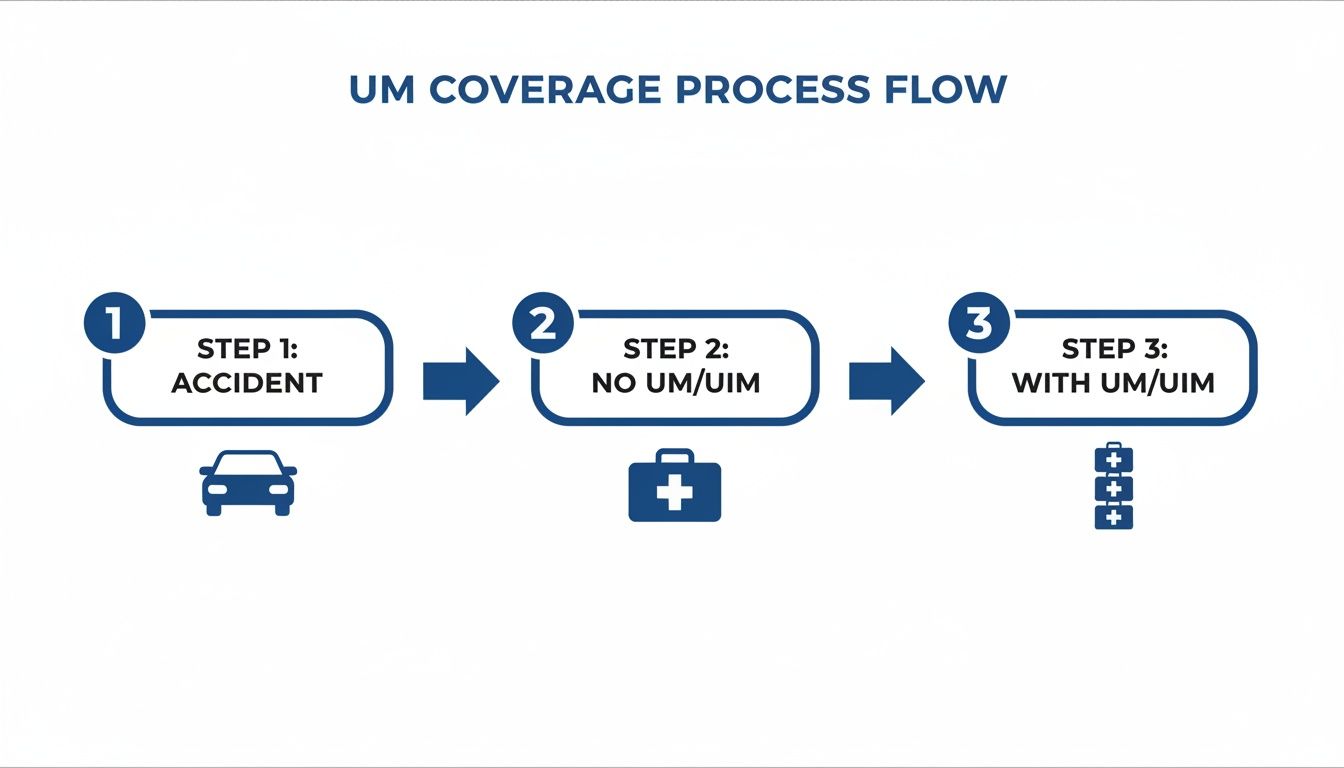
As you can see, having this coverage opens up a direct path to compensation for your injuries and losses—a path that’s otherwise a dead end.
What to Do Immediately at the Scene
Before anything else, your safety comes first. Check on yourself and your passengers. If you can, move your vehicle out of traffic. Once the immediate danger has passed, you need to shift into evidence-gathering mode to protect your claim.
- Call the Police. Always. Don’t let the other driver talk you out of it. A police report is an official, third-party record of what happened. It documents everything from road conditions to witness statements and is often the most important piece of evidence you’ll have.
- Become a Photographer. Pull out your smartphone and take pictures of everything. Get wide shots of the intersection, close-ups of the vehicle damage (both cars!), skid marks, and anything else that helps tell the story of the crash. Video is great, too.
- Exchange Information (Carefully). You still need the other driver’s name, phone number, and vehicle details. But keep the conversation short and factual. Don’t argue about who was at fault—that’s a conversation for later, and not at the side of a busy road.
Notifying Your Insurer and Documenting Your Damages
Once you’ve left the scene and gotten medical attention (which you should do, even if you feel fine), it’s time to get the ball rolling with your insurance company. Don’t wait. Most policies require you to report an accident promptly.
Call your insurance agent as soon as you can, ideally within 24 hours. Be very clear: “I was hit by an uninsured driver, and I need to open an uninsured motorist claim.” They will give you a claim number—write it down and keep it handy.
Meticulous documentation is the backbone of a successful UM claim. Treat it like a job—every receipt, every appointment, and every symptom must be recorded. Your ability to prove your losses directly influences the compensation you receive.
From this moment on, you are building your case. The paperwork you collect is your power. The general steps share some similarities with other injury cases, which you can read about in our guide on how to file a personal injury claim.
Building a Strong Claim File
To get the full and fair value of your UM claim, you have to prove every single dollar of your losses. An adjuster won’t just take your word for it. You need to create a comprehensive file that leaves no room for doubt.
Here’s what should be in your file:
- Medical Records: Keep a folder with every bill, doctor’s note, physical therapy summary, and prescription receipt.
- Lost Wages: Get a formal letter from your HR department that confirms your salary and the exact dates you were unable to work because of the accident.
- Pain and Suffering Journal: This one is surprisingly powerful. Every day, jot down notes about your pain level, your emotional state, and the daily activities you’re struggling with or can’t do at all.
The financial fallout from uninsured drivers in our state is massive. In 2020 alone, Floridians paid $1.6 billion in UM/UIM premiums, which was 22% of all auto liability insurance spending. And since only 52% of drivers even have this coverage, the true cost of uninsured motorists could be closer to 40% of total liability costs.
When you’re the one dealing with the aftermath, knowing what to do after being hit by an uninsured motorist can make all the difference between a devastating financial loss and a fair recovery.
Common Roadblocks When Filing a UM Claim
You’d think filing a claim with your own insurance company would be simple. After all, you’ve been paying them faithfully every month. But here’s the reality: your insurer is still a business, and their goal is to protect their bottom line. That means paying out as little as possible, which can throw some surprising hurdles in your way.
Knowing what to expect is half the battle. When you understand the common tactics insurance companies use, you can start building a rock-solid case from day one and push back effectively.
They’ll Downplay the Severity of Your Injuries
This is one of the most common plays in the insurance adjuster’s book. They might suggest your injuries are minor, that you’re exaggerating your pain, or that you should have recovered by now. It’s all a strategy to justify a lowball settlement offer, hoping you’re desperate enough to take it.
This is exactly why your medical records are everything. Just saying you’re “in pain” won’t cut it. You need to build a comprehensive, detailed medical history that leaves no room for doubt.
- Consistent Medical Care: Don’t skip doctor’s appointments or physical therapy. The insurance company will see any gap in treatment as proof that your injuries weren’t that serious.
- Detailed Doctor’s Notes: Make sure your doctor is thoroughly documenting your symptoms, your pain levels, and—crucially—how these injuries are affecting your daily life and ability to work.
- Follow Medical Advice to the Letter: If you don’t follow your doctor’s treatment plan, the insurer will turn it around and claim you’re the reason you aren’t getting better.
They’ll Blame Your Pre-Existing Conditions
Get ready for the insurance company to dig into your medical past. Their goal is to find any old injury or chronic condition they can use to argue that your current pain isn’t from the crash at all.
For example, if you had some minor back pain a few years ago, they’ll argue that your serious back injury from this accident is just a flare-up of that old issue. It’s a classic tactic to shrink their financial responsibility.
An insurance company’s objective is to pay as little as possible on a claim. Any ambiguity in your medical history or accident report will be used as leverage against you.
To shut this down, you need your doctor to explicitly state in their notes how the accident caused brand-new injuries or made a previously manageable condition much worse. An experienced attorney knows exactly how to work with your doctor to get this evidence documented correctly. If you’re running into this, learning how to fight an insurance denial is your critical next step.
They’ll Try to Shift Blame for the Accident
Even though you’re dealing with your own uninsured motorist coverage in Florida, the insurer might still try to pin some of the blame for the crash on you. Under Florida’s comparative negligence rule, if they can prove you were even 10% at fault, they can legally reduce your settlement by 10%.
They’ll question everything you did. Were you distracted for a split second? Could you have braked sooner? This is precisely why giving a recorded statement to an adjuster without a lawyer is so dangerous. Adjusters are masters at asking tricky, leading questions designed to get you to accidentally admit some fault. It’s always best to politely decline to give a recorded statement until you’ve spoken with an attorney.
When You Need a Florida Uninsured Motorist Attorney

Let’s be honest. A minor fender-bender is one thing, but a serious crash with an uninsured driver is a whole different ballgame. This isn’t just about getting your car fixed; it’s about protecting your financial future, and knowing when to call for help is everything.
Sometimes, your own insurance company will throw up red flags that tell you it’s time to lawyer up. They might be your insurer, but their goal is often to pay out as little as possible.
Clear Signs You Need Legal Help
If you run into any of these roadblocks, it’s a clear signal to get an experienced UM attorney involved immediately.
- Your Claim is Denied: The insurance company rejects your claim with a flimsy excuse or no real reason at all. This is a classic tactic, and you need a professional to fight back.
- The Settlement Offer is Too Low: You get a quick, lowball offer that doesn’t even begin to cover your medical bills, let alone your lost wages and other damages. Don’t fall for it.
- The Insurer Disputes Fault: Even when the other driver was clearly at fault, the adjuster starts trying to pin some of the blame on you to justify a smaller payout.
- You’ve Suffered Serious Injuries: If your injuries are life-altering, permanent, or require long-term medical care, the stakes are simply too high to navigate this process alone.
An experienced personal injury attorney completely changes the dynamic. They step in, handle all communications, and shield you from the adjuster’s pressure. Your case will be built on hard evidence, not on the insurance company’s self-serving opinions.
How an Attorney Strengthens Your Claim
Bringing a lawyer into your uninsured motorist coverage Florida claim is about more than just having a tough negotiator on your side. They become your strategist, your investigator, and your fiercest advocate.
A skilled attorney knows exactly what it takes to prove the true value of your claim. They’ll gather medical records, consult with experts to project future medical costs, and build a powerful case for non-economic damages like your pain and suffering.
This level of legal expertise is often the difference between a settlement that just scrapes by and one that truly secures your recovery. To learn more, check out our guide on when to hire a car accident attorney. Having a legal pro in your corner ensures your rights are protected from start to finish.
Got Questions? We’ve Got Answers About Florida UM Coverage
Even after you’ve got the basics down, a few specific questions always seem to pop up about uninsured motorist coverage. Let’s tackle some of the most common ones we hear from Florida drivers to clear up any confusion and make sure you’re confident in your coverage.
Does My UM Policy Cover Me If I’m Hit as a Pedestrian or Cyclist?
Yes, it absolutely does. This is one of the most powerful and often overlooked features of uninsured motorist coverage in Florida. Your policy is designed to protect you, not just your car.
Think of it as personal injury protection that follows you wherever you go. If an uninsured driver hits you while you’re out for a walk, jogging, or riding your bike, you can file a claim with your own UM policy. It’s there to cover your medical expenses, lost income, and pain and suffering, just as it would if you were behind the wheel of your own car.
What Happens if the Driver Who Hit Me Has Insurance, Just Not Enough?
This is an incredibly common situation, and it’s precisely what the “Underinsured Motorist” (UIM) part of your coverage is for. It’s designed to bridge the gap when the at-fault driver’s policy falls short.
Here’s a simple breakdown of how it plays out:
- First, you file a claim against the other driver’s Bodily Injury (BI) liability policy and recover the maximum amount their insurance allows.
- If your medical bills and other damages are higher than their policy limit, your UIM coverage kicks in.
- Your own policy then steps up to cover the rest of the costs, all the way up to the limits you chose for yourself.
This feature is a financial lifesaver. It ensures you aren’t stuck with a mountain of debt just because the person who caused the crash was carrying the bare minimum insurance.
Will My Insurance Company Jack Up My Rates if I Use My UM Coverage?
Nope. This is a persistent myth that, unfortunately, scares people away from using the very benefits they’ve been paying for. Florida law is crystal clear on this.
Under Florida Statute 626.9541, it is illegal for your insurance company to raise your premiums, cancel your policy, or refuse to renew it simply because you made a UM claim for a crash that wasn’t your fault.
Since the accident wasn’t your fault, your insurer can’t penalize you for filing a claim. This law exists to make sure you can use your coverage without worrying about being punished for it later. It gives you the power to make your insurance company deliver on the promise of protection they sold you.
Trying to figure out an uninsured motorist claim is tough enough when you’re healthy, let alone when you’re trying to recover from an injury. If you’re getting the runaround from your insurance company—delays, denials, or lowball offers—you don’t have to take them on by yourself.
The team at Martin Hernandez, P.A. knows how to handle these cases. We’re here to protect your rights and fight for every dollar you’re entitled to. Get in touch with us today for a free, no-pressure consultation at https://injurylawyersoftampa.com.