
When you’re in a car accident in Florida, the first moments are a blur of confusion and concern. Your primary focus is on getting medical help, not digging through insurance policies. That’s why understanding Personal Injury Protection (PIP) is so important.
The simple answer is this: PIP in Florida covers 80% of your initial medical bills and 60% of lost wages, up to a standard limit of $10,000, no matter who was at fault for the crash. This coverage is the cornerstone of Florida’s “no-fault” insurance system, designed to get you help fast.
Your Guide to Florida PIP After a Car Accident
Picture a typical fender-bender on a busy Tampa road like Dale Mabry Highway. In the chaos, the last thing you should worry about is how you’ll pay for an ambulance ride or an ER visit. This is exactly why Florida law requires every driver to carry Personal Injury Protection.
Think of PIP as your financial first responder. It kicks in immediately to provide benefits without having to wait for insurance companies to spend weeks or months arguing over who caused the collision. Because Florida is a “no-fault” state, you turn to your own PIP coverage first for immediate financial help.
The Critical 14-Day Rule
There’s a catch, and it’s a big one. The system has a strict, non-negotiable deadline. To be eligible for your PIP benefits, you must seek initial medical treatment within 14 days of the accident.
If you wait past this two-week window, you could forfeit your right to this crucial coverage entirely. It’s an unforgiving rule, which is why seeing a doctor right away is so vital. For more detailed steps, check out our guide on what to do after a car accident in Florida.
Why Understanding PIP Is Essential
Knowing how to use your PIP coverage is the most important first step toward protecting yourself financially after a crash. It’s not just about some abstract policy; it’s about getting the money you need for real, immediate expenses.
PIP is designed to cover those essential first costs, including:
- Ambulance rides and emergency room care
- Diagnostic tests like X-rays, CT scans, or MRIs
- Follow-up visits with your doctor or a specialist
- A portion of the income you lose if your injuries keep you from working
Understanding how PIP works isn’t just about insurance; it’s about securing the resources you need to recover without the added stress of immediate financial hardship. Knowing the rules, especially the deadlines, empowers you to take the right steps from day one. This initial section will break down the essentials, explaining what this mandatory coverage provides and why its limits are crucial for every Florida driver to understand.
Breaking Down Your PIP Benefits: Medical Bills and Lost Wages
When you’re dealing with the immediate aftermath of a car accident, your Florida PIP coverage is your first line of financial defense. It’s not meant to cover everything, but it targets the two biggest sources of stress: mounting medical bills and a sudden loss of income.
Think of your standard $10,000 PIP policy as a dedicated fund. Its job is to help you handle those initial expenses so you can focus on getting better, not on how you’re going to pay for the ER visit or make your next rent payment. Let’s look at exactly how it works.
Covering Your Medical Expenses
This is where PIP really springs into action. Your policy is set up to pay for 80% of your necessary and reasonable medical bills that stem directly from the accident, all the way up to your policy limit.
What does that actually include? The coverage is surprisingly broad and designed to handle the most common post-accident needs:
- Emergency Services: That crucial ambulance ride from the scene and the initial treatment you receive in the emergency room.
- Diagnostic Imaging: The X-rays, CT scans, or MRIs your doctors need to figure out the full extent of your injuries.
- Follow-Up Care: Visits to your primary doctor, specialists, and even chiropractors.
- Rehabilitation: The physical therapy and other treatments you’ll need to regain your strength and mobility.
PIP can even cover less obvious expenses. For instance, it can help with necessary medical equipment rentals or reimburse you for the mileage you put on your car driving to and from all those medical appointments. This is why keeping detailed records is so important.
Replacing Your Lost Wages
If your injuries are serious enough to keep you out of work, the financial pressure can build up fast. This is the second problem PIP is designed to solve. As mandated by Florida Statute 627.736, every policy provides a cushion for lost income.
Your $10,000 PIP benefit will pay out 60% of your lost wages for the time you’re medically unable to work.
Here’s a simple, real-world example:
Let’s say you make $1,000 a week, but a car accident forces you to miss two full weeks of work. That’s $2,000 in lost income. Your PIP policy would step in and cover 60% of that loss, paying you $1,200 to help keep you afloat while you recover.
Just like with medical claims, you’ll need your paperwork in order. Your insurance company will want to see pay stubs to verify your income and a note from your doctor confirming you can’t work.
Keep in mind that PIP leaves a 20% gap on medical bills and a 40% gap on wages. To help cover those remaining costs, many drivers add other policies. You can learn more about how to bridge that gap by reading our guide on what MedPay insurance coverage is and seeing how it works alongside PIP.
Who and What Your PIP Policy Actually Covers
A lot of drivers in Florida think their Personal Injury Protection (PIP) policy is tied strictly to their own car. It’s a common misconception. The reality is, your PIP coverage is more like a personal safety net that follows you around, offering protection in more situations than you might expect. Getting a handle on how far it reaches is the first step to protecting yourself after an accident.
Think of it this way: your policy isn’t just about your car; it’s about you and the people closest to you.
Who Is Covered Under Your PIP Policy?
The circle of people who can claim benefits under your policy is often wider than most people realize. It’s designed to protect people, not just a single driver behind a single wheel.
Let’s break down exactly who your PIP insurance typically covers:
- You, the Policyholder: This is the most obvious one. But it applies whether you’re driving your own car, are a passenger in your friend’s car, or even if you’re hit by a car as a pedestrian or bicyclist.
- Relatives Living With You: Family members who share your address are also protected by your policy. This is true even if they get hurt in a different vehicle or as a pedestrian.
- Passengers in Your Vehicle: If someone is riding in your car and gets hurt, they can often file a claim under your policy. This usually applies if they don’t own a car themselves and aren’t covered by another PIP policy.
The bottom line is, if you’re injured in a Florida auto accident, your own PIP is almost always your first stop for benefits. This is the whole point of our state’s no-fault system—to make sure everyone has a fast, direct way to get initial medical bills and lost wages paid.
What Your PIP Policy Does Not Cover
It’s just as crucial to understand what PIP doesn’t do. Knowing its limits upfront can save you a ton of frustration and prevent some nasty financial surprises later on. PIP is laser-focused on your own injuries and related financial losses, not damage to cars or the other driver’s expenses.
PIP is all about getting you immediate help with medical bills and lost wages. It intentionally leaves out property damage and non-economic damages to keep the process moving quickly.
Your PIP policy will not pay for these things:
- Damage to Your Car: Getting your vehicle repaired or replaced is handled by Collision or Comprehensive coverage. These are totally separate parts of your auto insurance policy.
- Damage to Someone Else’s Property: If you caused the accident, your Property Damage Liability coverage is what pays for the other person’s car repairs or any other property you damaged.
- Pain and Suffering: PIP doesn’t cover non-economic damages—things like physical pain, emotional distress, or the inability to enjoy your life like you used to. To get compensation for those kinds of losses, you have to step outside the no-fault system and pursue a personal injury claim against the at-fault driver.
How to Navigate the Florida PIP Claims Process
Filing a PIP claim in Florida can feel like a bureaucratic nightmare, especially when you’re already trying to recover from an accident. But if you break it down into a few key steps, you can get through it. The trick is knowing what to do—and just as importantly, when to do it.
Think of it this way: you’re building a case to access the benefits you’ve already paid for. Every form, every bill, every doctor’s note is a piece of that puzzle. Getting it right from the start can prevent simple mistakes that might otherwise cost you thousands of dollars in delays or even a denial.
Your Step-by-Step Guide to Filing
The aftermath of a car crash is chaotic. Adrenaline is high, and it’s easy to forget things. But following these five steps in order will give your PIP claim the best possible chance of success.
- Report the Accident Immediately. First things first, call the police to the scene. A formal police report provides an official, third-party account of what happened, which is a cornerstone of any insurance claim.
- Seek Medical Attention Within 14 Days. This is the one deadline you absolutely cannot miss. To qualify for PIP benefits, you must get initial medical treatment from an approved provider within 14 days of the crash. If you wait until day 15, your claim will almost certainly be denied. No exceptions.
- Notify Your Insurance Company. As soon as you can, let your own auto insurer know about the accident to get the PIP claim started. Every company has slightly different rules, so you’ll want to understand how long you have to report an accident to your insurance company to stay on the right side of their policies.
- Complete the Benefits Application. Your insurance company will send you an application for benefits. Be thorough and honest. Fill out every section with details about the accident, your injuries, and how it’s affecting your ability to work.
- Submit All Your Documentation. This is where organization comes in. Send your insurer copies of everything: medical bills, treatment notes from your doctor, and proof of your lost wages, like recent pay stubs.
This infographic gives a great visual summary of what Florida PIP is all about—who it covers, what it pays for, and what it leaves out.
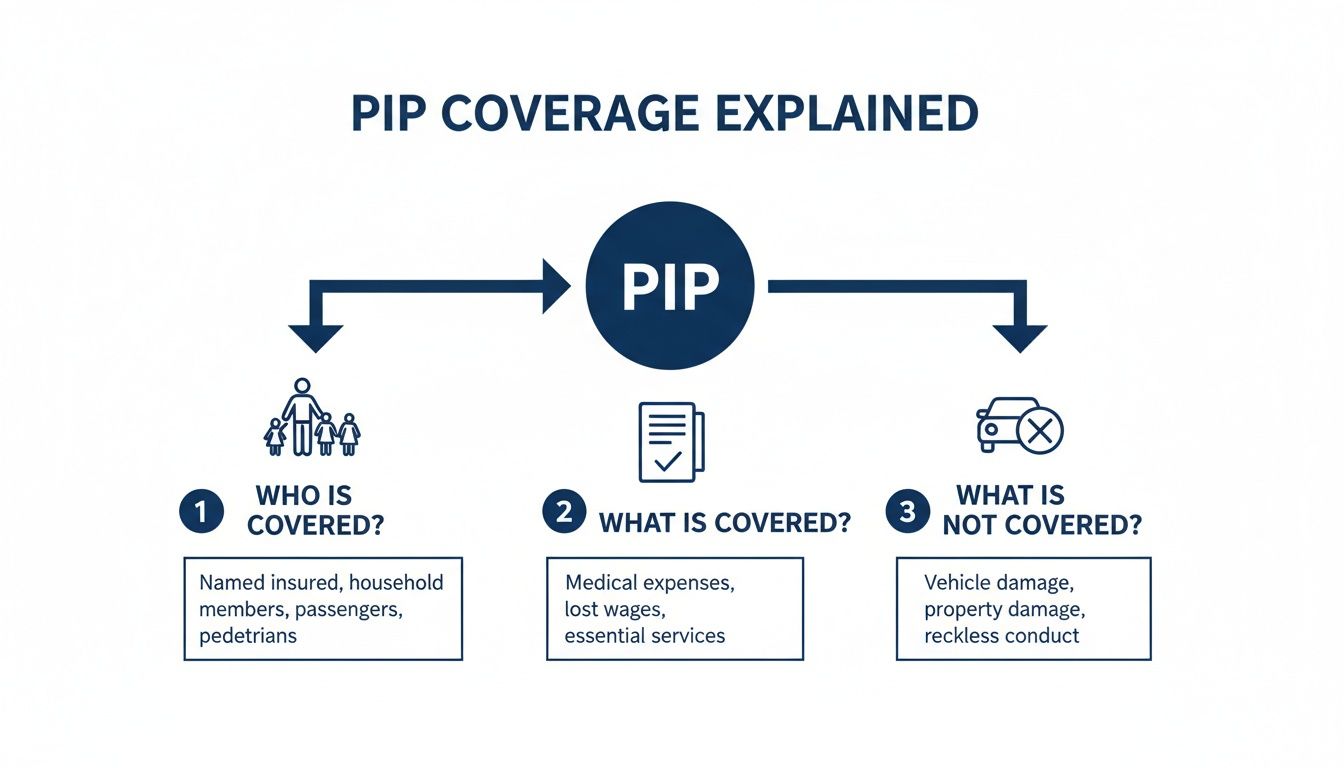
As you can see, PIP is all about covering immediate medical needs and lost income, not things like damage to your car.
The Importance of Meticulous Record-Keeping
During this process, good organization is your best friend. Start a dedicated folder, either a physical one or a digital one on your computer, for everything related to the accident.
Keep a running log of every single phone call or email with your insurance adjuster. Note the date, the time, and a quick summary of what you talked about. You’d be surprised how often this comes in handy if a disagreement pops up later.
Your file should have it all: the police report, every single medical bill, receipts for prescriptions, even a log of the miles you drive to and from your doctor’s appointments. Being organized and proactive puts you in control, helping you hit every deadline and sidestep errors that could put your benefits at risk.
What Happens When Your PIP Benefits Run Out?
In Florida, your mandatory $10,000 in PIP coverage is your first line of defense after a car wreck. But with the reality of today’s medical costs, that money can vanish in the blink of an eye.
A single trip to the emergency room or a few follow-up appointments can burn through your entire policy. It’s a common and incredibly stressful scenario, leaving accident victims wondering how on earth they’ll pay for the rest of their care.
If this happens to you, don’t panic. Think of your PIP coverage as just the first step in your financial recovery, not the last.
Tapping Into Other Insurance Coverages
Once your PIP funds are gone, it’s time to look at the other layers of financial protection you might have in place. These coverages are designed to kick in right when your primary benefits run out.
Here’s where you can turn next:
- Your Personal Health Insurance: Your health plan is a crucial safety net. It can step in to cover medical expenses once PIP is exhausted, though you’ll still need to handle your usual deductibles and co-pays.
- Medical Payments (MedPay) Coverage: Did you add this optional coverage to your auto policy? If so, now is its time to shine. MedPay is perfect for covering the 20% of medical bills that PIP doesn’t touch, as well as helping with your deductibles.
- The At-Fault Driver’s Insurance: Ultimately, the person who caused the crash is responsible for the damages. This means you can—and should—file a claim against their Bodily Injury (BI) liability insurance.
This is where the game changes. You’re moving beyond your own no-fault benefits and are now pursuing the at-fault driver for everything your PIP couldn’t cover. This includes the rest of your medical bills, your remaining lost wages, and compensation for your pain and suffering.
Pursuing a Claim for Full Compensation
Filing a claim against the other driver’s Bodily Injury (BI) insurance is how you get whole again. This is your chance to recover the 20% of medical costs and 40% of lost income that PIP legally leaves on the table.
Even more importantly, a BI claim is the only way to get compensated for what the law calls “non-economic damages.” These are the very real, personal losses that don’t come with a neat price tag, such as:
- Physical pain and suffering
- Emotional distress and mental anguish
- Loss of your ability to enjoy life’s activities
But what if the at-fault driver has minimal BI coverage—or worse, none at all? This is where your own foresight can save the day. If you have Uninsured/Underinsured Motorist coverage, you can turn to your own policy for help. You can learn more by reading about what underinsured motorist coverage is and see how it acts as another vital shield.
Why Your PIP Claim Could Be Denied
You’d think filing for PIP benefits would be simple. After all, you’ve paid your premiums. But insurance companies often throw up roadblocks, sometimes limiting your benefits or denying your claim altogether. Understanding their playbook is the first step toward getting the coverage you’re entitled to.
Some denials are straightforward. Your policy has specific exclusions, and if your injuries happened while you were, say, committing a crime, the denial is pretty much guaranteed. Those are the black-and-white cases.
The real trouble starts in the gray areas—and insurers are experts at navigating them. They have a whole set of tactics they use to challenge perfectly legitimate claims.
Common Tactics Insurers Use to Deny Claims
An insurance adjuster’s job isn’t just to process your claim; it’s often to find reasons to pay out as little as possible. They might argue that the treatment you received wasn’t “medically necessary,” or even suggest your injuries were from an old issue, not this new accident.
One of the most powerful tools in their arsenal is the Independent Medical Examination (IME).
Don’t let the name fool you. An IME is anything but independent. The doctor is hand-picked and paid by your insurance company. Their objective is often to find a reason to contradict your own doctor’s diagnosis, which gives the insurer the justification they need to cut you off.
A negative report from an IME can feel like a major setback, but it doesn’t have to be the end of the road. Insurers have other common reasons for denying claims, too.
- Treatment Disputes: They might claim the physical therapy you need is “excessive” or argue that your chiropractic adjustments aren’t directly related to your car accident injuries.
- Billing Errors: It’s shockingly common. A simple typo or a mistake in how a medical provider coded a service can cause the insurer’s automated system to kick your claim out.
- Missed Deadlines: Florida law is strict. If you don’t get initial medical treatment within that crucial 14-day window, or if paperwork is submitted late, they have a valid reason to deny you.
When an insurer starts pushing back, it’s a clear signal that you might need professional help. Knowing their strategies is half the battle. To get a deeper look into their methods, check out our guide on why insurance companies deny claims and what you can do about it.
Your Top PIP Questions, Answered
When you’re trying to figure out Florida’s PIP system, a lot of specific questions pop up, especially for situations that aren’t so straightforward. Let’s tackle some of the most common ones I hear from clients.
Does PIP Cover Me If I’m on a Motorcycle?
This is a big one, and the answer is no. The state of Florida doesn’t mandate PIP coverage for motorcycles. That means your standard car insurance policy’s PIP benefits won’t kick in if you get hurt in a motorcycle crash. Riders typically have to depend on their personal health insurance or, if another driver was at fault, file a personal injury claim directly against them.
What Happens If the Driver Who Hit Me Has No Insurance?
It’s a frustrating situation, but this is exactly what PIP was designed for. Because Florida is a no-fault state, you always turn to your own PIP coverage first, no matter who was responsible or whether they have insurance.
If your medical bills and lost wages exceed what your PIP policy covers, your next step would be to look at your own Uninsured/Underinsured Motorist (UM) coverage, if you opted to include it in your policy.
Will My Insurance Rates Go Up for Using My Own PIP?
Here’s some good news. Under Florida law, if you weren’t the one who caused the accident, your insurance company is legally prohibited from raising your rates just because you filed a PIP claim. It’s your benefit, and you’re entitled to use it.
However, if you are found to be at fault for the crash, it’s possible you could see your premium go up when it’s time to renew your policy.
If you’re hitting a wall with a denied PIP claim or dealing with serious injuries from an accident, remember you don’t have to take on the insurance giants by yourself. The experienced team at Martin Hernandez, P.A. knows how to protect your rights and fight for the full compensation you’re owed.
Reach out today for a free, no-pressure consultation at https://injurylawyersoftampa.com.