
Rideshare insurance is supposed to cover you when an accident happens, but what it covers and when is a totally different story. It all hinges on your status in the app at the exact moment of the crash. In Florida, the system is broken down into distinct phases. Think of it like a traffic light for your coverage.
While companies like Uber and Lyft boast about their big $1 million liability policies, that protection only kicks in when you’re actively driving a passenger. There’s a huge, risky gap when you’re online and just waiting for a ride request—a gap that could leave you holding the bag for a very expensive accident.
Your Guide to Rideshare Insurance in Florida
Driving for Uber or Lyft in Tampa seems easy enough, right? You turn on the app and start making money. The problem is, the insurance that’s supposed to protect you is anything but simple.
It’s not one solid policy that covers you from start to finish. Instead, your coverage acts like a series of switches, flipping on and off depending on what you’re doing in the app. This creates different “periods” of driving, each with wildly different levels of financial protection. For any driver in Tampa Bay, getting a handle on this is non-negotiable.
Your personal auto insurance policy was written for your daily commute, grocery runs, and road trips. The second you log into a rideshare app to accept rides, you’re operating as a business. That’s a critical difference, and it’s one that most personal policies specifically call out as a reason to deny your claim.
The Problem with Personal Policies
Thinking your personal auto policy has your back while you’re online for Uber or Lyft is a massive gamble. Almost every standard policy issued in Florida has what’s called a “commercial use exclusion” or “livery exclusion.”
If you get into an accident while you’re online waiting for a ride request, your insurance company can—and likely will—deny the claim. That leaves you on the hook for your car repairs, medical bills, and any damages you caused to someone else.
The heart of the problem is this: your personal insurer never agreed to cover the risks that come with carrying paying passengers. They see it as a commercial activity, which requires a completely different kind of policy.
This gap—where your personal policy stops and the rideshare company’s full coverage hasn’t started yet—is exactly where drivers get into deep financial trouble. To drive safely in Tampa, St. Petersburg, or anywhere else in Florida, you have to understand these periods and know how to bridge that gap.
We’re going to break down exactly what your rideshare insurance covers by walking through each of these phases. We’ll explore:
- The three distinct periods of rideshare driving and what they mean for your wallet.
- Why your personal car insurance just isn’t enough.
- How a simple add-on, often called a “rideshare endorsement,” can be a financial lifesaver.
- The exact steps you need to take right after a rideshare accident in Florida.
Getting this right isn’t just about playing by the rules. It’s about protecting your car, your finances, and your ability to keep earning. One accident without the right coverage can put it all at risk.
Understanding the Three Periods of Rideshare Coverage
To really get a handle on rideshare insurance, you need to stop thinking about your driving shift as one long trip. It’s actually more like three separate acts in a play. Each act, or “period,” has its own set of insurance rules, and the coverage from companies like Uber and Lyft shifts dramatically as you move from one to the next. For any driver here in Florida, knowing these periods isn’t just a good idea—it’s the key to protecting your finances.
This flowchart breaks down a typical shift and shows exactly how the insurance protection changes with each phase.
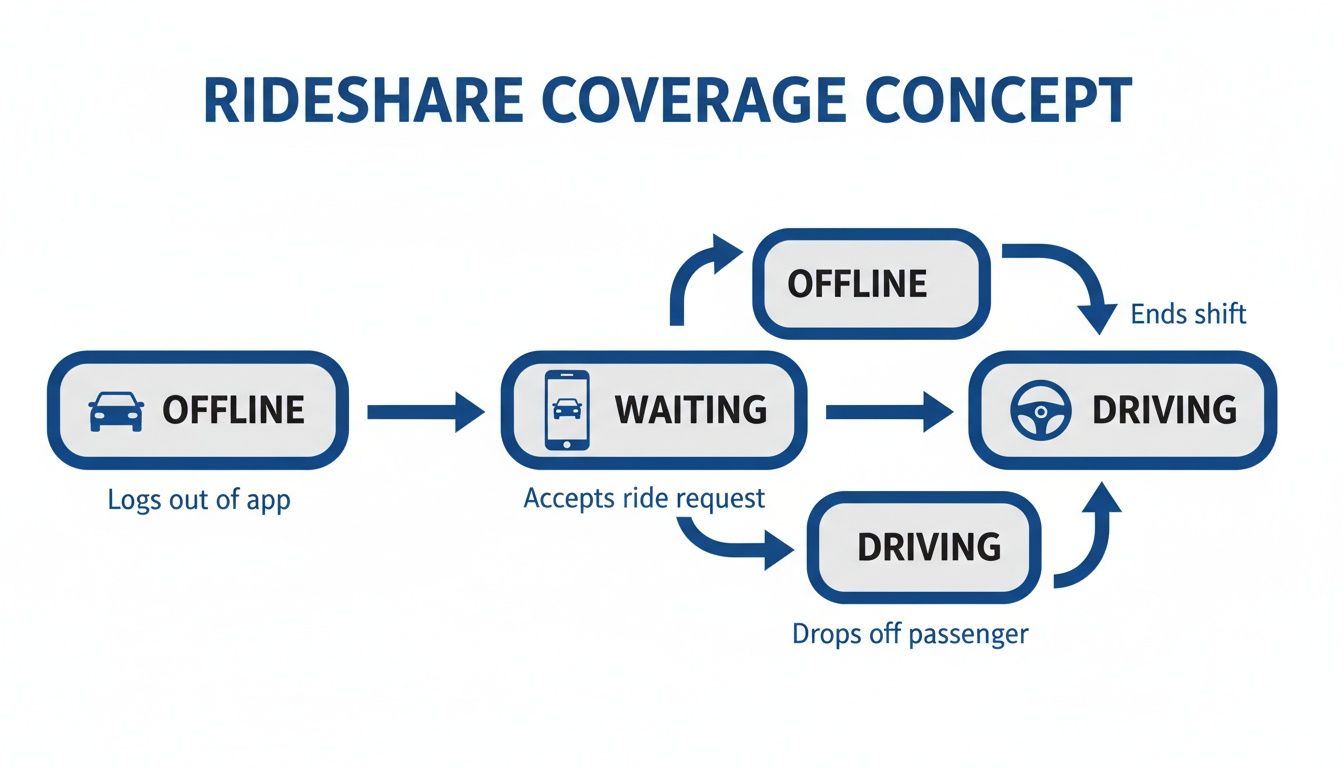
As you can see, the level of protection you have is tied directly to whether you’re just waiting for a ride or actively transporting a passenger.
Period 1: The Waiting Game
The moment you turn on your rideshare app and make yourself available for a ride request, you’ve entered Period 1. You’re online, driving around town, and waiting for that “ping,” but you haven’t been matched with a rider yet. This is, without a doubt, the most financially dangerous time for any rideshare driver.
Why? Because during this phase, your personal car insurance has likely clocked out. Most personal policies have a “commercial use exclusion,” which means they can—and will—deny your claim if you get into an accident while working. But at the same time, the rideshare company’s best insurance hasn’t kicked in yet.
In Period 1, you’re stuck in a risky gray area. Your own policy won’t cover you, and the rideshare company’s coverage is the bare minimum, designed only to protect other people—not you or your car.
So, what exactly does rideshare insurance cover during this crucial waiting period? The coverage from Uber and Lyft is extremely limited. Here in Florida, that usually means:
- $50,000 in bodily injury liability coverage per person
- $100,000 in bodily injury liability coverage per accident
- $25,000 in property damage liability per accident
Look closely at what’s missing. There is zero coverage for damage to your own car. If you cause an accident during Period 1, you are on your own for the repair bills.
Periods 2 and 3: When Full Coverage Kicks In
Everything changes the instant you accept a ride request. From that moment on, you’re in either Period 2 or Period 3, and the rideshare company’s much more powerful commercial insurance policy takes over.
- Period 2: This starts when you accept a request and are on your way to pick up the passenger.
- Period 3: This begins the second the passenger gets in your car and ends when they get out at their destination.
During both of these periods, a substantial commercial policy has your back. Typically, this includes:
- $1 million in third-party liability coverage
- $1 million in uninsured/underinsured motorist (UM/UIM) coverage
- Contingent collision and comprehensive coverage for your vehicle
This massive liability policy protects you from lawsuits if you cause an accident that hurts someone or damages their property. And that uninsured/underinsured motorist coverage is incredibly important, as it protects you and your passengers if you’re hit by someone who has little or no insurance of their own.
The Big Catch: That $2,500 Deductible
While having a $1 million policy sounds great, there’s a huge detail that catches many Florida drivers by surprise: the deductible for damage to your own car.
During Periods 2 and 3, the rideshare company’s insurance will cover your vehicle—but only if you already have comprehensive and collision coverage on your personal auto policy.
Even then, this coverage comes with a very steep price. Both Uber and Lyft hit you with a $2,500 deductible. This means if you get into a crash and your car has $5,000 in damage, you have to pay the first $2,500 out of your own pocket before their insurance contributes a dime. For most drivers, coming up with $2,500 on the spot can be a devastating financial blow.
Why Your Personal Car Insurance Won’t Cut It
It’s a common—and incredibly risky—assumption: many rideshare drivers think their personal auto policy has their back while they’re on the clock. But the reality is that a standard policy, even a good one with a fixed monthly insurance payment, was never built to handle the risks of driving for a living. Relying on it while driving for Uber or Lyft in Florida is a huge financial gamble.
The entire problem boils down to a single, critical detail buried in the fine print of almost every personal auto policy in the state: the commercial use exclusion. You might also see it called a “livery” exclusion.
This clause is straightforward and brutal. It says your insurance company won’t cover you if you’re using your car to transport people or property for a fee. The second you log into that rideshare app to start earning money, your personal insurer considers it a commercial activity—and they’re off the hook.
The Real-World Danger of the Commercial Use Exclusion
So what does this actually mean for a driver in Florida? If you get into an accident during Period 1—when your app is on but you’re waiting for a ride request—your insurance company has every right to deny your claim flat out.
And they will. Insurers don’t pay for risks they didn’t agree to cover. A claim denial means you are left holding the bag for every single dollar of the damages.
The commercial use exclusion isn’t just a technicality; it’s a giant off-switch for your coverage. It creates a massive, dangerous gap in your financial safety net the moment you start working.
This means you could be personally on the hook for:
- Your own car repairs: Hit a curb or get rear-ended? The cost to fix your vehicle is 100% your problem.
- Your own medical bills: While Florida is a no-fault state, a denied claim can make accessing your benefits a nightmare. You can learn more about how Florida Personal Injury Protection coverage works in our detailed guide.
- Damage to other people and their property: If you’re at fault, you’re personally liable for the other driver’s car repairs and medical expenses, which can easily spiral into tens or even hundreds of thousands of dollars.
Just one minor accident during Period 1 can be financially devastating without the right coverage. Your insurer could even cancel your policy for violating its terms, making it much harder and more expensive to find insurance later.
The Smart Solution: A Rideshare Endorsement
Thankfully, there’s a simple and affordable fix designed specifically to plug this gap: a rideshare endorsement. Think of it as an add-on or “rider” to your personal auto policy, not a whole new plan.
This endorsement modifies your personal policy, telling it to stay active and protect you during Period 1. That means if you have a fender bender while waiting for a ping, your own insurance carrier will handle the claim just like they would for any personal trip.
Adding this small rider gives you huge benefits:
- It closes the Period 1 gap: Your comprehensive and collision coverage stay on, so your own car is protected.
- It keeps your liability shield up: Your policy’s liability limits will cover injuries or damage you cause to others.
- It can help with high deductibles: Some endorsements even offer coverage to help with the massive $2,500 deductible Uber and Lyft charge if you have a claim during Periods 2 or 3.
A rideshare endorsement is a small investment for massive peace of mind. It turns your personal policy into a seamless shield that protects you from the moment you log on, ensuring you’re never driving unprotected.
How to Get the Right Rideshare Coverage in Florida
Figuring out the right insurance for your rideshare gig in Florida shouldn’t feel like navigating a maze. The key is knowing what to look for and which questions to ask. A little legwork now can protect you from a financial nightmare down the road.
The single most important thing you need is a rideshare endorsement, sometimes called a “rider.” This isn’t some separate, wildly expensive policy. It’s simply an add-on to your personal auto insurance policy that closes that critical Period 1 coverage gap, protecting you from the second you log into the app.
When you weigh the small monthly cost against the potential for thousands in personal liability, the choice becomes crystal clear.
What to Look For in a Good Policy
When you talk to your insurance agent, don’t just ask if they “cover rideshare.” You need to dig into the specifics of what their endorsement actually provides. The devil is in the details, and not all policies are created equal.
A solid policy offers two must-have benefits: gap coverage and deductible reimbursement. Gap coverage is the main event—it keeps your personal policy’s liability, collision, and comprehensive limits active while you’re online waiting for a ride (Period 1). This is non-negotiable.
Deductible reimbursement, however, is a massive financial lifesaver. As we’ve covered, Uber and Lyft stick you with a hefty $2,500 deductible if you get into an accident during Periods 2 and 3. Some of the better endorsements will help you cover that huge amount, so you’d only be on the hook for your much lower personal deductible.
Think of it this way: your goal is to build a seamless shield of protection. A good endorsement ensures there are no cracks for liability to slip through, whether you’re waiting for a ping or have a passenger in the back seat.
Here’s a simple checklist of questions to ask your agent:
- Period 1 Coverage: Does your endorsement extend my personal liability, collision, and comprehensive coverage through Period 1?
- Deductible Help: Does your policy offer any assistance with the rideshare company’s huge deductible for accidents in Periods 2 and 3?
- Policy Protection: Will adding this rider keep my personal policy from being canceled for using my car for business?
You need clear, “yes” answers to all three before you even think about accepting your next ride.
Comparing Costs and Major Providers
Flying without a rideshare endorsement is a huge gamble. You’re exposed to coverage gaps and massive deductibles that could wipe you out financially. Thankfully, adding one in Florida is a small investment that offers a huge return by slashing what you’d pay out-of-pocket after a crash.
For example, a State Farm endorsement that covers all three periods and includes deductible reimbursement can reduce your out-of-pocket costs significantly. Instead of Uber or Lyft’s $2,500 deductible, you would only have to pay your normal, lower personal deductible. Allstate offers a similar product. Most major carriers you already know—Progressive, Geico, USAA, and others—now offer some form of rideshare coverage in Florida. It absolutely pays to shop around, as the costs and what’s covered can vary quite a bit from one company to the next.
As you compare quotes, remember what you’re up against. Paying an extra $15 to $30 a month for an endorsement might feel like just another bill, but it’s nothing compared to the cost of one uncovered accident. A simple at-fault fender-bender while you’re waiting for a ride could easily leave you holding a bill for $10,000 or more. For more help, check out our guide on finding the right auto insurance providers.
Driving without the right coverage isn’t just a risk; it’s a guarantee that you’re one small incident away from a major financial crisis. That small, consistent cost for a proper endorsement is the single smartest investment you can make for your side hustle.
What to Do After a Rideshare Accident in Florida
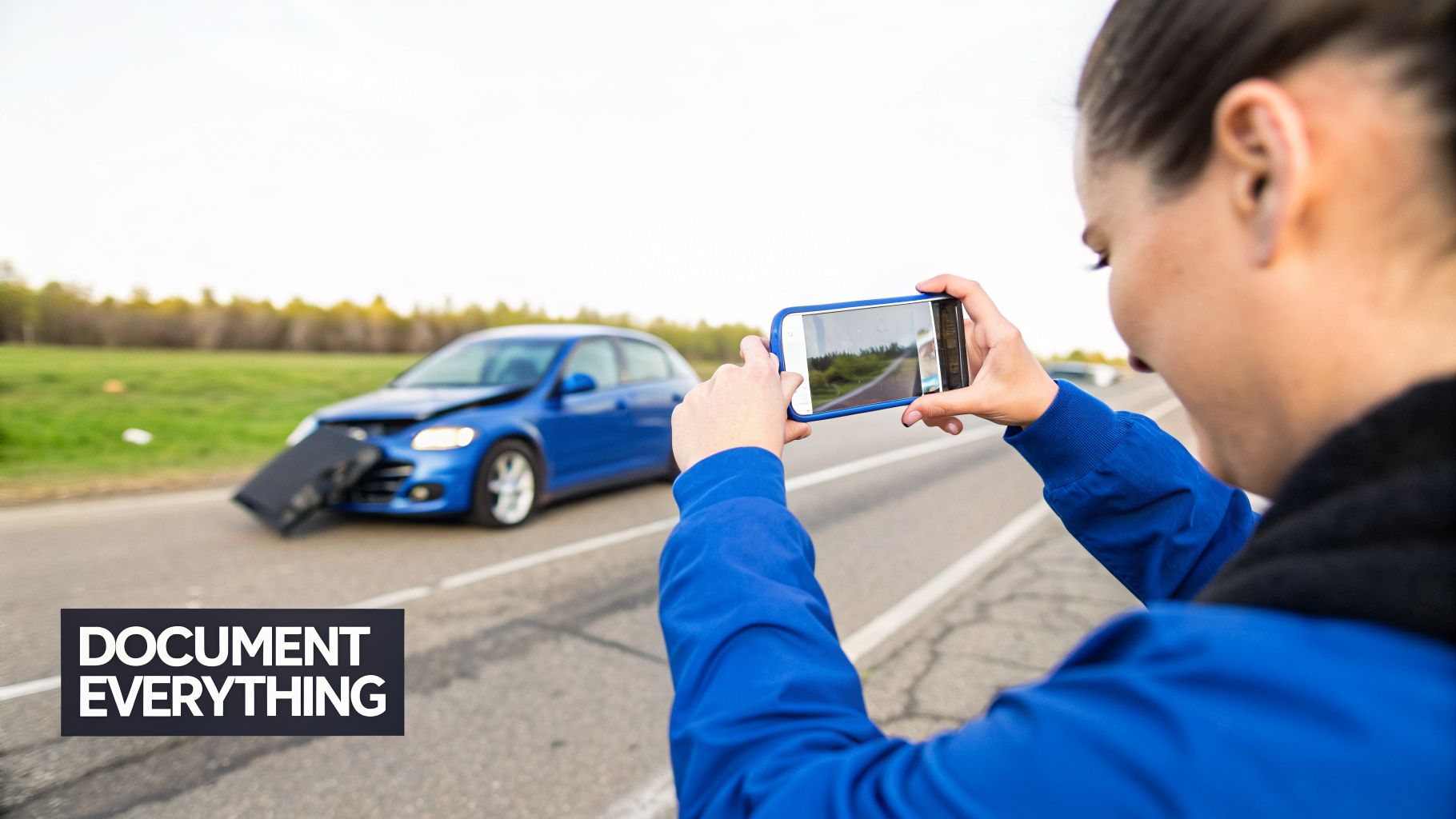
The moments right after an Uber or Lyft accident are a blur of confusion and adrenaline. It doesn’t matter if you’re the driver, the passenger, or another driver hit by a rideshare vehicle—what you do next can make or break your ability to recover physically and financially.
Being decisive at the crash scene is your best line of defense. The evidence you collect and the steps you take in those first few critical hours will lay the groundwork for everything that follows.
Your First Critical Actions at the Scene
The number one priority is always safety. If it’s possible, move your car out of the way of traffic and flip on your hazard lights to warn other drivers.
Then, call 911 right away. A police report creates an official, unbiased record of what happened, and it’s a non-negotiable piece of evidence for any insurance claim. Even if the accident seems minor, you need that official documentation.
While you’re waiting for help to arrive, and only if you’re in a safe spot, it’s time to start gathering evidence. This is where you begin to build your case.
Gather Essential Evidence Like a Pro
Think of your smartphone as your most important tool after a collision. You need to put on your detective hat and document absolutely everything you can see.
Take a ton of photos and videos from every angle imaginable. Don’t just snap one picture of the dented bumper. Get wide shots of the entire scene to show context, close-ups of the damage on every car involved, and pictures of any skid marks or debris on the road.
The single most important piece of evidence for a rideshare driver or passenger is a screenshot of the app. That one image proves whether you were waiting for a ride, en route to a pickup, or actively driving a passenger. It’s the key that unlocks which insurance policy is on the hook.
Here’s a quick checklist for what to capture:
- Vehicle Damage: Get detailed shots of the damage to all vehicles, from up close and far away.
- The Scene: Take wide-angle photos of the intersection, traffic lights, road signs, and any relevant weather conditions.
- Your Injuries: Photograph any visible cuts, bruises, or other injuries you have.
- App Screenshot: Before you do anything else, grab that screenshot of your Uber or Lyft app showing your trip status.
This visual proof is powerful because it’s hard for insurance companies to argue with. For more general advice, our guide on what to do after a car accident in Tampa offers some great tips that apply to any crash.
Seek Immediate Medical Care
You have to get checked out by a doctor after an accident, even if you feel perfectly fine. The rush of adrenaline can easily hide serious problems like whiplash or internal injuries, which might not show symptoms for hours or even days.
Here in Florida, waiting to see a doctor can seriously damage your injury claim. Getting medical attention right away creates an official record that ties your injuries directly to the accident, which is crucial for proving you deserve compensation for your medical bills.
Finally, watch what you say. Never admit fault or agree to give a recorded statement to an insurance adjuster before you’ve spoken with an attorney. Their goal is to pay out as little as possible, and they will use your own words against you to do it. The best way to protect your rights is to protect your words.
Navigating Your Claim with an Experienced Attorney
Trying to handle a rideshare accident claim by yourself is like stepping into a legal maze blindfolded. It’s not just one insurance company you’re dealing with. You could be up against Uber or Lyft’s massive corporate insurer, the driver’s personal insurance carrier, and potentially another driver’s insurance company.
Each of these companies has a team of adjusters and lawyers. Their job is simple: pay out as little as possible. This is where having an experienced legal team in your corner completely changes the game. We level the playing field and make sure these giants don’t steamroll you when you’re most vulnerable.
Fighting for the Compensation You Actually Deserve
A good attorney does a lot more than just fill out forms. We immediately launch a deep-dive investigation to nail down exactly who is at fault for the crash. This means getting the police reports, tracking down witnesses, and—most importantly—securing the rideshare app data that proves which insurance period the driver was in. That one detail determines everything.
From there, we build a rock-solid case that documents the full extent of your losses. This goes way beyond the initial ER bill. We’re talking about compensation for:
- All Your Medical Bills: This covers everything from the ambulance ride and hospital stay to future surgeries, physical therapy, and any long-term care you might need.
- Lost Income and Future Earnings: We calculate the paychecks you’ve already missed and, just as critically, how your injuries will impact your ability to earn a living down the road.
- Pain and Suffering: This is about putting a value on the real human cost of the accident—the physical pain, the emotional trauma, and the simple fact that your life has been turned upside down.
Insurance adjusters are notorious for making quick, lowball settlement offers before you even know how serious your injuries are. An attorney knows these tactics and fights back with hard evidence, using testimony from medical experts and financial professionals to prove every penny you’re owed.
The right lawyer makes sure you aren’t bullied into taking a fast, cheap settlement. They fight for a result that truly covers what you’ve lost, letting you focus on healing without the constant financial worry.
We also tackle the tricky issue of high deductibles, fighting to ensure you aren’t left holding the bag for thousands of dollars in a crash that wasn’t your fault. If you’ve been hurt, the first step is knowing your rights. To see how we can protect your claim, find out what a dedicated Tampa rideshare accident lawyer near you can do.
Florida Rideshare Insurance FAQs
After a rideshare crash, it’s natural to have a ton of questions. The insurance situation can get confusing fast, so let’s clear up some of the most common concerns for Uber and Lyft drivers and passengers in Florida.
As a Passenger, Am I Covered in an Uber Accident?
Yes, absolutely. When you’re a passenger in an Uber or Lyft, you’re covered by their large commercial insurance policy.
This is a big relief because it typically provides $1 million in liability coverage. It also includes the same amount in uninsured/underinsured motorist (UM/UIM) coverage, which is there to handle your medical bills and other losses if the at-fault driver has little or no insurance.
Does My Florida PIP Apply if I’m Injured Driving for Uber?
It should, but this is where things get tricky. As a Florida driver, your own Personal Injury Protection (PIP) coverage is your primary source for your initial medical bills, regardless of who was at fault.
Here’s the catch: your personal auto policy isn’t meant for commercial driving. If you haven’t told your insurer you drive for Uber and added a specific rideshare endorsement, they could deny your PIP claim. Worse, they could cancel your policy altogether for violating its terms.
What if an Uninsured Driver Hits Me While I’m Driving for Lyft?
This scenario is precisely why the rideshare companies carry substantial UM/UIM insurance. If you’re hit by someone without insurance (or not enough) while you’re on your way to pick up a rider or have a passenger in the car, you can make a claim against Lyft’s policy.
These policies are in place to protect you from the financial fallout of a crash that wasn’t your fault. You can learn more about how underinsured motorist coverage works and why it’s so critical in these situations.
A rideshare endorsement on your personal policy is not just a suggestion; it is the essential bridge that prevents your insurer from dropping you and ensures you are covered during the high-risk Period 1, when the rideshare company’s protection is at its weakest.
Can My Personal Auto Insurer Drop Me for Driving Rideshare?
Unfortunately, yes. It happens more than you might think. Standard auto insurance is for personal use only—commuting, errands, and road trips.
The moment you turn on the app and start driving for profit, you’re engaging in a commercial activity. If you get into an accident and your insurer discovers you were driving for a rideshare company without the proper endorsement, they have the right to deny the claim and cancel your coverage on the spot.
Navigating the insurance maze after a rideshare accident can be overwhelming, especially when you’re trying to recover from an injury. The legal team at Martin Hernandez, P.A. has the experience to handle these complex claims and fight for the compensation you deserve. Contact us today for a free consultation at https://injurylawyersoftampa.com.