
Underinsured motorist (UIM) coverage is a lifeline. It’s the part of your own car insurance policy that kicks in to cover your medical bills, lost wages, and other damages when the person who hit you doesn’t have enough insurance to pay for everything.
In Florida, this is a massive issue because the state minimum for bodily injury liability is a shockingly low $10,000. UIM coverage is what stands between you and a financial disaster, bridging the gap between what the other driver’s policy pays and what you truly need to recover.
The Insurance Gap That Leaves Florida Drivers Exposed
Let’s paint a picture. You’re driving down Dale Mabry Highway in Tampa when another driver runs a red light and T-bones your car. The crash wasn’t your fault, but you’re seriously hurt. The medical bills are piling up fast, and you can’t work.
Then comes the bad news: the at-fault driver only has Florida’s minimum $10,000 liability policy.
This is where you hit a wall. Your medical care might cost $50,000, $100,000, or even more, to say nothing of the income you’re losing. Once that other policy pays its tiny limit, you’re left holding the bag. This is exactly why Underinsured Motorist (UIM) coverage is so critical for Florida drivers.
Why Relying on Other Drivers Is a Gamble
Here in the Sunshine State, the law allows people to drive with very little insurance. That puts every responsible driver on the road at risk. When an accident happens, there’s a good chance the person who caused it won’t have nearly enough coverage to make things right.
This is where your UIM coverage becomes your personal safety net. Think of it as insurance you buy to protect yourself from someone else’s bad decision. It only activates after the at-fault driver’s insurance pays its full limit, covering the rest of your expenses up to the UIM limit you chose.
Without it, you could be stuck paying for someone else’s negligence out of your own pocket. UIM is designed to help with:
- Medical Expenses: Everything from the ambulance ride and hospital stay to surgery, physical therapy, and long-term care.
- Lost Income: The paychecks you miss while you’re recovering and any impact on your future earning ability.
- Pain and Suffering: Fair compensation for the physical pain and emotional trauma the accident has caused you.
People often talk about UIM and UM coverage together, but they are slightly different. For a closer look at the other side of this coin, you can learn more about what is Uninsured Motorist coverage in our detailed guide.
UIM coverage isn’t just another line item on your policy; it’s a financial shield against the widespread problem of minimally insured drivers on Florida’s roads. It ensures your recovery isn’t limited by another driver’s poor financial choices.
Figuring out how all these policies work together can get complicated fast. At Martin Hernandez, P.A., we help Tampa accident victims navigate this insurance maze every day. Our job is to fight for the full compensation you deserve so you can focus on rebuilding your life.
How UIM Coverage Actually Works in Florida
Think of Underinsured Motorist (UIM) coverage as your personal financial safety net. It’s an optional part of your Florida auto insurance policy, but it’s one of the most important protections you can buy. UIM doesn’t pay for anything upfront; instead, it sits quietly in the background, ready to step in when you need it most.
Your UIM coverage only kicks in after the at-fault driver’s own Bodily Injury (BI) liability insurance has completely paid out. If your medical bills and other losses are higher than what their policy covers, your UIM is there to pick up the rest, all the way up to the limit you chose.
This flowchart gives you a clear picture of how UIM fills the gap left behind by a driver who doesn’t have enough insurance.
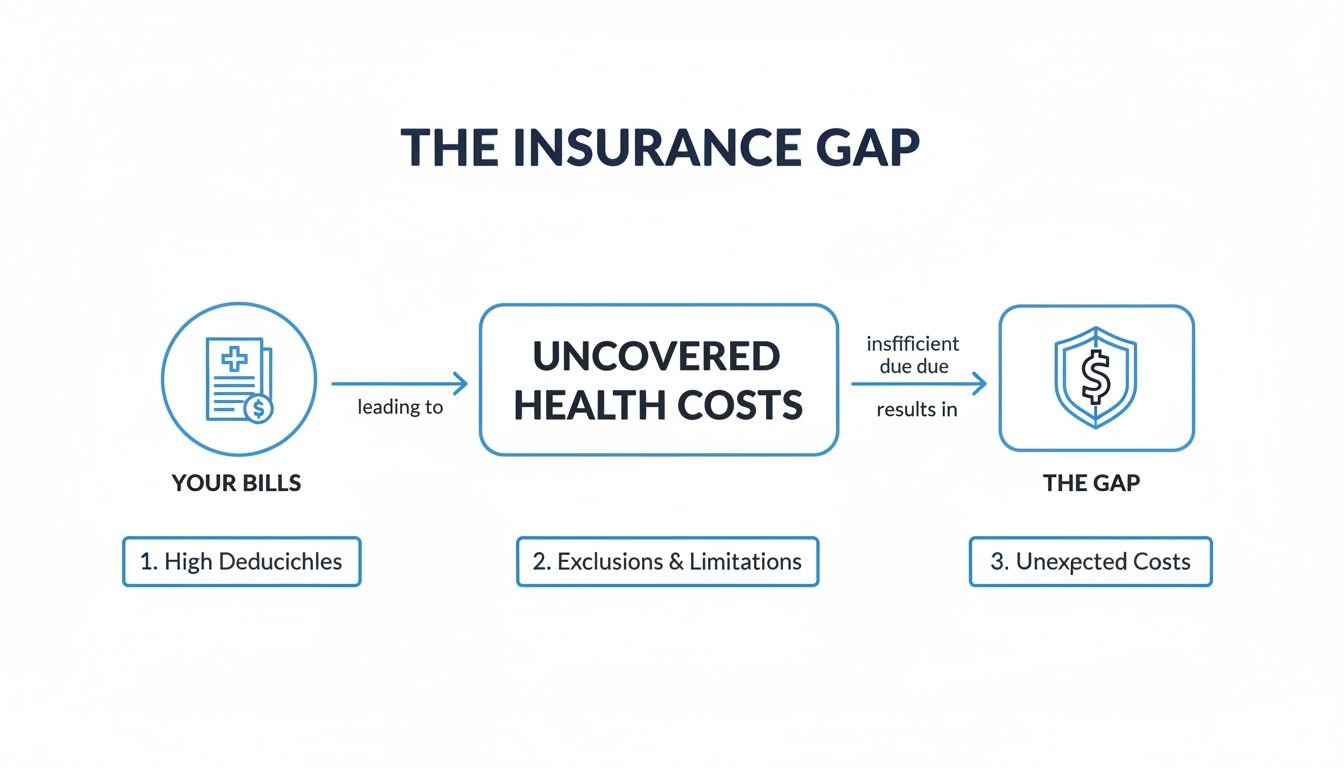
As you can see, when the other driver’s policy limit is exhausted but your bills keep coming, UIM is the critical bridge that keeps you from having to pay those costs out of your own pocket.
UIM vs. UM Coverage
Here in Florida, your insurance company has to offer you Uninsured/Underinsured Motorist (UM/UIM) coverage when you buy your policy. People often talk about them together, and they’re usually sold as one package, but they solve two very different problems.
- Uninsured Motorist (UM): This is for when the at-fault driver has no Bodily Injury insurance at all. It also applies in frustrating hit-and-run situations where you can’t identify the driver who hit you.
- Underinsured Motorist (UIM): This is for when the at-fault driver does have insurance, but their policy limits are just too low to cover the true cost of your injuries.
At the end of the day, both are designed to do the same thing: make sure you can get the financial help you need when the person who hurt you can’t pay for the damage they caused.
A Practical Example of UIM in Action
Let’s walk through a real-world scenario. Imagine you’re in a bad car wreck in Tampa that wasn’t your fault. Between the hospital stay, physical therapy, and time off work, your total damages add up to $100,000.
The driver who hit you only has Florida’s minimum BI liability coverage—a mere $10,000. Their insurance company cuts you a check for that $10,000, and that’s all they can do. Now you’re left with a staggering $90,000 in bills. If you want a deeper dive into their primary coverage, you can check out our guide on what is bodily injury liability coverage.
This is the exact moment your UIM coverage becomes a lifesaver. If you have $100,000 in UIM coverage on your own policy, you can file a claim with your own insurance company to get that remaining $90,000. Without it, that entire amount would be on you to figure out.
The Critical Choice: Stacking vs. Non-Stacking
When you purchase UM/UIM coverage in Florida, you’ll face a big decision: “stacking” or “non-stacking.” This choice can dramatically change how much coverage you have available after an accident, so it’s important to understand the difference.
Stacking is a feature that lets you combine the UIM coverage limits from multiple cars you own or that are insured in your household. This creates a much larger pool of money to draw from if you’re seriously injured.
Let’s say you have two family cars, and you bought $50,000 of stacked UIM coverage for each. If you get hurt in an accident (even in just one of those cars, or as a pedestrian), you can “stack” those limits together. Just like that, you have a total of $100,000 in UIM benefits available.
Here’s how it breaks down:
- Stacked UIM: You insure three cars, each with $100,000 in stacked UIM. After a crash, you have access to a total of $300,000 in coverage.
- Non-Stacked UIM: You insure the same three cars with $100,000 in non-stacked UIM. Your available coverage is capped at $100,000—the limit on the specific vehicle involved in the crash.
Yes, stacked coverage costs a little more, but that slightly higher premium buys you an incredible amount of protection. It’s one of the best ways to prepare for the devastating financial fallout of a crash caused by an underinsured driver.
What UIM Pays For After a Serious Accident
In Florida, every driver is required to carry Personal Injury Protection (PIP) insurance. What many people don’t realize until it’s too late is that PIP only covers the first $10,000 of your medical bills and lost wages. After a truly serious crash, that money can vanish in the first few hours of emergency room care.
This is exactly why Underinsured Motorist (UIM) coverage is so essential. It picks up where the at-fault driver’s inadequate policy and your own PIP leave off, covering the devastating costs that can derail your life.
Think of UIM as a critical financial safety net. It’s designed to help make you whole again, ensuring you aren’t buried in debt because someone else was careless and didn’t have enough insurance to cover the damage they caused.
Covering Your Medical Bills Now and in the Future
The most obvious benefit of UIM is how it handles your medical costs. While your PIP provides that initial $10,000, it’s rarely enough for severe injuries. UIM is there for the long haul.
Your UIM policy can step in to pay for a wide range of medical necessities, including:
- Surgeries and Hospitalization: This covers complex operations, any necessary follow-up procedures, and lengthy hospital stays.
- Rehabilitation Services: It pays for the physical, occupational, and vocational therapy you need to recover and regain your independence.
- Long-Term Care: If you suffer a permanent disability, UIM can help cover nursing care, in-home assistance, or assistive devices like wheelchairs.
PIP is a starting point, but it’s quickly exhausted. You can learn more about its limitations in our guide explaining what is PIP insurance in Florida to see just how crucial UIM becomes in a serious claim.
Compensation for Lost Income and Future Earnings
A bad accident doesn’t just rack up medical bills—it can completely shatter your ability to earn a living. This is another area where UIM provides vital protection.
It’s designed to compensate you not just for the paychecks you’ve already missed, but more importantly, for the loss of your future earning capacity. If your injuries stop you from returning to your old job or force you into a lower-paying career, UIM can help bridge that financial gap and secure your future.
A severe injury can sideline you for months or even years. UIM is the only coverage that truly protects your most valuable asset—your ability to provide for yourself and your family.
Recovering Damages for Pain and Suffering
This might be the single most important function of UIM coverage. It provides compensation for your “non-economic” damages—the profound, personal losses that don’t come with an itemized bill but can have the biggest impact on your life.
Your PIP policy provides exactly $0 for this. UIM is often the only way to get fair compensation for these very real human costs.
Non-economic damages include things like:
- Pain and Suffering: For the daily physical pain, chronic discomfort, and physical limitations caused by the injury.
- Mental Anguish: For the emotional trauma, anxiety, depression, or PTSD that often follows a violent crash.
- Diminished Quality of Life: For the loss of enjoyment you experience when you can no longer pursue hobbies, play with your kids, or participate in life the way you used to.
In most serious injury cases, these non-economic damages represent the largest part of the claim’s value. Without UIM coverage, you have no way to be compensated for these immense personal losses, leaving you to carry the full physical and emotional weight of the accident all on your own.
Navigating the Complex Florida UIM Claims Process
Filing an Underinsured Motorist (UIM) claim isn’t like any other insurance claim you’ve dealt with before. Suddenly, you’re not dealing with the other driver’s insurance company; you’re trying to get compensation from your own. This flips the script entirely. The company you’ve paid premiums to for years can suddenly feel like an adversary, and it’s up to you to prove just how much you’ve lost.
It can be a challenging journey, to say the least. But with diligence, the right documentation, and a clear understanding of the road ahead, you can successfully navigate the process.
Essential First Steps After the Accident
What you do in the moments and days right after a crash can make or break your UIM claim. It’s all about protecting your health first, and then your legal rights.
Your absolute top priority is to seek immediate medical attention. I can’t stress this enough. Even if you think you’re okay, adrenaline can hide serious injuries. If you wait to see a doctor, the insurance company will jump at the chance to argue that your injuries weren’t caused by the crash.
Once you’ve made sure everyone is safe, call the police. The official police report is a critical piece of evidence that helps establish who was at fault. It’s also important to understand your legal obligations after a car accident in Florida to make sure you’re checking all the required boxes from the start.
You need to put both insurance companies on notice right away—the at-fault driver’s and your own. This formal notification kicks off the claims process and is essential for preserving your right to tap into your UIM benefits down the line.
The Power of Meticulous Documentation
When it comes to a UIM claim, the burden of proof falls squarely on your shoulders. You have to build a compelling case that shows the full value of your damages. This is why keeping detailed records isn’t just a good idea; it’s non-negotiable.
Think of yourself as the lead investigator of your own case. Get a folder or a box and keep absolutely everything related to the accident and your recovery in one organized place.
Key Documents to Preserve:
- Medical Records: This is your paper trail of treatment. Collect every single bill, doctor’s note, physical therapy summary, prescription receipt, and MRI result. It should tell the complete story of your medical journey.
- Proof of Lost Wages: You’ll need a letter from your employer that details your salary or hourly rate, how many hours you’ve missed, and any sick or vacation days you had to burn. Pay stubs from before and after the crash are great for showing the financial impact.
- Communications Log: Every time you talk to an insurance adjuster—whether by phone, email, or letter—write it down. Note the date, time, who you spoke with, and what was discussed.
This mountain of evidence is your best weapon against an insurer’s attempt to minimize what you’ve been through.
Common Tactics Insurers Use to Deny Claims
Let’s be blunt: insurance companies are businesses, and their main goal is to protect their bottom line. When you file a UIM claim, you might be surprised to see your own insurer switch from a helpful partner to an opponent. They have a playbook of tactics designed to pay out as little as possible.
They might try to claim your injuries are from a pre-existing condition, not the accident. A classic move is to question your medical treatments, suggesting you got more care than was “necessary.” You might also get a quick, lowball settlement offer. They’re hoping you’re feeling desperate and will take the cheap payout before you realize what your claim is truly worth.
It’s overwhelming to face these tactics alone. Knowing how to fight an insurance denial is crucial, but it’s a tough battle to wage by yourself.
This is where having an experienced personal injury attorney in your corner makes all the difference. At Martin Hernandez, P.A., we’ve seen these maneuvers countless times. We prepare every UIM case as if it’s headed to trial, gathering expert witness testimony and building an ironclad argument for the full compensation you deserve. We don’t let our clients get pushed around by lowball offers or delay tactics—we make sure their insurer honors the policy they paid for.
Why You Must Not Settle Without Legal Counsel
After a serious car accident, seeing a settlement check from the at-fault driver’s insurance company can feel like a lifeline. Medical bills are piling up, you’re out of work, and the pressure is immense. It’s incredibly tempting to just sign the release, take the money, and try to move on.
But I’ve seen it time and time again: accepting that initial offer is often the single biggest mistake you can make, especially for your Underinsured Motorist (UIM) claim.
In Florida, the law is extremely strict and unforgiving on this issue. One misstep, one signature without the right permissions, and you could permanently lose your right to collect a single penny from your own UIM policy.
The Settlement Trap That Can Erase Your UIM Rights
Here’s the critical part: under Florida law, you absolutely cannot settle your claim with the person who hit you (or their insurance company) without first getting written consent from your own insurance provider. Think of it as a mandatory legal checkpoint. If you try to bypass it, the road to your UIM benefits is closed for good.
The reason for this rule is a legal concept called subrogation. When your insurer pays your UIM benefits, they essentially buy the right to go after the at-fault driver to recover that money. But if you sign a release, you’ve just signed away their ability to do that. As a result, the law says they no longer have to pay you.
This isn’t just some minor technicality; it’s a legal landmine. Signing a release from the at-fault party without your UIM carrier’s explicit, written permission will almost certainly lead to the complete denial of your UIM claim.
The Right Way to Protect Your Claim
To keep your right to UIM compensation safe, you have to follow a very specific legal procedure. It’s a formal process involving written communication and non-negotiable deadlines. This is exactly where an experienced attorney steps in to make sure nothing falls through the cracks.
Here’s how it’s supposed to work:
- Get a Settlement Offer: Your lawyer will first negotiate with the at-fault driver’s insurance company to get them to offer their full policy limits.
- Send Formal Notice: Once that offer is officially on the table, your lawyer must send a legally required notice to your own UIM insurance company. This letter formally tells them about the settlement offer and asks for their permission to accept it.
- Wait for the Insurer’s Decision: Your UIM provider then has 30 days to make a choice. They can either give you written permission to take the settlement and release the at-fault driver, or they can step in and pay you that settlement amount themselves to protect their right to sue the other driver later.
This isn’t something you handle with a quick phone call or a simple email. It requires formal legal documents sent via certified mail to create a paper trail that can’t be disputed. A firm like Martin Hernandez, P.A., manages this entire communication process, ensuring every legal ‘i’ is dotted and ‘t’ is crossed so your right to full compensation stays locked in.
The High Stakes of Getting It Wrong
Your UIM coverage is often your most important financial safety net, especially when you see how many people in Florida are driving without enough insurance. According to the Insurance Research Council, a shocking 20.4% of Florida drivers were uninsured in 2019, ranking the state sixth worst in the nation. This doesn’t even account for the countless others who carry only the bare minimum coverage required by law.
With so many drivers on the road carrying inadequate insurance, a simple procedural mistake during the settlement process could cost you tens, or even hundreds, of thousands of dollars. If your UIM claim is denied because of a misstep, knowing your next move is crucial; you can learn more about what to do when an insurance claim is denied to better protect your interests.
The bottom line is simple: never, ever sign anything from an insurance company without talking to a qualified Tampa personal injury attorney first.
When to Contact a Tampa Personal Injury Attorney
Dealing with the chaos after a car accident is hard enough. Figuring out if you need a lawyer for your UIM claim shouldn’t add to the stress. While you might handle a minor fender-bender on your own, certain situations are clear red flags that you need professional legal advice right away.
If you or a passenger suffered a serious injury, getting a lawyer isn’t just a good idea—it’s essential. The more severe the injuries, the higher the medical bills and other damages. That means the insurance company has more to lose, and you can bet they will fight much harder to pay out as little as possible.
Another major signal is when you start getting pushback from your own insurance company. If they are questioning the severity of your injuries, dragging their feet on payment, or flat-out denying your UIM claim, you need an advocate in your corner. These are classic tactics insurers use to protect their bottom line, not your well-being.
Clear Signals You Need Legal Help
Knowing your rights is half the battle. It’s always smart to understand when to hire a personal injury lawyer so you know what to expect from the process. But in some cases, it’s not a suggestion—it’s a necessity.
You absolutely need to call an attorney before you even consider accepting a settlement offer from the at-fault driver’s insurance. As we’ve covered, making a mistake at this stage could destroy your ability to collect UIM benefits later. If you’re confused by complex policy language, like your stacking options, that’s another sign it’s time to bring in an expert.
Don’t wait for a small problem to turn into a full-blown crisis. The best time to call a lawyer is the moment you suspect the other driver’s insurance won’t be enough to make you whole. Getting help early is the best way to protect your rights.
At Martin Hernandez, P.A., we work on a contingency fee basis. This is simple: you pay us nothing unless we successfully recover money for you. From the very beginning, we prepare every case as if it’s going to trial, using our in-depth knowledge of Tampa’s insurance companies and court systems to get you the best possible outcome.
Your financial stability is too important to risk. Schedule a free, no-pressure consultation with our team today to understand your options and secure the full compensation you deserve.
Answering Your Top Questions About Florida UIM Coverage
When you start digging into the details of Underinsured Motorist (UIM) coverage, it’s natural for questions to pop up. Let’s tackle some of the most common ones Florida drivers ask so you can get a clearer picture of this crucial protection.
Is Underinsured Motorist Coverage Required in Florida?
The short answer is no. UIM coverage is not mandatory in Florida. State law only requires you to carry PIP and property damage liability. UIM is an optional add-on to your policy.
That said, given Florida’s very low minimum Bodily Injury liability requirements for other drivers, UIM is one of the most important coverages you can buy. It’s your financial safety net when you’re hurt by someone who has insurance, just not nearly enough to cover the true cost of your injuries.
How Much UIM Coverage Should I Carry?
A great rule of thumb is to match your UIM limits to your own Bodily Injury (BI) liability limits. This simple approach means you’re giving yourself and your family the same financial shield you’re providing to others if you cause a crash.
Think about it this way: if you feel $100,000 is an appropriate amount of coverage to protect someone you might injure, doesn’t it make sense to have that same $100,000 shield for yourself? Your insurance agent can help you review your assets and risks to dial in the perfect amount.
Can My Insurance Company Raise My Rates for Using My UIM Coverage?
Absolutely not. It’s illegal for an insurer to jack up your premiums for making a UIM claim if the accident wasn’t your fault.
Florida Statute 626.9541 is very clear on this. It stops insurance companies from canceling your policy, refusing to renew it, or raising your rates just because you used the PIP or UM/UIM benefits you paid for.
You pay premiums for this exact scenario. You have every right to use the coverage you bought without being penalized when another driver is to blame.
This law ensures that safe, responsible drivers aren’t punished for protecting themselves.
What Happens if the At-Fault Driver Has No Insurance at All?
This is where the other half of your coverage kicks in. If the driver who hit you has no Bodily Injury insurance at all, you’ll file a claim under the Uninsured Motorist (UM) part of your policy. In Florida, UM and UIM are almost always sold together as a single package.
The process is a lot like a UIM claim. But instead of filling a gap, your UM coverage becomes the main source of payment for your medical bills, lost income, and pain and suffering. This also applies to frustrating hit-and-run situations where the other driver is never found.
If you’ve been hurt in an accident and are now stuck dealing with an underinsured driver’s insurance company, you don’t have to go through it alone. The experienced team at Martin Hernandez, P.A. is ready to fight for the full compensation you deserve. Contact us today for a free consultation to protect your rights and your future.