
When you buy insurance, you’re buying a promise. You hold up your end of the bargain by faithfully paying your premiums, and in return, the insurance company promises to be there for you when something goes wrong. A bad faith insurance claim is what happens when that promise is broken.
It’s not just a simple disagreement over a claim’s value. It’s when your insurer actively works against you, unfairly delaying, denying, or lowballing your valid claim to protect their own profits instead of honoring the policy you paid for.
Your Insurer’s Promise and When It’s Broken

Think of your insurance policy as more than just a piece of paper; it’s a contract rooted in a legal principle called the “covenant of good faith and fair dealing.” This is a fancy way of saying your insurance company has a legal and ethical duty to treat you fairly.
They are supposed to be your advocate, not your opponent. Their job is to promptly investigate what happened, honestly assess the damage, and pay the benefits you are rightfully owed under your policy. When they deliberately fail to do this, they are acting in bad faith.
The Difference Between Disagreement and Deceit
Let’s be clear: not every denied claim is a case of bad faith. It’s perfectly legal for an insurer to investigate a claim thoroughly and even dispute the amount if they have a reasonable, evidence-based reason to do so. A simple disagreement isn’t the problem.
The line is crossed when their behavior becomes unreasonable, deceptive, or completely unjustified. They stop acting like a partner and start acting like an adversary. For a clearer picture, it helps to see the two approaches side-by-side.
Good Faith vs Bad Faith At a Glance
Here’s a simple breakdown of how a responsible insurer acts compared to one that’s breaking its promise.
A good faith insurer conducts a prompt and thorough investigation, seeking all relevant facts. They keep you informed, respond to questions in a timely manner, interpret the policy language fairly, and make a settlement offer based on the facts and your coverage.
In contrast, a bad faith insurer delays the investigation without reason, ignores evidence that supports your claim, and fails to return calls or emails. They might twist the policy language to invent a reason for denial or offer an unreasonably low amount, hoping you’ll give up.
Essentially, bad faith boils down to a conscious choice by the insurance company to put its own financial interests ahead of its legal and ethical duties to you. You can learn more about the specific reasons insurance companies deny claims and how to spot when their arguments don’t hold water.
The Widespread Impact of Unfair Practices
Sadly, these tactics are more common than you might think. Research shows that a significant percentage of personal injury claims face some form of bad faith practice. The most frequent issues are infuriating delays in processing claims, outright wrongful denials, and insultingly low settlement offers, costing claimants thousands of dollars.
When an insurer acts in bad faith, they aren’t just withholding money—they are compounding the stress and financial hardship you’re already experiencing. This breach of trust can leave you feeling powerless and facing mounting bills, all while trying to recover from an accident or loss.
How Florida Law Defines Bad Faith Claims
When you buy an insurance policy in Florida, you’re buying a promise that is legally required. The law steps in to make sure insurance companies hold up their end of the bargain through a duty of good faith and fair dealing.
This legal duty is the cornerstone of your rights as a policyholder. It means your insurance company can’t put its own financial interests ahead of its obligation to you. They have to treat you, and your claim, honestly and fairly. Denying, delaying, or lowballing a valid claim without a good reason isn’t just bad service; it could be illegal.
The Teeth Behind the Law: Florida Statute § 624.155
The real power for consumers comes from a specific law: Florida Statute § 624.155. This is often called the “Bad Faith Statute,” and it gives policyholders the right to sue their insurance company directly for failing to act in good faith.
Before this statute existed, trying to hold an insurer accountable was a much tougher, more complicated battle fought through case law. This statute changed the game. It clearly defined the rules and gave everyday people a powerful tool to enforce their rights.
The big idea here is that an insurer’s job isn’t just to avoid outright fraud. They have a proactive duty to investigate, evaluate, and resolve your claim fairly and without unnecessary delays. The process matters just as much as the final payment.
First-Party vs. Third-Party Claims: Who Was Harmed?
Florida law splits bad faith into two main categories, and the difference comes down to who the insurance company wronged.
- First-Party Bad Faith: This is the one most people think of. It’s when your own insurance company treats you unfairly. Say you file a claim under your own auto policy after a fender-bender in Tampa, and your insurer invents a bogus reason to deny it. That’s a potential first-party bad faith claim. They’ve directly breached the duty they owe to you.
- Third-Party Bad Faith: This one is a bit more complex. It happens when your insurer fails to protect you from a claim made by someone else (a “third party”). Let’s say you cause a car accident and the other driver sues you. Your insurance company has a chance to settle the case for an amount within your policy limits but refuses to do so. If the case goes to trial and the other driver wins a verdict that’s far more than your policy covers, you’re now personally on the hook for the difference. In this situation, you may have a third-party claim against your insurer for failing to protect you from that excess judgment.
A Real-World Tampa Example
Let’s make this real. Imagine you’re caught in a nasty pile-up on I-275. Your car is a wreck, and your medical bills from Tampa General are piling up. Thankfully, you’ve been paying for a good auto insurance policy for years. This is exactly why you have it.
You do everything right. You send in the police report, photos, repair estimates, and every medical bill. But then… crickets. Weeks go by. Your calls go to voicemail. When you finally get someone on the phone, they claim they never got the paperwork you know you sent. They won’t give you a straight answer or a reason for the endless delay.
This isn’t just poor customer service. It’s the kind of behavior that can signal bad faith. The insurer is failing its basic duty to investigate your claim and communicate with you. Their stonewalling is causing you real financial harm and emotional stress, leaving you without a car and struggling to pay your doctors. You can learn more about how the system works by reviewing our guide explaining Florida no-fault insurance.
At the end of the day, a bad faith claim isn’t about an honest disagreement over the value of a dented bumper. It’s about unreasonable conduct—an insurer failing to fulfill its promise without a legitimate, well-supported reason.
Recognizing Bad Faith Insurance Tactics
How do you know if your insurance company is just being difficult, or if they’ve actually crossed a legal line into bad faith? It’s a question we hear all the time. The law gives us the rules, but spotting these tactics in the middle of a stressful claim is the real challenge.
Insurance companies are businesses, and sometimes they use strategies designed to do one thing: pay you as little as possible. Knowing what these moves look like is the first step to protecting your rights.
Unreasonable Delays
One of the oldest tricks in the book is the unreasonable delay. I’m not talking about the week or two it takes to process paperwork. This is a deliberate, drawn-out waiting game designed to wear you down until you’re so desperate you’ll accept whatever they offer.
Think about it. A hurricane rips through Tampa and damages your roof. You file a claim right away, but weeks become months. The adjuster is always “about to be assigned,” or your file is perpetually “under review.” Meanwhile, every new rainstorm brings more water into your home. This isn’t just poor customer service; it’s a classic bad-faith strategy.
“Justice too long delayed is justice denied.” – Martin Luther King Jr. This couldn’t be more true when you’re waiting on a claim. The delay itself causes real financial and emotional harm while you wait for the help you’ve been paying for.
Wrongful Claim Denial
An outright “no” on a valid claim is a huge red flag. Of course, an insurer can deny a claim if your policy doesn’t cover the damage. But when they deny a claim without a proper investigation or by twisting the words of your policy to invent an excuse, they are acting in bad faith.
Let’s say you’re in a car accident, and the other driver was clearly at fault. You have the police report and witness statements to prove it. But your insurance company denies the claim, vaguely blaming you for being “partially at fault” without a shred of evidence. That’s not a legitimate denial—that’s an insurer failing to do its job.
Inadequate Investigation
Every insurance company has a legal duty to perform a prompt, thorough, and fair investigation. Their job isn’t to hunt for excuses to deny your claim; it’s to find the facts, even the ones that help you.
A bad-faith investigation often involves things like:
- Ignoring key witnesses who saw what really happened.
- Never properly inspecting the property damage before making a lowball offer.
- Dismissing the evidence you provide, like your doctor’s medical records or a repair estimate from a trusted contractor.
The goal should be to find the truth, not a loophole. When they fail to look at the whole picture, they’ve breached their duty to you. Understanding the basics of talking to an insurance adjuster after an accident can help you recognize when the conversation feels off and they aren’t playing fair.
Lowball Settlement Offers
This one is incredibly common. The insurer makes a settlement offer that is insultingly below the true value of your claim. They know exactly what your damages are worth, but they throw out a low number, preying on your financial stress and hoping you’ll just take it and go away.
They might offer you $5,000 for a car that’s a total loss and valued at $15,000. Or they’ll offer to pay for a cheap patch on a roof that obviously needs a full replacement. These aren’t good-faith negotiations; they’re calculated attempts to cheat you out of the benefits you’re owed.
These tactics are more common than you’d think. Studies have revealed bad faith practices in a staggering percentage of personal injury claims. The most common offenders were unreasonable delays, wrongful denials, and lowball offers. These actions stretched the average time to resolve a claim significantly. You can discover more insights about how common these bad faith claims are on law-wv.com.
Building a Strong Bad Faith Insurance Case
It’s one thing to feel like your insurance company is giving you the runaround, but it’s another thing entirely to prove it and hold them accountable. Building a solid bad faith case isn’t about emotion; it’s about methodically creating a paper trail so clear and convincing that the insurer has nowhere left to hide.
The foundation of any strong case is documentation. You have to record every single interaction, no matter how small you think it is. Your memory will fade over time, but a written record is forever.
The Power of Meticulous Record-Keeping
From this point forward, you need to think of yourself as the lead investigator on your own claim. Your mission is to gather every shred of evidence that tells the story of how the insurance company dropped the ball. This is more than just saving a few emails—it’s about building a comprehensive file that details every single move they made, and just as importantly, every move they didn’t make.
Here are the absolute must-haves for your evidence file:
- Your Complete Insurance Policy: This is your contract with them. Get the declarations page and every single endorsement or rider attached to it.
- All Written Communications: Save every letter, email, and even text message that goes back and forth between you and the company.
- Proof of Damages: Keep all your repair estimates, photos and videos of the damage, and every receipt for anything you had to pay for out of pocket.
- Medical Records and Bills: In an injury claim, this paperwork is gold. You can learn more about the critical role of medical documentation in proving just how much you’ve lost.
The flowchart below shows the classic playbook insurers use when they’re acting in bad faith. It helps you see exactly what kind of behavior you need to be documenting.
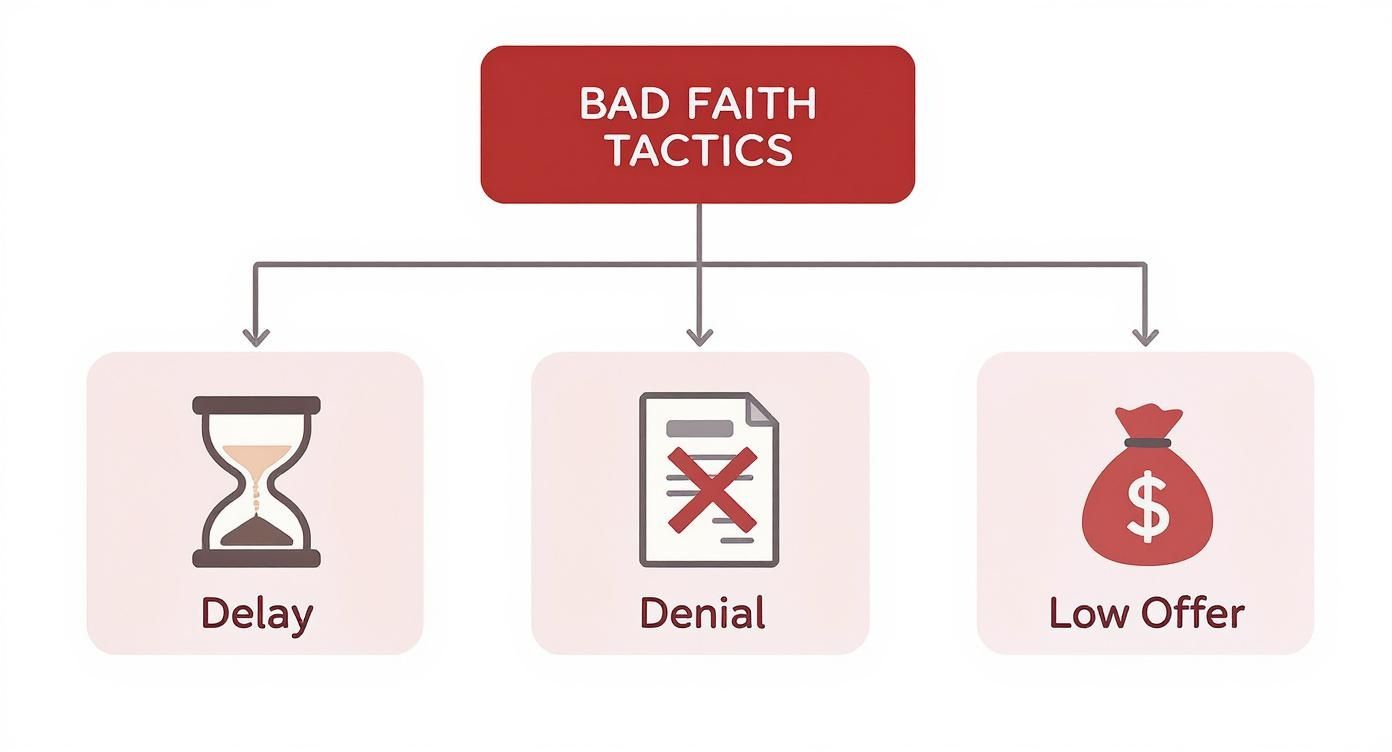
As you can see, whether they delay, deny, or lowball you, it all leads to the same place: a company breaking its promise to you.
Creating Your Communication Log
In addition to saving documents, start a detailed communication log immediately. This is basically a diary of every phone call or conversation you have with anyone from the insurance company. After you hang up the phone, write down these details right away:
- Date and Time of the Call: Be specific.
- Name and Title of the Person You Spoke With: Always get their full name and find out what department they’re in.
- A Summary of What Was Discussed: What did you ask them? What was their response? Did they make any promises or commit to a timeline?
A detailed log turns a vague complaint like “they kept giving me the runaround” into a documented timeline of specific failures. It shows a clear pattern of delay or misinformation that’s much harder for an insurer to dispute.
When sending over sensitive documents, especially medical records, you have to be careful. Understanding the rules for things like HIPAA-compliant faxing is essential for protecting your privacy and ensuring your information is handled legally.
The Civil Remedy Notice: A Florida Requirement
Here in Florida, you can’t just march into court and sue your insurer for bad faith. The law requires you to take a critical first step: filing a Civil Remedy Notice (CRN) with the Florida Department of Financial Services. This isn’t optional; it’s a mandatory prerequisite.
The CRN is a formal document that officially puts your insurance company on notice. It tells them, in no uncertain terms, that you believe they’ve acted in bad faith and lays out the specific ways they violated the law.
Filing the CRN kicks off a 60-day “cure” period. This gives the insurance company one last chance to do the right thing and pay the damages you’re fairly owed. If they pay the claim in full during these 60 days, you can no longer sue them for bad faith. But if they ignore the notice or fail to settle the claim properly, the door is officially open for a bad faith lawsuit once that 60-day window closes.
This is a powerful strategic move, and the stakes for insurers are getting higher. Reports show a significant rise in bad faith claims in recent years. Property and casualty insurers are getting hit the hardest, and the average payout for a bad faith case can be substantial.
Your Action Plan for Suspected Bad Faith

When you start feeling that pit in your stomach every time the insurance company calls, that’s your cue to stop reacting and start taking control. If you suspect your insurer is giving you the runaround, you can’t just wait and hope they’ll suddenly do the right thing.
It’s time to channel that frustration into a focused, deliberate plan. Following these steps will not only protect your rights but also build a rock-solid foundation for your claim and show the insurance company you mean business.
Step 1: Read and Understand Your Policy
First things first: your insurance policy is a contract. It’s the rulebook for this entire game. Before you can effectively argue that the insurer broke their promise, you need to know exactly what they promised you in the first place.
Pull out your policy documents and read them. I mean really read them. Pay close attention to the sections covering your specific type of loss—what’s covered, what’s excluded, and what the official claims process is supposed to look like. Knowing these details is your first line of defense against an adjuster who might be misrepresenting the terms.
Step 2: Document Absolutely Everything
From this moment on, you need to act as if you’re building a case that will one day be presented to a jury. Why? Because you might be.
Every single interaction with the insurance company needs to be documented with painstaking detail. This isn’t optional.
- Phone Calls: Keep a log. Note the date, the time, the name of the person you spoke with, and a quick summary of what was discussed.
- Emails and Letters: Create a dedicated folder—digital or physical—and save every single piece of correspondence. Don’t delete anything.
- Submitted Documents: Always keep copies of everything you send them. If you mail it, use certified mail for a receipt. If you email it, save the sent confirmation.
This isn’t just paperwork; it’s your evidence. It creates a timeline that can expose a clear pattern of delays, stonewalling, or unreasonable behavior.
A well-documented file is the single most powerful tool in a bad faith insurance claim. It transforms vague complaints into a concrete record of the insurer’s conduct, making it much harder for them to deny their actions.
Step 3: Put It All in Writing
Phone calls are quick, but they’re also deniable. A verbal promise means nothing without proof. For that reason, you need to shift all important communication to writing.
If you do have a phone call with an adjuster, send a polite follow-up email immediately afterward to summarize what was said.
For example: “Hi Jane, just to confirm our conversation a few minutes ago, you mentioned the engineer’s report should be completed within three business days. Please let me know if I’ve misunderstood anything.” This simple step creates a paper trail and holds them accountable.
Step 4: Don’t Give In to Pressure
Insurance companies are masters of the waiting game. They know that lowball offers and endless delays create financial and emotional pressure. Their goal is often to make you so desperate that you’ll accept a fraction of what you’re owed just to make it all stop.
Don’t fall into that trap.
Resist the urge to accept a settlement that doesn’t make you whole. If your claim was denied outright, take a breath and learn about your options. There are proven strategies to fight a denied car insurance claim, and understanding how to push back is a critical part of the process.
Step 5: Consult an Experienced Attorney
This is the most important step. Trying to take on a massive insurance corporation by yourself is like stepping into the ring with a heavyweight champion. You need a professional in your corner.
An attorney who specializes in Florida bad faith insurance claims can look at your situation, confirm if you have a case, and walk you through what comes next. They level the playing field. A good lawyer will handle the complex legal filings, like the Civil Remedy Notice, and fight to hold the insurer accountable for breaking their promise to you.
How a Florida Attorney Can Help Your Case
Trying to take on a massive insurance corporation by yourself is a David-and-Goliath battle, and the odds are not in your favor. These companies have deep pockets, entire legal departments, and decades of experience protecting their profits. That’s why bringing in an attorney who lives and breathes Florida bad faith law isn’t just a good idea—it’s essential.
Hiring an experienced lawyer completely changes the dynamic. They know the playbook insurers use to lowball, delay, and deny valid claims. The moment a lawyer gets involved, it sends a clear message to the insurance company: you know your rights, and you’re prepared to fight for them.
Accurately Calculating Your Full Damages
One of the first things a good attorney does is figure out what your case is really worth, which is often much more than the original value of your denied claim. When an insurer acts in bad faith, you can pursue damages that go far beyond the policy limits.
A dedicated bad faith lawyer will fight to recover compensation for all of your losses, including:
- The original benefits owed under your insurance policy.
- Consequential damages, which are all the financial hits you took because the insurer didn’t pay. This could be lost wages, out-of-pocket repair bills, or even damage to your credit score.
- Emotional distress caused by the stress and frustration of the insurer’s wrongful conduct.
- Your attorney’s fees and legal costs, so the expense of holding the insurer accountable doesn’t come out of your pocket.
- Punitive damages in cases where the insurer’s behavior was particularly outrageous. These are meant to punish the company and stop them from doing it to anyone else.
Navigating Complex Legal Requirements
The path to a bad faith insurance claim in Florida is loaded with procedural traps. One wrong move or a missed deadline can sink your case before it even gets started. Your attorney is there to make sure every single requirement is met perfectly and on time.
For example, they’ll handle the crucial Civil Remedy Notice (CRN). This isn’t just a simple form; it’s a highly technical legal document that must pinpoint the exact laws and policy provisions the insurer violated. If the CRN is filled out incorrectly, a judge can throw your case out.
When you hire a firm like Martin Hernandez, P.A., you are not just getting legal advice; you are getting a dedicated advocate who will manage every detail of your case. We handle the paperwork, the deadlines, and the aggressive negotiations, allowing you to focus on your recovery.
Choosing the right lawyer is one of the most important decisions you’ll make. For anyone in our area, learning how to look for a personal injury attorney in Tampa, Florida can give you a roadmap for finding the right fit. An experienced lawyer will fight to hold your insurer accountable for their broken promise, ensuring you get the justice and fair compensation you deserve.
Answering Your Questions About Florida Bad Faith Claims
Dealing with an insurance company can feel overwhelming, especially when you suspect they aren’t treating you fairly. Legal jargon and complex rules only add to the stress. To bring some clarity to the situation, here are plain-English answers to the questions we hear most often from our clients about bad faith insurance claims in Florida.
How Long Do I Have to File a Bad Faith Claim in Florida?
This is a critical question, and the answer isn’t always straightforward. In Florida, the statute of limitations for a statutory bad faith claim is generally five years.
But here’s the tricky part: that five-year clock doesn’t necessarily start ticking on the date of your accident or property damage. Instead, it often begins when your underlying insurance claim is resolved, either through a settlement or a final court judgment. Because of these nuances, it’s absolutely vital to talk to an attorney the moment you suspect bad faith. Waiting too long could mean losing your right to hold the insurer accountable.
What Kind of Compensation Can I Get in a Bad Faith Lawsuit?
A successful bad faith lawsuit isn’t just about getting the money the insurance company owed you in the first place. The law recognizes that their misconduct caused you additional harm, and the goal is to make you whole while also penalizing the insurer.
You could be entitled to recover:
- The full value of the insurance benefits that were unfairly denied or delayed.
- Any financial losses you suffered because of the insurer’s actions, like out-of-pocket expenses or lost income.
- Compensation for emotional distress and the mental anguish they put you through.
- Full payment of your attorney’s fees and legal costs.
- In particularly outrageous cases, the court may award punitive damages, which are designed specifically to punish the insurance company and deter them from harming others.
Is a Disagreement Over My Claim’s Value Considered Bad Faith?
Not every disagreement rises to the level of bad faith. It’s normal for you and the adjuster to have different opinions on what your claim is worth. An insurance company has the right to investigate and even dispute the value of a claim, as long as they have a reasonable basis for doing so.
Bad faith kicks in when the insurer’s behavior crosses the line from reasonable disagreement to unreasonable and unjustified conduct. Think of it this way: it’s one thing for an adjuster to question a high-priced repair estimate. It’s something else entirely for them to ignore all of the evidence you’ve submitted, refuse to perform their own inspection, and then throw out a lowball offer that has no basis in reality. The focus isn’t on the disagreement itself, but on how the insurer handles it.
When an insurance company breaks its fundamental promise to you, you need a strong advocate to make it right. At Martin Hernandez, P.A., we have the experience and the determination to stand up to powerful insurance corporations and hold them accountable for their unfair tactics. If you feel you’re a victim of bad faith, contact us today for a free, no-obligation consultation. We’ll help you understand your rights and explore your options. Visit us at injurylawyersoftampa.com to get started.