
When you hear “bodily injury liability coverage,” what does it actually mean? Put simply, this is the part of your car insurance that pays for the injuries you cause to other people if you’re at fault in an accident. It’s your first line of defense, covering their medical expenses, lost wages, and even their pain and suffering, up to the limits you’ve selected for your policy.
Your Financial Shield Against Accident Claims
Think of everything you’ve worked for—your savings, your home, your future earnings—as being locked away in a secure vault. Now, picture bodily injury (BI) liability coverage as the heavy-duty, reinforced door on that vault. If you cause a crash that hurts someone, they can file a claim to cover their damages. Without that BI coverage, they could sue you directly, putting your personal assets on the line.
This coverage is the critical buffer that stands between an accident claim and your life savings. Instead of a lawsuit targeting you personally, the claim goes to your insurance company. Your insurer then steps in to pay for the other person’s damages up to your policy limit, keeping that vault door shut and your financial future secure.
Distinguishing BI from Other Florida Coverages
It’s common to get BI mixed up with other types of auto insurance, but they all have very different jobs. Knowing the difference is crucial to understanding what you’re actually protected against.
- Property Damage (PD) Liability: This coverage is for wrecking someone else’s stuff—their car, a mailbox, a fence. BI, on the other hand, is only for injuries to people.
- Personal Injury Protection (PIP): This is for your own medical needs. Florida is a no-fault state, which means your own PIP coverage pays for your initial medical bills right after a crash, no matter who caused it. BI is the opposite; it pays for the other person’s injuries when the accident was your fault.
You can dive deeper into what is liability insurance coverage in our comprehensive guide.
The Real Cost of an Injury Claim
The financial fallout from injuring someone in a car accident can be absolutely devastating. According to the Insurance Information Institute, the average auto liability claim for a bodily injury has now soared to over $24,000. That number is climbing every year, quickly outpacing what basic insurance policies will cover.
A single serious accident here in Hillsborough County can easily result in claims that make that average look small, turning robust BI coverage from a smart choice into a financial necessity.
Why so high? Because BI liability doesn’t just cover the initial emergency room visit. It’s meant to compensate for the full spectrum of an injured person’s losses. For a clearer picture of the basics, this explanation on understanding third-party liability coverage can be quite useful. At the end of the day, carrying enough coverage isn’t just about following the law—it’s about protecting yourself from the massive, unpredictable costs that a serious crash can bring.
How Bodily Injury Liability Works After a Florida Accident
Let’s set the scene: you’re navigating the afternoon traffic on Dale Mabry Highway in Tampa. Traffic suddenly brakes, you can’t stop in time, and you end up causing a fender bender. The driver of the car you hit is now complaining about a sore neck and a splitting headache. This is the exact moment your Bodily Injury (BI) liability coverage kicks in, standing as a financial shield between their injury claims and your personal savings.
The aftermath of a crash can feel chaotic, but the insurance process follows a pretty standard path. The injured driver will get checked out medically. Once it’s determined you were at fault, they’ll file a claim against your auto insurance policy. From that point on, your insurance company steps in and manages the whole situation for you.
The Claims Process from Start to Finish
After the claim is filed, your insurer gets to work. They’ll assign an adjuster to dig into the details of the accident. This adjuster acts like a detective, reviewing the police report, talking to witnesses, looking at photos from the scene, and assessing the other driver’s medical records. Their main job is to figure out the facts and determine how much your policy is on the hook for.
This is where your BI coverage really proves its worth. It’s designed to cover a whole range of costs the injured person might have, protecting you from having to pay out of your own pocket.
- Medical Bills: This is the big one. It covers everything from the ambulance ride and ER visit to hospital stays, surgeries, MRIs, and follow-up care with specialists.
- Rehabilitation Costs: If the injuries are serious enough to require long-term care, your BI policy can cover things like physical therapy, chiropractic treatments, or necessary medical equipment.
- Lost Wages: If the other driver can’t work while they recover, your coverage is there to compensate them for that lost income.
- Pain and Suffering: This is for the non-financial toll of an injury. It provides compensation for the physical pain, emotional distress, and general impact the accident has had on their life.
This process is all about protecting you, the at-fault driver, from financial ruin.
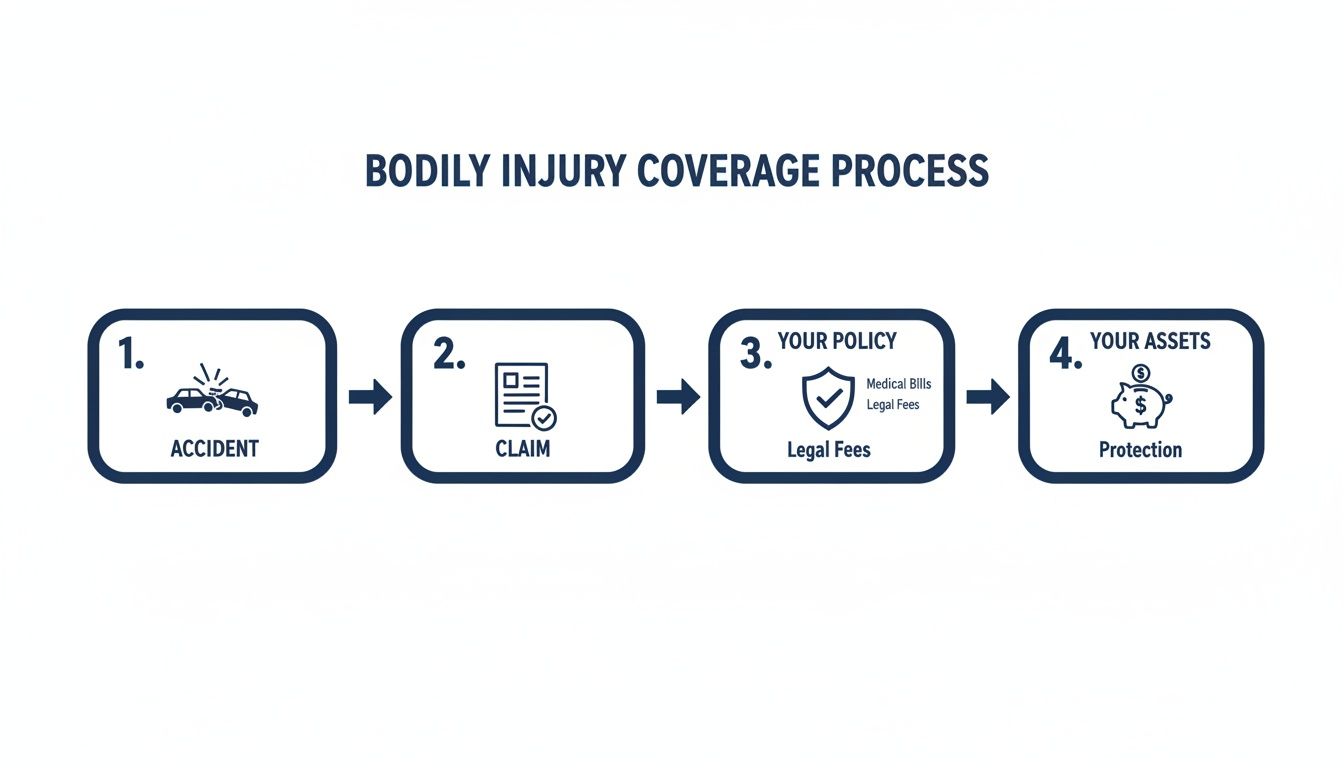
The infographic perfectly shows the flow: an accident triggers a claim, your policy handles it, and your personal assets stay safe.
How Florida’s Laws Influence the Claim
Florida has a rule called “modified comparative negligence.” What this means is that fault isn’t always 100% on one person. If you are found to be more than 50% at fault for an accident, you cannot recover any damages from the other party. If you are 50% or less at fault, your recovery is reduced by your percentage of fault. For example, if the other driver was speeding while you made an improper lane change and they were found 20% at fault, any money they receive from your policy would be reduced by that 20%. Your insurance adjuster will argue these points to keep the payout as low as possible.
It’s also critical to understand how BI works with other insurance. In Florida, an injured person must first go through their own Personal Injury Protection (PIP) coverage before they can make a claim against your BI policy for certain expenses. To get the full picture on this initial layer of coverage, check out our guide on what PIP insurance is in Florida.
Your insurer’s job is to handle all the negotiations and legal heavy lifting. You shouldn’t have to speak with the other driver’s lawyer or argue over medical bills. Your insurance company manages the entire stressful, complex process for you.
In the end, your provider’s goal is to settle the claim with the injured party. If they reach a fair agreement, your insurer pays the settlement, and the case is closed. As long as that settlement amount is within your BI policy limits, you won’t have to pay a dime. This whole process shows you exactly what Bodily Injury liability coverage is: a service that not only pays for damages but also manages the entire messy ordeal on your behalf.
The Dangerous Gap in Florida’s Minimum Requirements
A lot of Florida drivers get behind the wheel thinking their state-required auto insurance has them fully covered. It’s a common, and dangerous, mistake. The hard truth is that Florida’s laws leave a massive gap in protection for everyone on the road.
Here’s the shocker: Unlike almost every other state, Florida does not make every driver carry bodily injury (BI) liability coverage.
Most people are surprised to learn this. While you absolutely must have Personal Injury Protection (PIP) and Property Damage (PD) liability, BI coverage is only legally mandated in specific cases. For example, you might be forced to buy it after a DUI conviction or if you’re found at-fault for a crash that injures someone.
This unique setup means a startling number of drivers on our roads have absolutely no insurance to pay for the injuries they cause. It’s a huge risk for us all.
Why the State Minimums Are Barely a Band-Aid
Even for drivers who do have BI coverage, either by choice or by law, Florida’s minimum limits are alarmingly low. The standard minimum is just $10,000 per person and $20,000 per accident.
Those numbers might not sound too bad on paper, but when you apply them to a real-world crash, they disappear in the blink of an eye.
The real danger kicks in the moment injury costs blow past those minimal limits. From that point on, the at-fault driver is on the hook personally for every remaining dollar. This puts their savings, their home, and their future income at risk of being seized through a lawsuit.
Think about a typical collision on a Tampa expressway that sends the other driver to the hospital for surgery. Just one night in the hospital, plus the surgeon’s bill and a few weeks of physical therapy, can easily soar past that $10,000 limit. Once your policy pays out that amount, your insurance company walks away. But the bills don’t stop—and now they’re coming straight to you.
How a $10,000 Policy Vanishes in an Instant
Let’s look at just how fast a minimum BI policy gets eaten up. Imagine a simple rear-end collision where the victim ends up with whiplash and a herniated disc—an incredibly common outcome.
The immediate bills could easily look like this:
- Ambulance Ride: $800 – $1,500
- Emergency Room Visit (with scans like an MRI or CT): $5,000 – $10,000+
- First Visit with a Specialist (like an Orthopedist): $500 – $1,000
These first few steps alone can burn through an entire $10,000 policy. And that’s before you even get to the big-ticket items like surgery, ongoing physical therapy, prescriptions, or the income they lost because they couldn’t work.
Once that $10,000 is paid, you are personally liable for the rest. If the total bill hits $50,000, you could be facing a $40,000 debt. If it reaches $150,000, you owe $140,000. This is exactly how one bad day on the road can lead to financial ruin for a family.

The Sobering Statistics
This isn’t just a “what if” scenario; it’s a statistical reality. While Florida’s $10,000 minimum feels like some sort of safety net, real accident data shows just how exposed it leaves you. Today, the average bodily injury claim costs over $24,000. With claim severity recently jumping significantly, that figure is only climbing.
What does that mean for you? Even an “average” crash could leave a minimally insured driver personally responsible for over $14,000 out of their own pocket. You can explore more about these rising costs and auto insurance trends to see the full picture.
The data confirms a critical truth: relying on Florida’s minimum BI coverage isn’t a protection strategy—it’s a financial gamble. For real peace of mind, drivers have to look past what’s legally required and get the coverage that’s financially necessary to protect their future. That gap can mean the difference between a manageable setback and complete financial devastation.
Choosing the Right Coverage Limits to Protect Your Assets
Now that you’ve seen just how fast a minimum policy can get wiped out, the big question is: how much coverage do you actually need? Deciding on your bodily injury liability limits is one of the most critical financial decisions you’ll make as a driver. This isn’t just about finding the cheapest premium; it’s about strategically protecting everything you’ve worked for from being taken in a lawsuit.
Think of higher limits as a stronger fortress around your financial life. A minimal policy is like a flimsy picket fence—easily knocked down by a serious injury claim. A solid policy, on the other hand, is a stone wall, built to withstand the immense financial pressure that follows a severe crash.
Decoding Your Policy Numbers
When you look at your insurance options, you’ll see pairs of numbers like “10/20,” “100/300,” or “250/500.” They might look like code, but the concept is actually pretty simple.
- The First Number (Per-Person Limit): This is the absolute maximum your insurance company will pay for a single person’s injuries in an accident you cause.
- The Second Number (Per-Accident Limit): This is the maximum total your insurer will pay for all injuries combined in that one accident, no matter how many people were hurt.
Let’s break it down with a $100,000/$300,000 (or “100/300”) policy:
- Your insurer will cover up to $100,000 for any one person’s medical bills, pain, and suffering.
- The total payout for that entire crash won’t go above $300,000, even if you injured four people with significant medical needs.
This structure is exactly why a high per-accident limit is just as vital as the per-person limit, especially with the multi-car pileups we often see on Tampa-area highways.
Practical Recommendations for Florida Drivers
Florida’s minimum requirements are frighteningly low. For anyone driving responsibly, carrying just the state minimum is a massive financial gamble.
A much safer starting point for the average Florida driver is a BI liability policy of at least $100,000 per person and $300,000 per accident (100/300). This amount provides a real buffer against the vast majority of injury claims, protecting your savings and income from being garnished in a lawsuit.
If you have more to protect—like a home, investments, or a good-paying job—upgrading to $250,000/$500,000 is a smart move. You’d be surprised how small the monthly premium increase often is for such a huge jump in protection. And while we’re focused on standard cars, remember that special vehicles often have unique classic car insurance requirements that deserve a separate look.
Choosing higher limits is an act of financial self-defense. You are proactively shielding your family’s future from the devastating consequences of one bad moment on the road.
When You Need an Umbrella Policy
For some people, even a 250/500 policy isn’t enough. If you have significant assets—maybe you own a business, are a professional with high future earning potential, or have a sizable investment portfolio—you need another layer of protection. This is where an umbrella policy comes into play.
An umbrella policy is secondary insurance that kicks in only after your main auto or homeowners policy has been completely maxed out. These policies are usually sold in increments of $1 million and provide an enormous safety net for a relatively low price.
Imagine you cause a catastrophic accident resulting in $800,000 in damages. If your BI limit is $300,000, your umbrella policy would cover the remaining $500,000. The premium for this extra peace of mind is often a factor in the average full coverage car insurance cost for drivers seeking maximum security. At the end of the day, your choice of limits must be based on a realistic look at your financial life, ensuring you have enough coverage to secure your assets and your future.
What Happens When an At-Fault Driver Has No or Low Coverage
We’ve talked a lot about how bodily injury liability protects you when you’re at fault. But let’s flip the script for a moment. Picture yourself driving down a busy Tampa road when another driver runs a red light and T-bones you. It’s clearly their fault. What happens if their insurance is non-existent, or worse, just the bare-bones minimum Florida requires?

This is a nightmare scenario that plays out far too often. You’re left with serious injuries and a mountain of medical debt, only to find out the person who caused it all has no way to pay for the damage they’ve done. This is where a different kind of coverage becomes your personal safety net.
Your Lifeline: Uninsured and Underinsured Motorist Coverage
When the other driver can’t cover your costs, Uninsured/Underinsured Motorist (UM/UIM) coverage is designed to step in. This is coverage you purchase on your own policy, specifically to protect yourself from irresponsible drivers on the road. It’s not for them; it’s for you.
Think of it this way: your UM/UIM coverage essentially stands in for the bodily injury liability insurance the other driver should have had. It pays for the same things their policy would have, like your medical bills, lost wages, and pain and suffering.
In a state like Florida, which consistently has one of the highest rates of uninsured drivers in the country, having solid UM/UIM coverage isn’t a luxury. It’s an absolute necessity for protecting your financial future.
Without it, your only real option is to sue the uninsured driver directly. And while you might get a judgment in your favor, trying to collect money from someone who couldn’t afford proper insurance in the first place is usually a dead end. They simply don’t have the assets.
How a UM Claim Works in Practice
Filing a UM claim can feel a bit strange because you’re essentially making a claim against your own insurance company for an accident that someone else caused. It kicks in under two main circumstances:
- The Uninsured Motorist (UM) Claim: This is for when the at-fault driver has zero bodily injury liability coverage. Your UM policy steps up to cover your damages, right up to the limits you chose.
- The Underinsured Motorist (UIM) Claim: This applies when the at-fault driver has BI coverage, but their policy limits are too low to cover all your damages. For example, if your medical bills hit $80,000 but they only have a $10,000 BI policy, your UIM coverage can bridge that $70,000 gap.
This is exactly why picking high UM/UIM limits is just as critical as choosing your BI limits. You are literally deciding the level of protection you want for yourself and your family if you become the victim. The process can get complicated, so it’s good to know the details. To get a better handle on it, you can learn more about how uninsured motorist coverage in Florida works to protect you.
At the end of the day, you can’t control another driver’s decisions about their insurance. But you can absolutely control your own. By adding strong UM/UIM protection to your policy, you’re building a financial shield that keeps you safe from other people’s negligence, ensuring you have a path to recovery no matter who hits you.
When to Contact a Tampa Car Accident Attorney
Trying to piece your life back together after a car crash is chaotic enough without having to fight an insurance company. You might think their job is to help, but the reality is they’re in business to make a profit. Their goal is to protect their own bottom line, which often comes at the expense of your financial well-being.
That’s why understanding when to call for legal backup is so important.
Not every little parking lot tap requires a lawyer. But when the crash is serious and leaves you with real injuries, medical bills, and uncertainty, it’s time to get an expert in your corner. If you’ve been seriously hurt or, tragically, lost a family member, a skilled attorney can step in immediately to safeguard your rights.
When the Stakes Are Too High to Go It Alone
The insurance claims process is a maze by design. Insurers use confusing jargon and high-pressure tactics to push you into accepting a fast, lowball settlement. They want you to sign on the dotted line before you even know how much your recovery will truly cost.
These are the red flags that mean you should call a lawyer, no questions asked:
- You’ve suffered serious injuries. Things like broken bones, back or neck trauma, or a traumatic brain injury mean you’re facing a long, expensive road to recovery. An insurer’s first offer will almost never be enough.
- The insurance adjuster offers a quick, cheap settlement. This is a classic move. They dangle a small amount of cash, hoping you’ll take it before you realize you’ll need months of physical therapy or can’t return to work.
- The other driver is trying to pin the blame on you. If they’re twisting the facts and their insurance company is trying to assign you fault, you need someone to fight back with evidence and prove what really happened.
- You’re forced to file an uninsured/underinsured (UM/UIM) claim. It’s shocking, but even your own insurance company can become an adversary when you need to use your UM/UIM coverage. They’ll look for ways to pay as little as possible.
The Value of Experienced Legal Representation
Hiring a seasoned Tampa personal injury firm like Martin Hernandez, P.A. completely changes the dynamic. We don’t just make phone calls; we bring in accident investigators and medical experts to build a rock-solid case that shows exactly what you’ve lost.
We dig deep to calculate every single damage—from the emergency room bills you have now to the wages you’ll lose in the future, plus the very real cost of your pain and suffering.
We prepare every single case as if it’s headed for the courtroom. That aggressive stance lets the insurance giants know we won’t be bullied into accepting a lowball offer.
Best of all, we work on a contingency fee basis. Simply put, you don’t pay us a dime unless we win your case. This ensures everyone has access to top-tier legal help, no matter their financial situation. For a deeper dive, you can learn more about when to hire a car accident attorney on our site. When a crash turns your world upside down, you shouldn’t have to fight that battle alone.
Got Questions About Bodily Injury Liability? We Have Answers.
Car insurance can feel like a maze of confusing terms. Let’s clear up some of the most common questions Florida drivers have about Bodily Injury Liability coverage so you can feel confident you’re protected.
What’s the Difference Between Bodily Injury Liability and Personal Injury Protection?
This is a big one in Florida. Think of it this way: Personal Injury Protection (PIP) is for you and your passengers. It pays for your initial medical bills no matter who was at fault, which is why Florida is called a “no-fault” state.
Bodily Injury (BI) Liability is the exact opposite. It’s for the other person when you are the one who caused the crash. It covers their medical bills, lost wages, and pain and suffering.
Does My BI Liability Cover My Own Injuries?
No, it never does. This is a common point of confusion, but the answer is a firm no. Bodily Injury Liability only pays for injuries you cause to someone else.
Your own injuries after an accident you caused would fall under your own PIP coverage and your personal health insurance.
Key Takeaway: BI Liability is your financial shield. It protects your personal assets when someone else makes a claim against you. It’s not for your own medical care.
I Have Good Health Insurance. Do I Still Need High BI Limits?
Yes, and this is critically important. Your health insurance has absolutely no power to cover the other driver’s lost income, their long-term pain and suffering, or other damages that go beyond medical treatment.
A serious car accident lawsuit will absolutely seek compensation for those non-medical losses. Only your Bodily Injury Liability coverage stands between that lawsuit and your personal savings, home, and future earnings.
Can My Paycheck Really Be Garnished After an Accident?
Unfortunately, yes. If you cause a crash and the other driver’s damages are more than your BI policy limits, they can sue you directly for the difference.
If they win that lawsuit, a judge can issue an order to garnish your wages or seize your assets to pay off the debt. This is precisely why just carrying the minimum state-required coverage can be a huge financial gamble.
If you’ve been hurt in a crash and the insurance company is giving you the runaround, you don’t have to take them on by yourself. The experienced team at Martin Hernandez, P.A. knows their tactics and is ready to fight for the full compensation you deserve. Contact us today for a free, no-pressure consultation at https://injurylawyersoftampa.com.