
When you’re dealing with the aftermath of a car accident, the last thing you want to worry about is how you’re going to pay for your medical care. In Florida, Med Pay is an optional type of auto insurance that acts as a financial safety net for precisely these situations.
The key thing to understand is that it’s no-fault coverage. That means it helps pay for necessary medical expenses for you and your passengers, no matter who was to blame for the crash.
Your Quick Guide to Med Pay in Florida

Imagine you’ve just been in a wreck on Tampa’s Dale Mabry Highway. On top of the physical pain and stress, medical bills start arriving. While every Florida driver has to carry Personal Injury Protection (PIP) insurance, most people are surprised to learn about its limits. This is exactly where Medical Payments coverage, or Med Pay, proves its worth.
Think of Med Pay as a first-aid kit for your wallet. Its main job is to fill the financial gaps left behind by your other insurance, giving you immediate access to funds for your accident-related medical treatment.
How Med Pay Protects You Financially
Med Pay is built for speed and simplicity. It’s designed to cover a range of costs that pop up right after an accident, giving you a layer of financial security when you’re most vulnerable.
Here’s what makes it so helpful:
- No-Fault Payments: It pays your medical bills right away. You don’t have to wait for the insurance companies to argue and decide who was at fault.
- Passenger Protection: Your coverage also protects any passengers in your car who were injured in the accident.
- Gap Coverage: It’s perfect for paying the 20% of medical bills that Florida PIP won’t cover, and it can also cover expenses that go beyond your PIP limit.
Med Pay is the immediate answer to the financial crunch that follows a car accident. It helps ensure you get the care you need without delay by taking care of copays, deductibles, and other out-of-pocket costs.
Let’s look at a real-world example. Say you have a $5,000 emergency room bill after a crash. Your mandatory PIP coverage only pays for 80%, which is $4,000. Without Med Pay, you’d be stuck with the remaining $1,000 bill. With Med Pay, it steps in to cover that difference for you.
This no-fault add-on handles these costs for you and your passengers, regardless of who caused the collision. Policy limits typically range from $1,000 to $5,000 per person, though you can often purchase higher amounts. It kicks in quickly for things like ER visits, X-rays, and even funeral costs, usually without any deductibles or copays. If you’d like to get more information, you can find some great additional insights about MedPay coverage.
How Med Pay Fills Critical Gaps in Your Policy
Think of your required Florida PIP coverage as your first line of defense after a crash. It’s a $10,000 fund meant to cover your initial medical costs. But here’s the catch—it’s not a complete shield. PIP only pays for 80% of your medical bills, leaving you on the hook for the rest. Once that $10,000 is gone, you’re responsible for everything else.
This is exactly where Med Pay steps in. It’s designed to fill that 20% gap left by PIP. Even better, it acts as a secondary reserve of funds, kicking in after your PIP benefits are maxed out. It’s the backup plan that prevents a mountain of medical bills from landing on your doorstep.
What Exactly Does Med Pay Cover?
At its core, Med Pay is there to handle reasonable and necessary medical and funeral expenses from a car accident, no matter who was at fault. This coverage is refreshingly broad and gives you immediate access to funds when you need them most.
For instance, Med Pay can be used to pay for:
- Emergency Medical Services: Think ambulance rides from the scene and that initial, critical ER visit.
- Hospital and Doctor Visits: This covers hospital stays, specialist appointments, and follow-ups with your family doctor.
- Rehabilitative Care: The costs for things like physical therapy or chiropractic treatments needed for your recovery are often included.
- Other Medical Needs: It can also cover dental work for crash-related injuries, X-rays or MRIs, and even prosthetics.
- Funeral Expenses: In the tragic event of a fatality, Med Pay provides benefits to help a family with funeral costs.
The flexibility here is a huge advantage. If you have a health insurance plan with a high deductible, you can use your Med Pay benefits to cover it, ensuring you get the care you need without a massive out-of-pocket hit.
Coverage That Follows You
One of the best things about what is Med Pay insurance coverage is that it’s personal. It’s not just tied to your car; it’s tied to you. This means you and your resident family members are protected in a variety of situations.
You’re covered if you’re injured:
- While riding as a passenger in a friend’s car.
- As a pedestrian who is hit by a vehicle.
- While cycling and being struck by a car.
Med Pay is your personal accident-related medical coverage. It protects you and your family not just as drivers or passengers in your own car, but as people moving through the world.
This comprehensive protection is what makes Med Pay so valuable in Florida. Med Pay is built to bridge the exact financial gap from medical bills, paying for hospital stays and surgeries directly without waiting on a fault determination.
As industry leaders like State Farm note, a common $5,000 limit is often enough to handle these initial, high-stress costs and provide some much-needed peace of mind.
Understanding Med Pay vs. PIP in Florida
Here in Florida, every driver is required to carry Personal Injury Protection (PIP) as part of our no-fault insurance system. While PIP is the law, Med Pay is a smart, optional add-on that can make a huge difference after a crash. It’s really important to understand how these two coverages work, both separately and together.
Think of them as two layers of protection. Both are “no-fault,” which means you can use them no matter who caused the accident. But that’s where the similarities end. PIP is your first line of defense, but it has some serious gaps.
How PIP and Med Pay Work Together
Florida law mandates that every driver has at least $10,000 in PIP coverage. But here’s the catch a lot of people miss: PIP only pays for 80% of your “reasonable” medical bills and 60% of any lost wages, up to that $10,000 limit. That leaves a pretty significant chunk of the bill that you’re on the hook for.
This is exactly why adding Med Pay to your policy is such a strategic move. Med Pay is designed to step in and handle that 20% of medical costs that PIP leaves behind. It can also kick in to cover medical expenses after you’ve completely used up your PIP benefits. For a complete breakdown of the mandatory coverage, take a look at our guide on what Personal Injury Protection (PIP) insurance covers.
A Real-World Tampa Accident Example
Let’s walk through a situation we see all the time. Say you’re in a wreck on I-275 and your initial emergency room visit leaves you with a $12,500 bill.
Here’s how the insurance would likely play out:
- PIP Pays First: Your required PIP coverage is the first to respond. It will pay 80% of your medical bills until it hits its $10,000 ceiling. In this case, your PIP pays out the full $10,000.
- The Remaining Bill: You still have a $2,500 balance that the hospital will now bill you for directly.
- Med Pay Fills the Gap: This is where your foresight pays off. If you have a $5,000 Med Pay policy, it steps right in to cover that remaining $2,500.
Without Med Pay, that $2,500 bill would have been your problem. With Med Pay, your out-of-pocket medical cost for this incident is zero.
Med Pay acts as a crucial secondary layer of protection. It works directly with your PIP coverage to create a more complete financial safety net, ensuring medical bills don’t become an immediate financial burden while you recover.
It’s this coordinated teamwork that makes Med Pay such a valuable piece of any Florida auto policy. It brings peace of mind when you need it the most, letting you focus on getting better instead of stressing over how you’re going to pay for your care.
How Med Pay Works with Your Health Insurance and UM Coverage
After a serious car wreck, the last thing you want to do is juggle a bunch of different insurance policies. But when you have Med Pay, health insurance, and Uninsured Motorist coverage, figuring out how they work together is a huge strategic advantage. It can literally save you from financial disaster.
Think of these policies as players on a team, each with a specific job. When you use them correctly, they create a powerful financial safety net. Med Pay is often the quick, flexible player that steps in to cover the gaps the others leave behind.
The flowchart below breaks down the basic differences between Florida’s required PIP coverage and the optional Med Pay you can add.
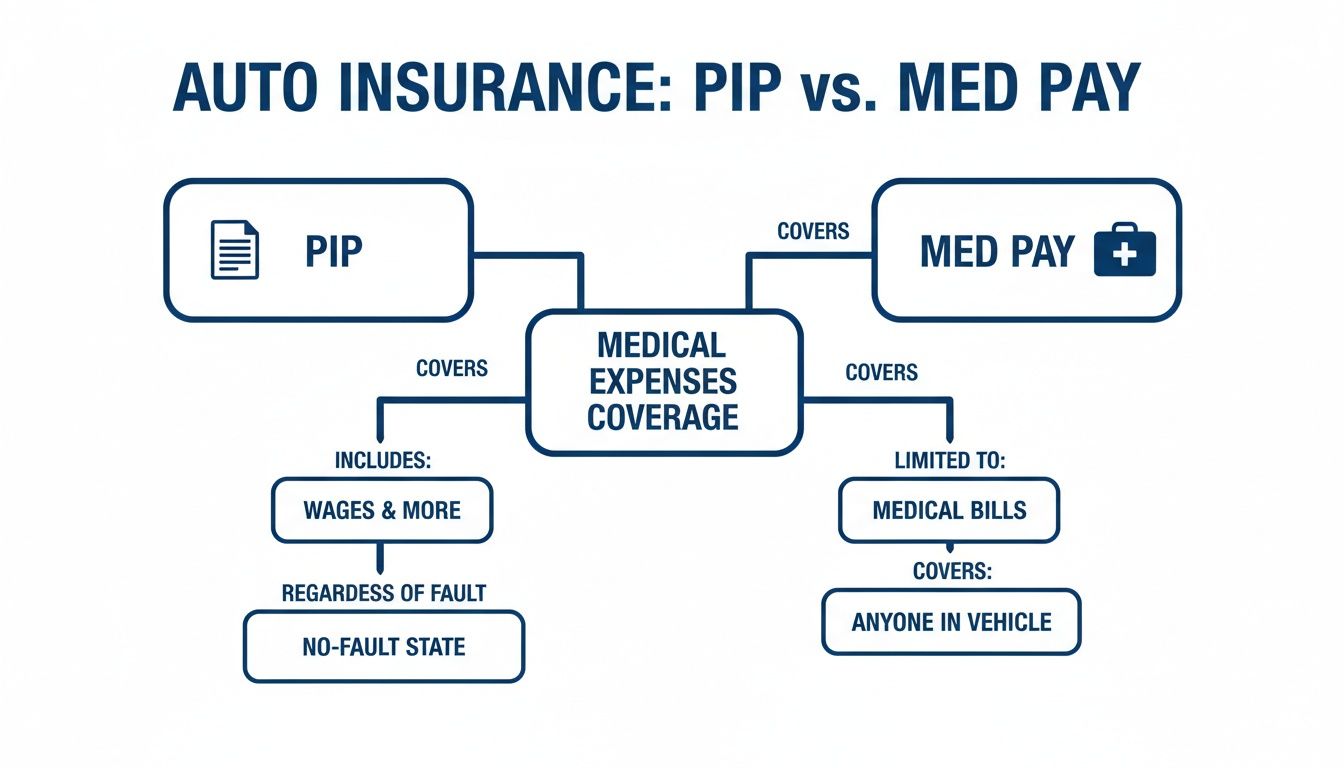
As you can see, PIP is mandatory and covers more than just medical bills. Med Pay is a focused, optional supplement specifically for those medical costs.
Using Med Pay to Handle Immediate Bills
One of the best things about Med Pay is how it can bridge the gap with your regular health insurance. Let’s say you have a high-deductible plan. You could be on the hook for thousands of dollars before your health insurance even starts paying a dime.
This is where Med Pay shines. You can use it to pay that deductible directly. It can also be used for those annoying copayments and other out-of-pocket expenses your health insurance won’t touch. In short, it lets you get the medical attention you need, right away, without worrying about the upfront cost.
Using Med Pay to cover your health insurance deductible and copays often means you can get extensive medical treatment with zero immediate cost out of your own pocket. This removes the financial stress so you can focus on getting better.
Med Pay can also be a lifesaver for specific treatments that your health plan might not cover well. Think about things like chiropractic care, which is incredibly common and helpful after a whiplash injury from a rear-end collision. Med Pay often fills these kinds of gaps, preventing you from getting stuck with significant medical debt after an accident.
Saving Your Uninsured Motorist Coverage for When It Counts
This strategy is absolutely critical if the person who hit you has little or no insurance. Your Uninsured/Underinsured Motorist (UM) coverage is one of the most important parts of your policy, designed to cover major damages when the at-fault driver can’t pay. You can learn more about its role in our complete guide on what is Uninsured Motorist coverage.
Here’s the key: you want to save your UM coverage for the really big, life-altering damages that Med Pay and health insurance simply won’t cover. We’re talking about things like:
- Future medical care and long-term treatments
- Lost future income if you can no longer do your job
- Permanent disability or scarring
- Pain and suffering
By using your Med Pay to handle the initial ER visit, follow-up appointments, and therapy, you keep your valuable UM policy untouched. This leaves the full amount of your UM coverage available to compensate you for the most severe consequences of the crash, providing true long-term financial security for you and your family.
Filing a Med Pay Claim After a Florida Car Accident
Having MedPay coverage on your policy is one thing; knowing how to actually use it when you need it most is another. After the chaos of a car accident, navigating the claims process can feel overwhelming, but a few straightforward steps can make all the difference. Remember, your first and most important priority is always your health.
Even if you feel okay after a crash, get checked out by a doctor right away. The adrenaline rush can easily hide serious injuries, and that initial medical report is crucial. It officially connects your injuries to the accident, which is the foundation of any insurance claim you’ll file.
Your Step-by-Step Guide to the Med Pay Claim
Once your immediate medical needs are handled, it’s time to get the ball rolling on your claim. The sooner you act, the better. Quick and thorough documentation shows the insurance company you’re serious and helps avoid unnecessary delays.
Here’s exactly what you need to do:
- Notify Your Insurer: Call your own insurance company as soon as you can. Be specific—tell them you need to open both a PIP claim and a Med Pay claim.
- Gather Key Documents: Your adjuster will need evidence to process your claim. Start collecting every medical bill, the official police report, and any receipts for things you paid for out-of-pocket, like prescriptions or crutches.
- Submit All Paperwork: Make copies of everything and send them to the adjuster handling your case. Always, always keep the original documents for your own files.
The secret to a less stressful claims process is simple: stay organized. Keep a physical or digital folder with every single bill, report, and email related to your accident. This paperwork is your power when dealing with the insurance company.
Handling Common Insurance Company Tactics
It’s a frustrating reality, but even when you’re dealing with your own insurance company, you can hit a wall. Insurers are in the business of making money, and that sometimes means they’ll delay, question, or deny valid claims to protect their profits. You might hear them question if a treatment was “reasonable and necessary” or find that payments are taking forever to arrive.
This is exactly why that folder of documents is so vital. If an adjuster disputes a bill, your organized records are the proof you need to fight back effectively. For a full rundown of what to do right after a wreck, take a look at our guide on the most important steps to take after a car accident.
It’s also helpful to know that many insurers now use automated claims processing systems to speed things up, which makes submitting accurate and complete information more important than ever.
Why You Should Consider a Tampa Car Accident Attorney
Even when you have coverages like MedPay and PIP, the aftermath of a car crash is almost never straightforward. Trying to juggle insurance claims on your own can feel like a second job, pulling your focus away from what’s most important: getting better. This is exactly why bringing a skilled personal injury attorney onto your team is such a critical step.
Think of an experienced lawyer as your personal advocate. Their job is to make sure all your different insurance policies—from your own PIP and MedPay to the at-fault driver’s liability coverage—work together to get you the best possible financial outcome. They take over the endless phone calls and mountains of paperwork, giving you the space you need to heal.
Protecting Your Right to Fair Compensation
Let’s be honest: insurance companies are in business to make money, which often means paying out as little as possible. A good attorney knows this and is prepared to fight back against unfair claim denials or lowball settlement offers that don’t come close to covering your real-world expenses.
Your lawyer understands the playbook insurers use and knows exactly how to build a powerful case with solid evidence and sharp legal arguments. They will track down every potential source of compensation. This frequently involves filing a lawsuit against the negligent driver to recover damages that your own policies, like MedPay and PIP, simply can’t cover—most notably, your pain and suffering.
Ultimately, hiring an attorney levels the playing field. It sends a clear message to the insurance company that you are serious about receiving the full compensation you deserve for your injuries, losses, and emotional distress.
They carry the complex legal and financial weight of the situation so you can focus your energy where it belongs: on your physical and emotional recovery. For a deeper dive, check out our guide on getting a lawyer after a car accident.
Florida MedPay: Your Questions Answered
When you’re trying to figure out car insurance, the details can get a little fuzzy. Let’s clear up some of the most common questions Florida drivers have about Medical Payments coverage so you can feel confident about your policy.
Is MedPay Required in Florida?
Nope, it’s not. Florida law requires every driver to carry Personal Injury Protection (PIP), but MedPay is an optional add-on. Think of it as an extra financial cushion for medical bills that can really save the day after an accident.
Can I Use MedPay if the Accident Was My Fault?
Yes, absolutely. Just like PIP, MedPay is a “no-fault” coverage. That means it doesn’t matter who caused the crash; your MedPay benefits are there to cover your necessary medical treatments right away.
The real power of MedPay is its speed. It kicks in to pay for your medical care without waiting for the insurance companies to spend weeks or months arguing over who’s to blame.
Does MedPay Cover Lost Wages?
This is a common point of confusion. MedPay is strictly for medical bills and, in the worst-case scenario, funeral expenses. It doesn’t touch lost income.
For lost wages, you’ll look to your mandatory PIP coverage. PIP is designed to cover a portion of your lost income (up to 60%) if your injuries keep you out of work.
How Much MedPay Coverage Should I Buy?
There’s no single magic number; it really comes down to your personal finances and health insurance situation. A smart way to think about it is to match your MedPay limit to your health insurance deductible.
For example, if your health plan has a $5,000 deductible, getting a $5,000 MedPay policy is a great strategy. That way, MedPay can cover your out-of-pocket costs before your health insurance even has to step in.
Even with the best coverage, insurance companies can sometimes put up a fight. If you’re getting the runaround on a claim, knowing how to fight an insurance denial is crucial for getting the benefits you’ve paid for.
If you’ve been hurt in an accident and the insurance company is giving you a hard time, you don’t have to take them on by yourself. The experienced team at Martin Hernandez, P.A. is here to stand up for your rights and fight for the compensation you’re owed. Contact us for a free, no-obligation consultation to go over your case by visiting https://injurylawyersoftampa.com.