
TL;DR:
- Negligence is the failure to exercise reasonable care that causes harm to another person and forms the basis of most injury claims.
- Proving negligence requires establishing duty, breach, causation, and damages, with fault rules varying by state.
Negligence in accidents is defined as the failure to exercise reasonable care that directly causes harm to another person. This legal concept forms the foundation of nearly every personal injury claim filed in the United States. If you’re reading this after a crash or an injury caused by someone else’s carelessness, understanding negligence is the first step toward knowing whether you have a valid claim. The law does not require the other party to have intended harm. It only requires proof that they failed to act as a reasonably careful person would, and that failure hurt you.
What is negligence in accidents and why does it matter legally?
Negligence is the legal bridge between someone’s careless behavior and your right to compensation. Negligence law focuses on behavior below reasonable care rather than intentional harm, which means you can file a claim even when the other driver or property owner never meant to hurt you. That distinction matters enormously. Most accidents are not malicious. They are the result of distraction, poor judgment, or failure to follow safety rules.
The legal standard courts apply is called the “reasonable person” standard. A judge or jury asks what a hypothetical, ordinarily careful person would have done in the same situation. If the defendant fell short of that standard, the law treats their behavior as a breach of duty. This objective test prevents defendants from excusing reckless behavior by claiming they thought they were being careful.
What are the four elements required to prove negligence?
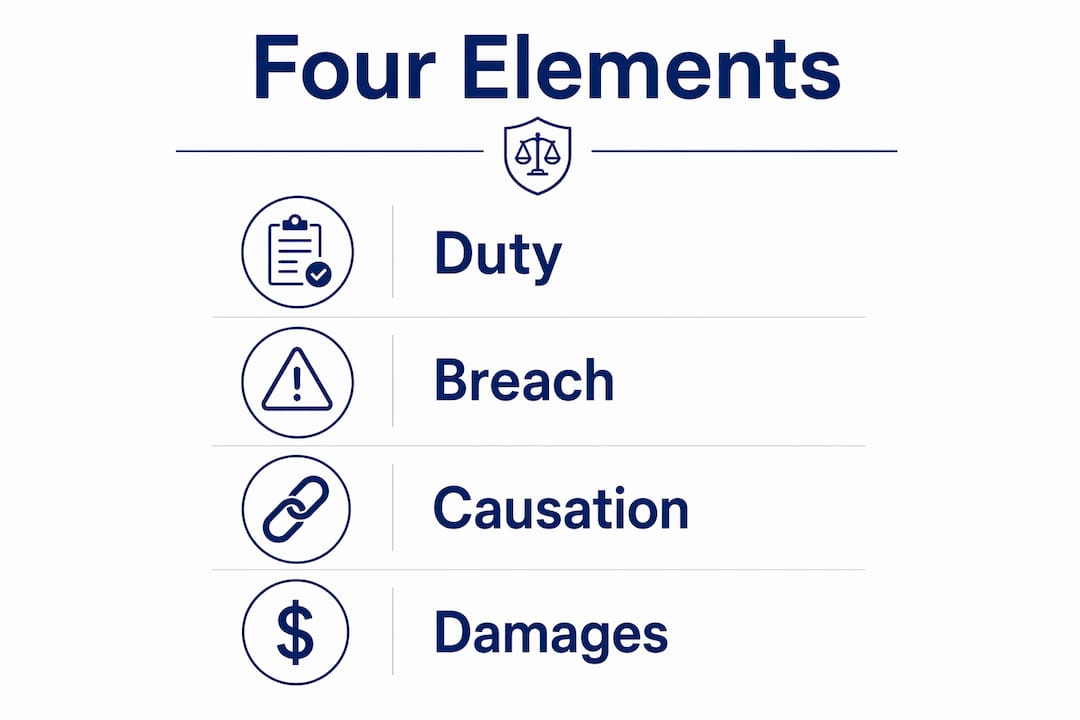
Proving negligence requires establishing four distinct elements: duty, breach, causation, and damages. Every element must be proven. Failing to establish even one of them ends the claim before it reaches trial.

1. Duty of care
Duty of care is the legal obligation to act reasonably toward others in a given situation. Every driver on the road owes a duty of care to other drivers, passengers, and pedestrians. A property owner owes a duty to keep their premises reasonably safe for visitors. This duty exists automatically in most accident scenarios. You do not need to prove it was agreed upon.
2. Breach of duty
Breach occurs when the defendant’s behavior falls below the reasonable person standard. The reasonable person standard is objective and does not depend on the defendant’s actual thoughts or intentions. A driver who runs a red light has breached their duty, regardless of whether they were distracted or simply in a hurry. Courts measure conduct against what a careful, ordinary person would have done.
3. Causation
Causation has two parts: actual cause and proximate cause. Actual cause means the breach directly produced the injury. Proximate cause means the injury was a foreseeable result of the breach. If a driver rear-ends you because they were texting, both parts are satisfied. The texting caused the crash (actual cause), and a crash is a foreseeable result of distracted driving (proximate cause).
4. Damages
Damages are the measurable losses you suffered because of the injury. These include medical bills, lost wages, property damage, and pain and suffering. Without provable damages, there is no claim. Even if someone clearly breached their duty and caused an accident, you cannot recover compensation if you suffered no real harm.
Pro Tip: Document every expense and symptom from day one. Medical records, accident reports, and expert testimony are the backbone of any negligence claim, and gaps in documentation are one of the most common reasons claims fail.
How do negligence rules determine fault and compensation?
Not all states handle fault the same way. The rule your state follows can be the difference between recovering full compensation and recovering nothing at all.
Five U.S. jurisdictions apply contributory negligence, the strictest standard in American law. Those jurisdictions are Alabama, Maryland, North Carolina, Virginia, and Washington, D.C. Under this rule, if you are even 1% at fault for the accident, you are completely barred from recovering any damages. Defense attorneys in these states work aggressively to pin even minimal fault on the plaintiff, because any finding of fault destroys the claim entirely.
The majority of states use comparative negligence systems, which treat fault proportionally. There are three main versions:
- Pure comparative negligence: You can recover damages no matter how high your fault percentage is. If you are 80% at fault and your damages total $100,000, you still recover $20,000. Florida follows this rule.
- Modified comparative negligence (51% bar): You can recover only if your fault is 50% or less. At 51% or higher, recovery is barred entirely.
- Modified comparative negligence (50% bar): You can recover only if your fault is strictly less than 50%. Being exactly 50% at fault bars recovery in these states.
- Slight vs. gross negligence: A small number of states use this older framework, which compares the degree of carelessness rather than assigning percentages.
Think of fault allocation like a dial. Reducing your fault percentage even slightly can significantly increase the compensation you receive. A shift from 40% fault to 20% fault on a $200,000 claim means $40,000 more in your pocket. That is why fault determination is one of the most contested parts of any personal injury case.
Pro Tip: In states with modified comparative negligence, the 50% or 51% threshold is the critical line. If the defense can push your fault above that threshold, you walk away with nothing. An experienced attorney fights to keep that number low.
What are the common types of negligence in accidents?
Negligence takes many forms, and recognizing the type involved in your accident shapes how your claim is built.
Negligent driving is the most common form in personal injury cases. Examples include distracted driving (texting, eating, adjusting the radio), speeding, running red lights, failing to yield, and driving under the influence. Each of these behaviors falls below the reasonable person standard that every driver is held to.
Premises liability involves a property owner’s failure to maintain a safe environment. A grocery store that ignores a wet floor for hours, a landlord who fails to repair broken stairs, or a business that provides inadequate lighting in a parking lot can all be held liable when someone is injured as a result.
Negligence by omission occurs when someone fails to act when they had a legal duty to do so. A lifeguard who does not respond to a drowning swimmer, or a driver who fails to signal before changing lanes, can be liable for harm caused by that inaction.
Negligence per se is a powerful legal doctrine that applies when a defendant violates a safety statute designed to protect people in the plaintiff’s situation. Running a red light that causes a collision automatically establishes breach of duty under negligence per se. The plaintiff does not need to argue about reasonable behavior. The statutory violation speaks for itself.
Understanding the elements of a negligence claim for your specific type of accident is critical, because the evidence you need to gather differs depending on which category applies.
How does negligence affect your personal injury claim?
The burden of proof in a civil negligence case rests entirely on the plaintiff. You must prove each element of negligence by a preponderance of the evidence, meaning your version of events must be more likely true than not. This is a lower bar than the criminal standard of “beyond a reasonable doubt,” but it still requires real, organized evidence.
Here is how the process typically unfolds:
- Gather evidence immediately. Photos of the scene, witness contact information, police reports, and medical records all support your claim. Each piece of evidence ties back to one of the four elements.
- Establish duty and breach. Your attorney will show that the defendant owed you a duty and that their specific conduct fell below the reasonable person standard. Traffic camera footage, cell phone records, and eyewitness accounts are common tools here.
- Prove causation with medical documentation. Doctors’ notes and expert testimony connect your injuries directly to the accident. Without this link, the defense will argue your injuries existed before the crash.
- Calculate and document all damages. Every bill, every missed workday, and every treatment record adds to the damages calculation. Courts award compensation only for losses that are proven, not estimated.
Insufficient proof on any single element can result in dismissal through a motion for summary judgment, meaning your case never reaches a jury. This is why building a complete evidentiary record from the start is not optional. It is the foundation of the entire claim.
Fault allocation also directly affects your final recovery. In comparative negligence states like Florida, the jury assigns a fault percentage to each party, and your damages are reduced by your share. If the defense successfully argues you were 30% at fault for a $100,000 claim, you receive $70,000. Every percentage point matters.
Key Takeaways
Negligence in accidents is the legal standard that connects careless behavior to compensation, and proving all four elements by a preponderance of the evidence is the only path to recovery.
| Point | Details |
|---|---|
| Four elements are required | Duty, breach, causation, and damages must all be proven or the claim fails. |
| Fault rules vary by state | Contributory negligence bars all recovery; comparative negligence reduces it proportionally. |
| Negligence per se simplifies breach | A statutory violation like running a red light automatically establishes breach of duty. |
| Evidence is the foundation | Medical records, accident reports, and expert testimony are what turn facts into compensation. |
| Fault percentage affects recovery | In comparative negligence states, every percentage point of fault reduces your final award. |
What I’ve learned about negligence after years of accident cases
After handling personal injury cases in Tampa and Hillsborough County for years, the single biggest mistake I see injured people make is assuming that being “not at fault” is obvious. It is not. The other side’s insurance company will look for any reason to assign you partial fault, because even a small percentage can reduce what they owe you, and in contributory negligence states, it eliminates the claim entirely.
The second mistake is waiting too long to document everything. People are shaken after an accident. They focus on medical care, which is right. But they forget to photograph the scene, save their medical bills, or write down what happened while it is fresh. By the time they call an attorney, critical evidence is gone.
What I tell every client is this: negligence law does not require the other party to be a bad person. It only requires proof that they failed to meet a basic standard of care. That is a legal question, not a moral one. And it is a question that evidence answers, not emotion.
Understanding how negligence applies to your specific situation is the first real step toward knowing what your claim is worth. Do not let the complexity of fault rules or legal standards stop you from asking that question.
— Martin Hernandez
How Martin Hernandez, PA approaches negligence claims
If you were hurt in a car accident, truck collision, or any incident caused by someone else’s carelessness, the legal path forward starts with understanding whether negligence applies to your case.

Martin Hernandez, PA represents injured people in Tampa and Hillsborough County on a contingency fee basis. You pay nothing unless your case is won. Every case is prepared for trial from day one, which gives clients real leverage in settlement negotiations. The firm’s staff speaks fluent Spanish, so language is never a barrier. If you want a clear, honest evaluation of your personal injury claim, reach out to Martin Hernandez, PA for a consultation. There is no cost to find out where you stand.
FAQ
What is the legal definition of negligence in accidents?
Negligence is the failure to exercise reasonable care that directly causes harm to another person. Courts measure conduct against what a hypothetical reasonable person would have done in the same situation.
What are the four elements of negligence?
The four elements are duty of care, breach of duty, causation, and damages. All four must be proven by a preponderance of the evidence for a claim to succeed.
How does comparative negligence affect my car accident claim?
Comparative negligence reduces your compensation by your percentage of fault. In Florida, which follows pure comparative negligence, you can still recover damages even if you were mostly at fault, though your award is reduced accordingly.
What is the difference between negligence and recklessness?
Negligence involves failing to meet a reasonable standard of care without necessarily knowing the risk. Recklessness involves consciously disregarding a known and substantial risk, making it a more serious legal finding that can support punitive damages.
What is negligence per se?
Negligence per se applies when a defendant violates a safety statute designed to protect people in the plaintiff’s class. That statutory violation automatically establishes breach of duty, removing the need to argue about reasonable behavior.
Recommended
- What Is Negligence In A Personal Injury Case? – Personal Injury Lawyers of Tampa
- Pure Comparative Negligence: Florida Law 2026 Guide – Personal Injury Lawyers of Tampa
- What Happens When More than One Party Is Negligent in a Car Crash or Personal Injury Accident? – Personal Injury Lawyers of Tampa
- Motorcycle Accident Liability Explained for Riders – Personal Injury Lawyers of Tampa