
TL;DR:
- Personal injury law allows victims to seek compensation for harm caused by others’ negligence or intent.
- Proving duty, breach, causation, and damages is essential, and most claims settle before trial.
Personal injury law is the branch of civil law that allows people harmed by another party’s negligence or intentional actions to seek monetary compensation. Unlike criminal law, which punishes wrongdoers on behalf of the state, personal injury law focuses entirely on making the victim whole again. The legal framework rests on four elements of negligence: duty of care, breach, causation, and damages. Understanding what is personal injury law, how it works, and what to expect from the claims process can be the difference between recovering what you deserve and walking away with far less.
What is personal injury law and how does it work?
Personal injury law is a subset of tort law, meaning it addresses civil wrongs rather than criminal offenses. When someone’s careless or intentional conduct causes you harm, tort law gives you the right to file a claim and recover compensation. The harm covered is broad. Injuries include physical damage to your body, emotional distress, reputational harm, and in some cases property loss.

The distinction from criminal law matters practically. A driver who runs a red light and hits your car may face a traffic citation from the state, but that process does nothing for your medical bills or lost wages. A personal injury claim runs separately and addresses your losses directly. Both proceedings can happen at the same time, and a criminal conviction can actually strengthen your civil case.
Personal injury law applies whether the harm was caused by negligence (carelessness) or an intentional act (assault, fraud). Negligence cases are far more common and require you to prove a specific set of legal elements before any compensation is owed.
What are the core legal principles behind personal injury law?
Every personal injury claim rests on four elements of negligence that you must prove to win your case. Miss any one of them and the claim fails, regardless of how serious your injuries are. Here is what each element means in plain terms:
- Duty of care: The defendant owed you a legal obligation to act reasonably. Drivers owe a duty to other road users. Doctors owe a duty to their patients. Property owners owe a duty to visitors.
- Breach: The defendant failed to meet that standard. Running a red light, prescribing the wrong medication, or leaving a wet floor unmarked are all examples of breach.
- Causation: The breach directly caused your injury. You must show that “but for” the defendant’s conduct, you would not have been harmed.
- Damages: You suffered actual, measurable harm. Pain alone without any financial loss or documented injury is rarely enough to sustain a claim.
Two additional legal concepts shape how claims play out in practice. Comparative fault allows a court to reduce your compensation by the percentage of fault assigned to you. If you are found 20% responsible for an accident, your recovery drops by 20%. Statutes of limitations and comparative fault rules vary by state and can bar valid claims entirely if deadlines are missed. In Florida, acting quickly is not optional.
Pro Tip: Document everything from day one. Photographs, witness names, and a written account of what happened are your first line of defense against a comparative fault argument later.
What types of personal injury cases exist?
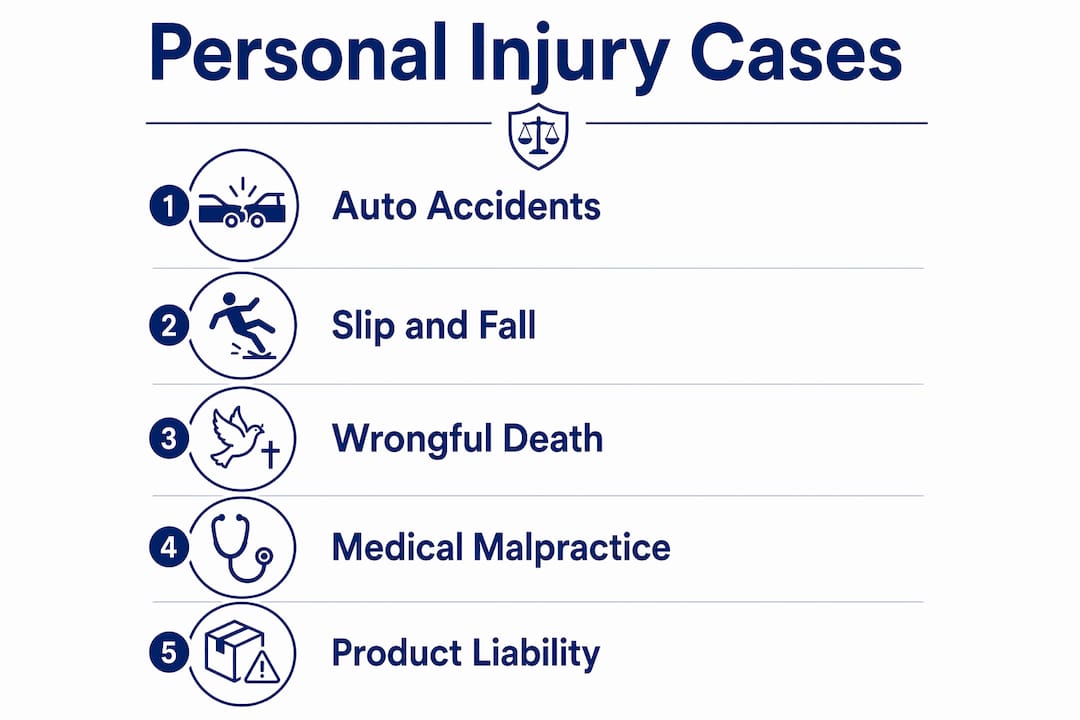
Personal injury law covers a wide range of situations. The common thread is that someone else’s conduct caused your harm. The table below outlines the most common case types, typical claim examples, and the kinds of damages usually at stake.
| Case type | Typical example | Common damages |
|---|---|---|
| Auto accident | Rear-end collision on I-275 | Medical bills, lost wages, pain and suffering |
| Slip and fall | Wet floor in a grocery store | Emergency care, rehabilitation, lost income |
| Medical malpractice | Surgical error or misdiagnosis | Future medical costs, lost earning capacity |
| Product liability | Defective car airbag | Injury treatment, property damage, punitive damages |
| Wrongful death | Fatal truck collision | Funeral costs, loss of financial support, grief |
| Defamation | False statements damaging reputation | Lost business income, emotional distress |
Auto accidents are the most common entry point into personal injury law. Slip and fall cases often hinge on whether the property owner knew about the hazard. Medical malpractice claims are among the most complex because they require expert testimony to establish the standard of care. Product liability cases shift the focus from individual negligence to a manufacturer’s design or manufacturing failure.
Wrongful death claims deserve special mention. When negligence kills someone, surviving family members can pursue compensation for both economic losses and the emotional toll of losing a loved one. Filing a wrongful death lawsuit in Florida follows specific rules about who qualifies as a claimant, and those rules are stricter than most people expect.
How does the personal injury claims process work?
The personal injury claims process follows a predictable sequence, though the timeline varies significantly by case complexity. Simple cases resolve in 6–12 months; litigated cases often take 1–3 years. That range reflects how much the process can expand when insurers dispute liability or when injuries require extended treatment.
Here are the core stages in order:
- Seek medical treatment immediately. Your health comes first, and your medical records become the foundation of your claim.
- Report the incident. File a police report for accidents. Notify the property owner for slip and fall cases. Create a paper trail from the start.
- Collect evidence. Gather photographs, witness statements, surveillance footage, and any relevant documents.
- Hire an attorney. An attorney evaluates your claim, identifies liable parties, and begins building your case.
- Reach Maximum Medical Improvement (MMI). MMI is the point at which your condition has stabilized. Settling before MMI risks losing future medical cost recovery and significantly undervalues the claim.
- Send a demand letter. Your attorney sends a formal demand to the insurer outlining your damages and the compensation requested.
- Negotiate. Insurers typically counter with a lower offer. Negotiation can resolve the case here or push it toward litigation.
- File a lawsuit. If negotiation fails, your attorney files suit and the case enters the court system.
- Discovery. Both sides exchange evidence. Plaintiff depositions typically last 3–7 hours and are central to this phase. What you say under oath directly shapes case value.
- Mediation. A neutral mediator facilitates settlement talks. About 70–80% of cases that reach mediation settle within 1–3 sessions. That statistic explains why most attorneys treat mediation as a serious strategic event, not a formality.
- Trial or final settlement. Fewer than 5% of filed cases go to a jury verdict. Those that do can result in outcomes higher or lower than pre-trial offers.
Pro Tip: Never accept an insurer’s first offer before reaching MMI. Early settlements feel like relief but often leave significant future medical costs uncovered.
How are personal injury lawyers paid?
Personal injury attorneys work on a contingency fee basis, meaning you pay nothing unless they recover money for you. Contingency fees typically range from 33% to 40% of the final recovery, with the percentage rising if the case goes to trial. That structure matters because it removes the financial barrier to hiring experienced legal representation.
The contingency fee model aligns the attorney’s financial interest directly with yours. A lawyer who earns 33% of a $100,000 settlement has every reason to fight for $200,000 instead. That incentive is built into the fee structure by design.
One detail many clients miss: attorney fees and case expenses are two separate things. Case expenses cover filing fees, expert witnesses, medical record retrieval, and deposition costs. These are often advanced by the firm and deducted from your recovery. Verify whether expenses are deducted before or after the attorney fee is calculated, because the order changes your net recovery. Ask this question before signing any fee agreement.
| Resolution stage | Typical fee percentage |
|---|---|
| Pre-suit settlement | 33% |
| Post-filing settlement | 35%–40% |
| Trial verdict | 40% |
Pro Tip: Ask your attorney for a written breakdown of how expenses are handled before your case begins. Transparency here prevents surprises at the end.
Key Takeaways
Personal injury law gives you a legal path to compensation when someone else’s negligence or intentional conduct causes you harm, but winning requires proving duty, breach, causation, and damages while meeting strict procedural deadlines.
| Point | Details |
|---|---|
| Four elements are non-negotiable | Every claim must prove duty, breach, causation, and damages to succeed. |
| Settle only after reaching MMI | Premature settlements forfeit future medical cost recovery and undervalue claims. |
| Most cases never reach trial | Fewer than 5% of filed cases go to verdict; mediation resolves most disputes. |
| Contingency fees align incentives | Attorneys earn 33%–40% of recovery, so their financial interest matches yours. |
| Deadlines can kill valid claims | Statutes of limitations and comparative fault rules vary by state and are strictly enforced. |
What I’ve learned after years of handling injury claims
After handling personal injury cases in Tampa for years, the pattern I see most often is not dramatic courtroom battles. It is people who waited too long, documented too little, or settled before their injuries fully revealed themselves.
The biggest misconception I encounter is that personal injury law is straightforward once you have a police report and a doctor’s note. The reality is that insurers have experienced adjusters and legal teams whose job is to minimize what they pay. A police report establishes facts; it does not establish value. Medical documentation, expert opinions, and a clear narrative of how your life changed are what actually move the needle.
I also see clients surprised by how much the deposition matters. What you say under oath during discovery shapes every settlement conversation that follows. Preparation is not optional. An attorney who treats your deposition as routine is not serving you well.
The contingency fee model exists for a reason. It gives ordinary people access to the same quality of legal representation that large insurers rely on every day. When I take a case, my recovery depends on yours. That is not a marketing line. It is the structure that keeps me fighting when insurers dig in.
My practical advice: contact an attorney before you speak to any insurance adjuster, including your own. Adjusters are trained to gather information that limits payouts. An attorney helps you understand what your claim is actually worth before you say a word.
— Martin Hernandez
How Martin Hernandez, PA approaches your personal injury claim
If you are trying to figure out whether you have a valid claim, or you already know you do and want someone in your corner, Martin Hernandez, PA handles personal injury cases throughout Tampa and Hillsborough County with a clear commitment: every case is prepared for trial, which means insurers take settlement negotiations seriously.

The firm handles auto accidents, truck collisions, wrongful death claims, and more, all on a contingency fee basis. You pay nothing unless your case is won. Whether you are dealing with a minor injury or a life-altering accident, understanding your options starts with a conversation. If you are wondering whether pursuing a minor injury claim is worth your time, the answer depends on the facts of your case, and Martin Hernandez, PA can help you evaluate them. The firm’s staff speaks fluent Spanish, so language is never a barrier to getting the help you need.
FAQ
What is the personal injury definition in legal terms?
Personal injury is defined as harm to a person’s body, mind, emotions, or reputation caused by another party’s negligence or intentional conduct. It is a civil law claim, separate from any criminal charges that may arise from the same incident.
How long does a personal injury lawsuit take?
Simple cases typically resolve in 6–12 months, while litigated cases often take 1–3 years depending on complexity and whether the case goes to trial.
What does a personal injury lawyer do for your case?
A personal injury lawyer investigates the incident, gathers evidence, negotiates with insurers, and represents you in court if needed. Their compensation is tied to your recovery through a contingency fee agreement.
What types of compensation can you recover in a personal injury claim?
Compensation typically covers medical expenses, lost wages, future medical costs, pain and suffering, and in some cases punitive damages when the defendant’s conduct was especially reckless.
Can you still recover compensation if you were partly at fault?
Yes, in most states including Florida, comparative fault rules allow you to recover compensation reduced by your percentage of fault. However, jurisdictional rules on comparative fault vary, and some states bar recovery entirely if you are above a certain fault threshold.
Recommended
- What Is Negligence In A Personal Injury Case? – Personal Injury Lawyers of Tampa
- Why Sue For Personal Injuries? – Personal Injury Lawyers of Tampa
- When to Hire Personal Injury Lawyer: Florida Guide – Personal Injury Lawyers of Tampa
- Why Hire a Personal Injury Attorney: Your 2026 Guide – Personal Injury Lawyers of Tampa