
Think of Personal Injury Protection (PIP) coverage as your financial first-aid kit after a car accident here in Florida. It’s a type of no-fault insurance, which means it kicks in to cover your initial medical bills and lost wages right away, no matter who was to blame for the crash. This is all about getting you immediate financial help without having to wait for a long, drawn-out fault investigation.
Your Financial First Aid Kit After a Florida Car Accident
Let’s paint a picture. You’ve just been in a fender-bender on Dale Mabry Highway. Your neck is sore, you need to see a doctor, and suddenly, the medical bills are piling up. Who pays? This is exactly where PIP comes into play. It’s designed to give you quick access to money for your most pressing needs.
Here in Florida, the law is clear: every single vehicle owner must carry a minimum of $10,000 in PIP coverage. It’s not just a good idea—it’s a mandatory part of our state’s no-fault insurance system. The entire point is to make sure that if you’re hurt in a crash, you have a direct way to pay for your initial medical care and get some help for the time you miss from work.
Why No-Fault Coverage Matters
That “no-fault” part is the real game-changer. It means you go through your own insurance company first, completely bypassing the messy, often delayed process of proving the other driver was at fault. The state created this system to cut down on lawsuits over smaller injuries and, most importantly, to get money into the hands of accident victims much faster.
This quick access to your benefits is the first critical step in your recovery. You can start getting the medical treatment you need without stressing about how you’re going to pay for it, which is huge for your physical healing. As you begin to navigate the aftermath and have frequently asked questions about auto accident care, PIP is there to handle those initial costs.
PIP coverage acts as a financial buffer, giving you breathing room to focus on your health rather than on how to pay for your first doctor’s visit or emergency room bill.
The Limits of Your First Aid Kit
Now, while PIP is an absolute necessity, it’s crucial to know its limits. Think of it as a starting point for your financial recovery, not a complete fix for serious injuries. PIP only covers a percentage of your medical bills and lost wages, and only up to your policy limit.
Once you understand what to do after a car accident in Florida, you’ll quickly see how fast those initial benefits can be used up, especially with hospital stays or ongoing therapy. This is why so many people in Tampa find they need experienced legal help to pursue the full compensation they deserve for all the costs that go far beyond what their PIP will cover.
What Your Florida PIP Benefits Actually Cover
Now that we’ve established that Personal Injury Protection (PIP) is your first line of financial defense after a crash, let’s get into the nitty-gritty of what it actually pays for. Think of your standard $10,000 PIP policy as a fund with three specific purposes: handling your medical bills, making up for some lost income, and providing a small death benefit if the unthinkable happens.
But it’s not as simple as getting a $10,000 check. The way Florida law slices up these benefits is very specific, and not understanding the rules can leave you with unexpected bills.
Breaking Down Your Medical and Disability Benefits
This is where many people get tripped up. Your PIP benefits are there to cover your immediate needs, but they don’t cover 100% of the cost. This detail is crucial.
Here’s how the math works:
- Medical Bills: PIP pays for 80% of your “reasonable and necessary” medical expenses. This covers the ambulance ride, the ER visit, follow-up appointments, physical therapy, prescriptions—pretty much any standard medical care you need because of the crash.
- Lost Wages: If your injuries keep you out of work, PIP steps in to cover 60% of your documented lost income.
Your insurance company will pay out these percentages until you’ve used up your $10,000 policy limit. So, if you get a $1,000 bill from the emergency room, PIP will cover $800 of it. You’re still on the hook for the other $200. This is exactly why other coverages, like MedPay, can be so important. You can learn more about how that works in our guide on what MedPay insurance coverage is.
In the tragic event that an accident is fatal, PIP also includes a $5,000 death benefit. This is separate from and in addition to the medical and disability benefits.
Don’t forget, the clock is ticking from the moment of the crash. Florida’s strict “14-Day Rule” means you must get initial medical treatment within two weeks. If you wait, you could lose your right to use your PIP benefits at all.
The $2,500 vs. $10,000 Problem: The EMC Rule
A major change to Florida’s PIP law created a two-tier system based on how serious your injuries are. To access your full $10,000 in PIP medical benefits, a doctor (or other qualified professional) has to officially diagnose you with an “Emergency Medical Condition” (EMC).
What happens if they don’t? Your medical benefits are automatically capped at just $2,500.
This makes that first medical evaluation after an accident absolutely critical. Getting the right diagnosis can be the difference between having the coverage you need to get better and being left with a mountain of medical debt. That initial diagnosis literally determines whether you have $2,500 or $10,000 available for your care.
Who Your PIP Policy Actually Protects
One of the biggest misunderstandings I see with Personal Injury Protection is people thinking it only covers them when they’re driving their own car. That’s just not the case. Think of your Florida PIP policy less like car insurance and more like a personal safety net that follows you around.
Knowing how far this coverage actually extends is critical to protecting your rights after a crash. It’s designed to cover you, the policyholder, not just a specific vehicle. This means your own PIP is the first line of defense for your medical bills, even if you weren’t anywhere near your own car.
Your Coverage Beyond the Driver’s Seat
The protection your PIP policy offers is surprisingly broad. It’s not just for when you’re driving; it’s a crucial safety net for many situations you might find yourself in on Florida’s busy roads.
Your policy is there to protect you if you’re injured in these common scenarios:
- As a passenger in someone else’s car. If you’re hurt while riding with a friend, it’s your own PIP that kicks in first. We often get questions about this, and you can learn more about being injured as a passenger in a car accident in our guide.
- As a bicyclist. If a car hits you while you’re cycling anywhere in Florida, your auto insurance PIP is what will cover your initial medical treatment.
- As a pedestrian. The same rule applies if a vehicle strikes you while you’re out for a walk or a jog. Your PIP benefits are there to pay for your injuries.
This wide reach is the backbone of Florida’s no-fault system. It’s set up to make sure you have immediate access to medical benefits after most kinds of traffic-related incidents, without having to first prove who was at fault.
Protecting Your Household and Passengers
Your PIP policy doesn’t just stop with you. It also provides essential protection for the people closest to you—a detail many policyholders don’t realize until they desperately need it.
For instance, if your child is hit by a distracted driver while riding their bike in your neighborhood, your auto policy’s PIP coverage will extend to their medical treatment. This provides immediate financial relief for your family during an incredibly stressful time.
A key feature of Florida PIP is its protection for resident relatives. This includes your spouse, children, and any other family members who live in your home, as long as they don’t own their own vehicle.
On top of that, your PIP can also cover certain passengers who were in your car during a crash. If a passenger doesn’t own a vehicle and isn’t covered by the PIP policy of a relative they live with, your insurance can step in to provide them with benefits. It’s another way the system ensures people have a path to getting their initial medical bills paid.
How to File a Successful PIP Claim in Florida
Getting into a car accident is disorienting, to say the least. Your head is spinning, you’re in pain, and now you have to figure out insurance. But when it comes to your Personal Injury Protection (PIP) claim, taking the right steps in the right order can make all the difference.
Think of it this way: your PIP policy is a safety net you’ve paid for. Now, you just need to know how to use it. The key is to act quickly and be thorough.
The clock starts ticking the second the accident happens. Your most important first move has nothing to do with paperwork—it’s getting medical help. Under Florida law, you have just 14 days from the date of the crash to see a doctor for your injuries. If you miss this deadline, your insurance company can—and likely will—deny your PIP claim entirely, no matter how badly you were hurt.
Your First Steps After a Crash
Once you’ve seen a doctor, it’s time to get the ball rolling with your insurance company. You need to let them know what happened without delay.
Here’s a simple breakdown of what to do next:
- Call Your Insurer: Report the accident to your own car insurance company right away. Remember, PIP is your coverage, so you file with your own insurer even if someone else caused the crash.
- Fill Out the Application: They will send you a PIP application. This is a critical document. Be honest and fill it out completely, providing clear details about the accident and your injuries.
- Gather Your Paperwork: You’ll need to supply a copy of the police report, your initial medical records, and if you’ve missed work, a letter or form from your employer verifying your lost wages. Good record-keeping is your best friend here.
As this graphic shows, PIP isn’t just for drivers. It’s a broad coverage that can protect you in many different situations.
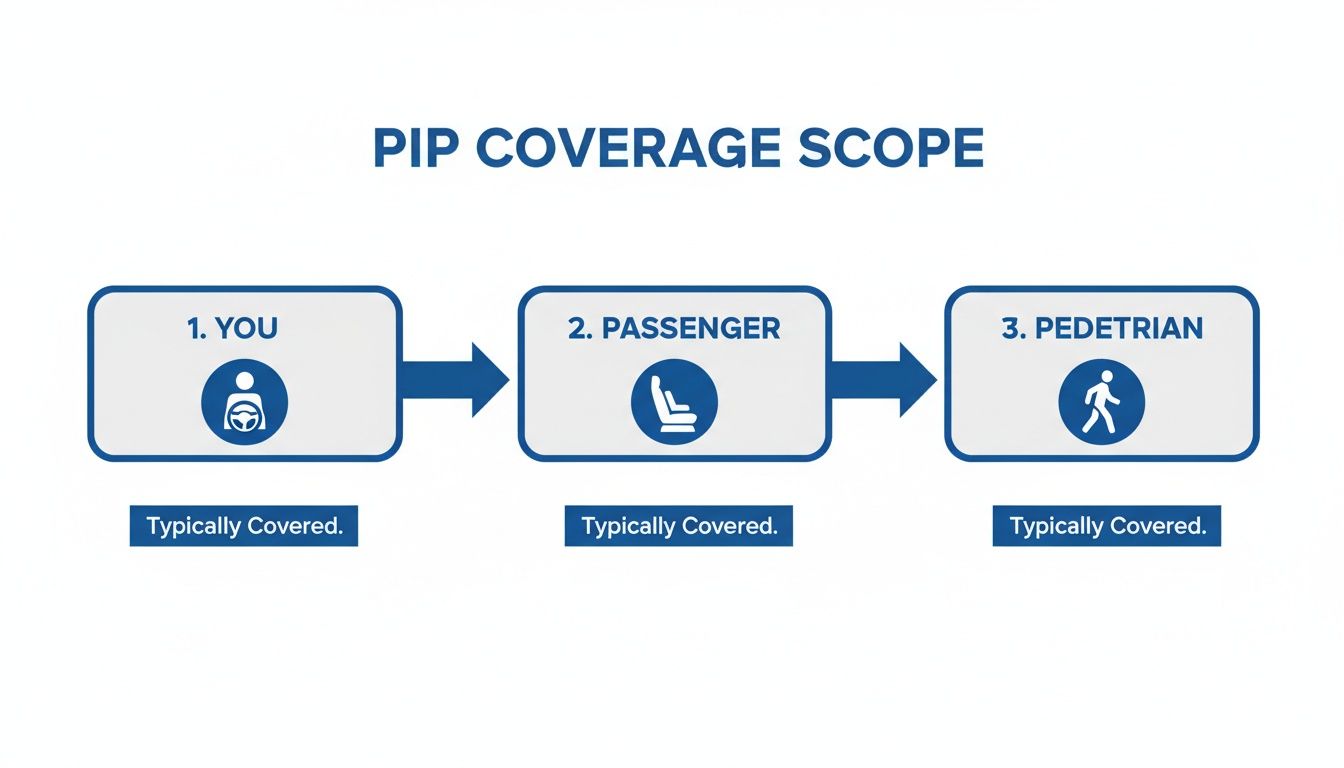
This shows just how valuable the coverage can be, offering a financial cushion whether you were behind the wheel, a passenger, or even a pedestrian.
Common Pitfalls That Can Sink Your Claim
The process might seem simple, but it’s loaded with potential traps. Insurance adjusters are looking out for their company’s financial interests, and an innocent mistake on your part could give them a reason to pay less or deny your claim altogether.
One of the biggest mistakes people make is giving a recorded statement to an insurance adjuster—even their own—before talking to a lawyer. Adjusters are skilled at asking questions that can get you to downplay your pain or accidentally say something that implies you were at fault. Anything you say in that recording can come back to haunt you.
It’s vital to remember that the insurance adjuster is not on your side. Their goal is to close the claim for as little money as possible. Always be polite and stick to the facts, but never guess or speculate about what happened.
You also need to be extremely careful about signing forms or accepting a quick check from the insurer. Those early settlement offers are almost always lowball numbers that don’t account for your future medical needs. It’s crucial to understand how long you have to report an accident to insurance, but rushing to settle is a mistake that can cost you thousands. Having an experienced attorney in your corner from the start is the best way to protect yourself from these tactics.
When Your PIP Coverage Is Not Enough
Think of your Personal Injury Protection as financial first aid after a car crash. It’s a great start, but for a serious injury, it’s like putting a small bandage on a major wound. It helps with the immediate shock, but it’s almost never enough to cover the true cost of getting back on your feet.
While that $10,000 PIP policy provides some initial relief, it comes with some painful limitations that can leave you with a massive financial headache.
Your PIP benefits get eaten up shockingly fast. The policy only covers 80% of your “reasonable and necessary” medical bills and just 60% of your lost wages—and that’s only up to the $10,000 limit. A single trip to the emergency room or one MRI can wipe out your entire policy. Suddenly, you’re left staring at bills for ongoing physical therapy, future surgeries, or weeks of lost income with no way to pay them. We see this happen to people in Florida all the time.
What’s more, PIP provides absolutely nothing for the human cost of a crash. There’s zero compensation for your physical pain, the emotional trauma, or the simple fact that you can’t enjoy your life the way you used to. This is where you have to look beyond your own policy and hold the at-fault driver accountable.
Stepping Outside the No-Fault System
To recover everything that PIP leaves on the table, you have to step outside Florida’s “no-fault” bubble and file a claim against the driver who actually caused the accident. But there’s a catch. Florida law has a specific legal hurdle you must clear first, known as the “serious injury threshold.”
To pursue a claim for your full damages—including pain and suffering—your injury must legally qualify as one of the following:
- Significant and permanent loss of an important bodily function.
- Permanent injury within a reasonable degree of medical probability.
- Significant and permanent scarring or disfigurement.
- Death.
Proving your injury meets this standard is not a simple task. It requires detailed medical evidence and a sharp understanding of Florida’s personal injury laws. This is the moment an experienced attorney goes from being a good idea to an absolute necessity.
Consider the numbers: in the U.S., workplace injuries alone cost $176.5 billion in 2023, and the average medically consulted case was $43,000. It’s easy to see how quickly a $10,000 PIP policy disappears after a serious car wreck. An experienced attorney can guide you through this process every day, helping them break past these limits to get the full compensation they are owed. You can read more about personal injury market trends here.
Simply put, meeting the serious injury threshold is your key to unlocking full and fair compensation. It allows you to seek recovery for every dollar PIP left unpaid and for all the ways the accident has impacted your life.
Building a powerful case to prove you’ve met this threshold is critical. We work to gather all the necessary evidence to show not just what your injuries have cost you in dollars, but how they’ve permanently changed your life.
This is also why it’s so important to understand what other insurance coverages can help. You can learn more about underinsured motorist coverage in our article and see how it can be a lifesaver in these situations.
Common Tactics Insurers Use to Limit PIP Payouts
You faithfully pay your insurance premiums every month, trusting that your provider will have your back when you need them most. But after an accident, many people are shocked to find that even their own insurance company can become an adversary. The unfortunate reality is that an insurer’s primary goal is often to protect its bottom line by paying out as little as possible on your PIP claim.
The good news is that their strategies are predictable. Knowing what to watch for is your best defense against the tactics they use to question, delay, and flat-out deny the benefits you rightfully deserve.
Disputing Your Medical Treatment
One of the most common hurdles you’ll face is the insurer challenging the very medical care you need to recover. An adjuster might suddenly start acting like a medical expert, claiming the physical therapy or MRI your doctor ordered isn’t really necessary or connected to the crash. They are, in effect, trying to overrule your doctor to avoid paying the bills.
They also love to lean heavily on the 14-day rule. If you wait too long to get checked out, they can use that delay as a legal loophole to deny your entire claim, leaving you responsible for every last medical expense.
The So-Called “Independent” Medical Examination
This one sounds official and unbiased, but it’s often a trap. If the insurance company wants to dispute the severity of your injuries, they can force you to attend an Independent Medical Examination (IME) with a doctor they hire and pay.
Surprise, surprise—the doctor performing the IME often writes a report that conveniently minimizes your injuries. They might say you’ve fully recovered or that your condition isn’t as serious as your own trusted physician believes. This report gives the insurer the ammunition they need to justify cutting off your medical and lost wage benefits long before you’re actually better.
An IME report that contradicts your treating physician’s diagnosis is a major red flag. It’s a clear signal that the insurer is preparing to fight your claim and deny further payments for your care.
Florida’s no-fault system, which has been in place since 1972, was supposed to make this whole process simpler and reduce lawsuits. Yet, the system is loaded with pitfalls. Even with reforms meant to lower costs, accident victims frequently find themselves in a huge financial hole when their PIP benefits are unfairly limited. This is where meticulous documentation and strong advocacy become absolutely critical. You can learn more about how these personal injury statistics affect claims and see why having an expert on your side is so important.
Why a Lawyer Is Your Best Defense
Trying to take on an insurance company by yourself is a tough, exhausting fight. An experienced Florida personal injury attorney has seen this playbook a thousand times and knows exactly how to shut it down.
A good lawyer handles all the communication, shielding you from intimidating phone calls and requests for recorded statements that can be twisted against you. They will challenge a biased IME report, gather the powerful medical evidence needed to prove your case, and fight back hard against any wrongful denial. Their entire job is to hold your insurer accountable and make sure you get every penny you’re entitled to, so you can focus on what really matters: getting better.
Navigating an insurance claim while recovering from an injury is a challenge you should not have to face alone. If your insurer is delaying, denying, or lowballing your PIP claim, the team at Martin Hernandez, P.A. is ready to fight for you. We know the tactics they use and how to defeat them. Contact us today for a free consultation to ensure your rights are protected. Visit us at https://injurylawyersoftampa.com to get started.