
If you’ve been in a car accident in Florida, you’ve probably heard the term “PIP insurance” thrown around a lot. What is it, exactly? Think of it as your financial first responder after a crash. Personal Injury Protection (PIP) is mandatory coverage for Florida drivers, designed to quickly cover your initial medical bills and a portion of your lost wages, no matter who was at fault.
Your Guide to Florida PIP Insurance

At its heart, PIP is the foundation of Florida’s “no-fault” auto insurance system. The entire point is to get money into your hands for medical care right away, without getting bogged down in a lengthy legal fight over who caused the wreck.
This system was created to streamline the process for smaller claims, ensuring injured people get the help they need when it matters most—immediately following an accident. It’s the first line of defense, which is why it’s almost always the first insurance policy you’ll deal with.
Florida’s Mandatory PIP Coverage
Under Florida law, every single driver must carry a minimum of $10,000 in PIP coverage. This isn’t just a good idea; it’s a legal requirement to register and drive a vehicle in the state. This has been a core part of Florida’s no-fault system since it was first introduced, with the goal of speeding up payments.
Your PIP benefits are set up to pay for:
- 80% of your initial medical expenses, up to that $10,000 limit.
- 60% of your lost wages if your injuries keep you from working.
The “no-fault” part simply means your own insurance company handles these initial payments, even if the other driver was 100% to blame for the crash. For a deeper dive, you can explore a detailed explanation of how Florida’s no-fault insurance system works in our guide.
Who Is Covered By Your PIP Policy?
One of the best things about PIP is how far its coverage reaches. It doesn’t just protect you, the person who bought the policy. It casts a much wider net, creating a crucial safety net for others, too.
This coverage typically includes you, any relatives who live in your household, most passengers in your vehicle who don’t have their own PIP, and even you as a pedestrian or cyclist if you are struck by a motor vehicle. This wide scope ensures immediate care is accessible for many parties involved.
Who and What Your PIP Policy Actually Covers
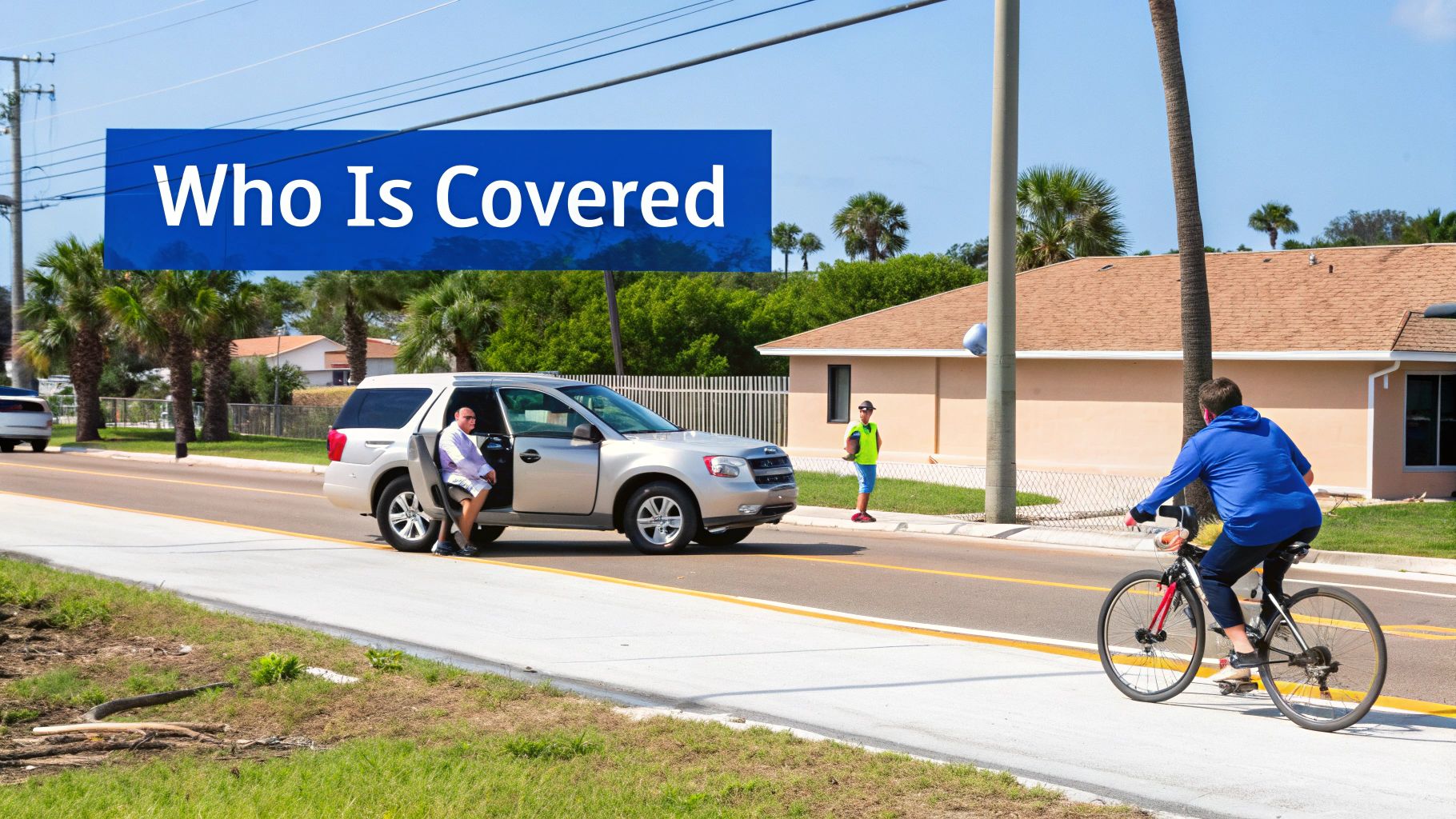
It’s easy to think of your PIP policy as just covering you, the driver. But in reality, it’s a much wider safety net designed to provide quick financial help to a number of people who could be hurt in an accident involving your vehicle.
This coverage follows you, the policyholder, whether you’re behind the wheel of your own car or someone else’s. It also protects relatives living in your household, passengers in your car who don’t have their own PIP, and even cyclists or pedestrians hit by your car, provided they don’t have their own PIP coverage. It’s a broad but very specific system.
The Two Most Important Rules for Your Benefits
When it comes to actually using your PIP benefits, Florida law is incredibly strict. Two rules, in particular, can make or break your claim. If you don’t know them, you could lose out on thousands of dollars in coverage you’ve been paying for.
First, there’s the 14-day rule. This one is non-negotiable. You absolutely must get initial medical treatment within 14 days of the accident. Wait until day 15, and the insurance company has the right to deny your claim entirely. You get nothing.
The second rule governs how much money you can access. To get the full $10,000 in medical benefits, a doctor must officially determine that you have an “Emergency Medical Condition” (EMC). If they don’t, or if your injuries aren’t deemed an EMC, your medical benefits are automatically capped at just $2,500.
What Your PIP Policy Pays For
So, assuming you’ve jumped through the initial hoops, what does the money actually cover? PIP is designed to pay for a portion of your most immediate expenses, but it’s important to understand it won’t cover everything.
Here’s a breakdown of what your policy pays:
- Medical Bills: PIP covers 80% of your reasonable and necessary medical costs. This applies to things like ambulance rides, hospital visits, doctor appointments, MRIs, and physical therapy.
- Lost Wages: If you can’t work because of your injuries, PIP will pay 60% of your verified lost income. This benefit also extends to paying someone to handle household duties you can no longer perform yourself.
- Death Benefits: In the tragic event of a fatal accident, Florida PIP provides a flat $5,000 death benefit to the family or estate.
Example in Tampa: Let’s say you get into a wreck on Dale Mabry Highway. You go to an urgent care clinic five days later and the doctor diagnoses you with an EMC. Your initial medical bills total $8,000. PIP will pay 80% of that, which comes to $6,400. You are left responsible for the other $1,600. This is a perfect example of why it’s useful to learn about what MedPay insurance coverage is, as it can help cover those gaps.
When Your $10,000 PIP Coverage Is Not Enough
That mandatory $10,000 in Personal Injury Protection is a lifesaver right after an accident, but let’s be honest—it often feels more like a small bandage than a complete fix. For a serious Florida car crash, that money disappears shockingly fast.
Think about it. One trip to the emergency room, an MRI, and a couple of follow-up visits can burn through that $10,000 before you know it, leaving you holding a stack of unpaid bills.
Imagine a multi-car pile-up on I-275 during Tampa’s rush hour. The cost for the ambulance, hospital stay, and initial treatments can easily blow past $10,000 in the first 24 hours. This is the tough spot many accident victims find themselves in: your main insurance is maxed out before your recovery has even really started.
The Built-In Financial Gap of PIP
Here’s something many people don’t realize until it’s too late: PIP was never designed to cover everything. From the very first dollar, the system has a built-in financial gap that you are responsible for.
Your policy only pays 80% of your medical bills and just 60% of your documented lost wages. That means you’re on the hook for out-of-pocket costs right from the start.
For example, if you get a $5,000 hospital bill, PIP will pay $4,000. You have to figure out how to cover the remaining $1,000. If you miss work and lose $2,000 in pay, PIP only covers $1,200 of it, leaving you $800 short. Those gaps add up fast, creating a ton of financial stress when all you should be worried about is getting better.
Florida’s PIP system really defines how personal injury cases work, especially in busy areas like Tampa-St. Petersburg-Clearwater. With an 80/60 split and a $10,000 cap, serious injuries almost always lead to costs that spill over. Just think—lost wages from a single truck wreck in Hillsborough County can top $20,000 a month for a professional driver. You can learn more about occupational employment and wages from the Bureau of Labor Statistics.
Stepping Beyond Your PIP Claim
This is precisely when a personal injury claim becomes essential. When your bills and losses shoot past what your PIP policy will pay, Florida law gives you the right to step outside the no-fault system and go after the driver who caused the accident.
And we’re not just talking about covering the leftover 20% of your medical bills or 40% of your lost wages. A personal injury lawsuit is the only way to get compensation for the full extent of your damages, which often includes things PIP won’t touch:
- Future Medical Expenses: This covers ongoing physical therapy, potential future surgeries, or any long-term care you might need.
- Full Lost Wages: We’re talking about the total income you’ve already lost and what you’ll lose in the future because of your injuries.
- Pain and Suffering: This is compensation for the physical pain and emotional trauma the accident put you through.
These are absolutely critical pieces of a fair recovery, and PIP simply doesn’t account for them. By understanding the types of damages available in personal injury cases, you can see how a legal claim is designed to fill the huge financial void left by your limited PIP coverage. Getting advice from an experienced attorney is often the best way to make sure the at-fault party is held responsible and you get the resources you need to truly recover.
How to File Your Florida PIP Claim Correctly
The moments after a car accident are often chaotic and confusing. While you’re dealing with the shock and potential injuries, you also have to start thinking about insurance. Filing a PIP claim in Florida isn’t just a suggestion; it’s a critical process with a stopwatch running from the second the crash happens.
Getting it right means following a specific set of steps, and timing is everything.
Your First Steps Are Time-Sensitive
The single most important thing you can do after a crash is to get checked out by a medical professional. Your health is the priority, of course, but it’s also a legal necessity for your insurance claim.
Here’s why: Florida law gives you just 14 days from the date of the accident to get initial medical treatment. If you see a doctor for the first time on day 15, your auto insurance company has the legal right to deny your entire PIP claim. That deadline is unforgiving and absolute.
With your immediate medical needs handled, two other tasks need your prompt attention:
- Report the Crash: Call the police to get an official accident report. This document is a cornerstone of your claim, providing an objective record of what happened.
- Notify Your Insurer: Contact your own car insurance company right away to report the accident. They’ll open a PIP claim file and assign you a claim number and an adjuster.
This 14-day window is the first hurdle every accident victim in Florida must clear. To understand just how serious this deadline is, it’s worth reading more about the Florida PIP 14-day rule and its impact on your benefits.
Document Everything and Avoid Common Mistakes
Think of yourself as the chief record-keeper for your own case. Start a dedicated folder (physical or digital) and collect every single piece of paper related to the accident. This includes medical bills, treatment notes, pharmacy receipts, and a clear letter from your employer documenting any time you missed from work and the wages you lost.
Knowing what to do is only half the battle; knowing what not to do is just as important. Insurance adjusters are trained to protect their company’s bottom line, and they may ask you for things that seem routine but can seriously damage your claim. Be wary of requests for recorded statements or broad medical authorizations.
Here are a few common traps to sidestep:
- Giving a Recorded Statement: You are not obligated to give a recorded statement. Adjusters can use your words against you later, twisting innocent comments to argue you weren’t really hurt. It’s best to decline, especially without talking to an attorney first.
- Signing Blank Forms: Never, ever sign a blank or incomplete form from an insurance company. You’re giving them a blank check to fill in the details however they see fit.
- Minimizing Your Injuries: After an accident, don’t try to be tough and downplay your pain to a doctor, an adjuster, or on social media. Be honest and thorough about what you’re experiencing.
This process can feel complicated, but the diagram below helps visualize how PIP works. It shows that your policy covers its share first, but you’re often left with remaining expenses.

As you can see, PIP pays 80% of your initial medical bills. That remaining 20%, along with other uncovered losses, is precisely why a separate personal injury claim against the at-fault driver is often necessary to make you whole again.
Common PIP Exclusions and Insurance Company Tactics
While your Personal Injury Protection is meant to be a straightforward benefit, it’s certainly not a blank check. Your policy has very specific rules, and insurance companies have developed a playbook of tactics to limit what they pay out. Knowing what these hurdles are is the first step in making sure you get the full benefits you’ve paid for.
Simply put, PIP doesn’t cover everything. If you were injured while committing a felony, for example, your claim will be denied. The same goes if you were driving a vehicle you own that wasn’t insured, or if the injuries were intentionally self-inflicted.
Strategies Insurers Use to Limit Claims
Beyond the black-and-white exclusions in your policy, insurance adjusters have other ways to challenge or reduce your claim. It’s important to see these tactics for what they are: strategies. They can feel personal and intimidating, but they can often be overcome with the right evidence and legal help.
One of the most frequent moves is to dispute the medical care you received. An adjuster might argue that a certain treatment wasn’t actually necessary or that you received care for longer than they think you should have. It’s a classic way they try to chip away at the final payout.
Another powerful tool in their arsenal is the Independent Medical Examination (IME).
Don’t let the name fool you. An IME is anything but independent. The doctor performing this exam is chosen and paid by the insurance company. Their job is often to find a reason to disagree with your own doctor’s diagnosis, downplay your injuries, or declare you’ve reached “maximum medical improvement” so they can legally cut off your benefits.
The Use of Surveillance in PIP Cases
It might sound like something out of a spy movie, but it’s true: insurance companies absolutely use surveillance to watch people who file claims. They can and do hire private investigators to take photos or videos of you going about your day, hoping to catch you doing something that contradicts your reported injuries.
For example, if you’ve told your doctor you have a severe back injury that makes it hard to lift things, a photo of you carrying a heavy bag of groceries can become “Exhibit A” in their argument that you’re exaggerating. This is why it is absolutely critical to be honest and consistent with your doctors and your legal team about what you can and cannot do.
An experienced personal injury attorney knows these tactics inside and out. We see them coming. We prepare for them by building a solid case file, packed with strong medical evidence from the doctors who are actually treating you. By meticulously documenting your injury and recovery, a lawyer can fight back against a biased IME report or show how surveillance footage was taken out of context, forcing the insurance company to value your claim fairly.
Why You Need a Lawyer for Your PIP Claim
Florida’s PIP system is called “no-fault,” but don’t let the name fool you. Getting the benefits you paid for is almost always a fight. Remember, your insurance company is a for-profit business, and their goal is to pay out as little as possible. That puts you in an immediate conflict of interest. What should be a straightforward process becomes a battle you have to wage while you’re trying to recover.
Trying to navigate this system on your own can be a huge, and costly, mistake. A good personal injury lawyer acts as your champion, making sure your rights are protected from day one. They level the playing field and hold the insurance company accountable for what they legally owe you.
Maximizing Your PIP Benefits
Having an attorney on your side adds value right from the start. They ensure your claim is filed correctly and on time, which helps you sidestep simple administrative errors that can get your claim denied outright.
One of the first and most important fights is proving your injury qualifies as an Emergency Medical Condition (EMC). This is a critical distinction.
Without a formal EMC diagnosis from a qualified doctor, your PIP medical benefits are automatically capped at a measly $2,500. That’s it. A lawyer will work directly with your doctors to gather the right evidence and properly document the EMC, which unlocks your full $10,000 in PIP coverage.
What happens if the insurance company denies your claim or cuts you off after sending you to their own doctor for an “Independent” Medical Examination (IME)? Your attorney will be ready. They can challenge the IME report, depose the insurance company’s doctor, and use the medical evidence from your own physicians to fight back against an unfair denial.
Moving Beyond the Limits of PIP
Here’s where an attorney becomes absolutely essential. PIP was never designed to make you whole again. It only covers a percentage of your initial medical bills and lost wages and offers zero compensation for your pain and suffering.
An experienced lawyer’s main job is to build a case against the driver who caused the crash to recover full compensation for all of your losses.
This involves a lot of moving parts:
- Investigating the Crash: We’re talking about more than just the police report. It means gathering witness statements, photos from the scene, and any other evidence to prove the other driver was at fault.
- Documenting Your Damages: We don’t just calculate the 20% of medical bills and 40% of lost wages that PIP left on the table. We work with experts to project the costs of future surgeries, ongoing therapy, and any impact on your ability to earn a living down the road.
- Quantifying Your Pain and Suffering: This is the human cost of the accident. A lawyer knows how to place a monetary value on the physical pain, emotional trauma, and the loss of enjoyment of life you’ve experienced.
This thorough preparation sends a clear signal to the other driver’s insurance company: you are serious, and you’re not going away. This comprehensive approach is fundamental after a serious crash, and you can learn more about the benefits of getting a lawyer after a car accident in our detailed guide.
By handling all the calls and paperwork from insurers, managing every deadline, and building a case that’s ready for trial if needed, an attorney frees you up to focus on what matters most—your recovery. Think of them as your essential partner, working to protect your financial future while you work on getting your life back on track.
Common Questions We Hear About Florida PIP
When you’re dealing with the fallout from a car accident, the rules around Personal Injury Protection can seem confusing. Let’s clear up some of the most frequent questions we get from clients in Florida.
Do I Have to Use My Own PIP Insurance?
Yes, you do. Florida law is crystal clear: your own PIP coverage is the first source of payment for your medical bills and lost wages after an accident. It doesn’t matter who caused the crash.
This is the whole point of Florida’s “no-fault” system. The idea is to get your medical bills paid quickly so you can get treatment right away, without having to wait weeks or months for insurance companies to decide who was at fault.
Will PIP Pay to Fix My Car?
No, not at all. This is a huge point of confusion for many drivers. PIP insurance has absolutely nothing to do with property damage.
Think of it this way: PIP is for people, not property. It’s designed specifically to cover your personal medical needs (80% of medical bills) and lost income (60% of lost wages), up to the limit of your policy.
So, how do you get your car fixed? That falls to other types of coverage. The at-fault driver’s Property Damage (PD) liability insurance is supposed to pay for your repairs. If they don’t have enough insurance (or if you were at fault), you’ll need to rely on your own Collision coverage, if you purchased it.
What if the Driver Who Hit Me is Uninsured?
This is a scary situation, but your PIP coverage still works exactly the same way. Since it’s your own no-fault benefit, it kicks in to cover your initial costs regardless of the other driver’s insurance status. You will still have access to your medical and lost wage benefits up to your $10,000 policy limit.
What about the costs that go beyond your PIP benefits? For medical bills, lost wages, and pain and suffering that exceed what PIP pays, you’ll need to turn to your own Uninsured/Underinsured Motorist (UM/UIM) coverage. This is an optional but incredibly important part of your policy. It essentially steps into the shoes of the at-fault driver’s missing insurance, protecting you from a devastating financial blow.
If you’re hitting a wall with your PIP claim or need to go after the at-fault driver for your remaining damages, don’t try to battle the insurance companies on your own. The experienced team at Martin Hernandez, P.A. knows how to fight for what you’re owed. Contact us for a free consultation and let us help.