
When you’re trying to build a personal injury case, think of it like putting together a puzzle. Each piece of evidence—a photo, a document, a text message—helps create the full picture of what happened. But what if the other side deliberately throws away a critical piece?
That’s the core of spoliation of evidence. It’s the legal term for when someone involved in a lawsuit intentionally alters, hides, or destroys evidence that’s relevant to the case. This isn’t just an accident or a simple mistake; it’s a serious action that can completely derail the search for truth.
The First Step in Protecting Your Injury Claim

Let’s put this in a real-world Tampa context. Imagine you’re hit by a driver who ran a red light because they were texting. If that driver immediately deletes their text messages from the minutes before the crash, they’ve just committed spoliation. They knew those messages could prove their fault, and they got rid of them.
In Florida, this matters immensely. Personal injury cases live and die on the evidence. Without that proof, it becomes your word against theirs, and getting the compensation you deserve becomes much, much harder.
Key Elements of Spoliation
So, how does a Florida court decide if spoliation actually happened? It isn’t just about evidence going missing. Generally, three things have to be proven to the court’s satisfaction. To prove spoliation, we, as your attorneys, would need to demonstrate the following three core elements:
- Existence of Potential Litigation: This means the person who destroyed the evidence must have reasonably anticipated a lawsuit was coming. For example, in a Tampa car accident, the at-fault driver knew you were injured at the scene, making a future claim or lawsuit foreseeable.
- Duty to Preserve: The person had a legal obligation to save that specific piece of evidence for the case. As soon as the crash happened, that driver had a duty to preserve their phone records, vehicle data, and other relevant information.
- Destruction of Evidence: This is proof that the evidence was actually lost, hidden, or destroyed, and is now unavailable to you. For instance, the driver deleted the text messages, or their company “lost” the black box data from their commercial truck.
Simply put, you can’t just claim spoliation because something is missing. You have to connect the dots to show the other party knew better and destroyed the evidence anyway.
Spoliation of evidence is a direct attempt to hide the truth. When a trucking company “loses” its maintenance logs after a crash or a grocery store’s security footage is “accidentally” erased, it’s often a calculated move to defeat a valid claim.
This has become even more critical as our world has gone digital. A study from the Federal Judicial Center revealed that electronically stored information (ESI) was at the center of 53% of spoliation disputes. In contrast, tangible items like a wrecked car only accounted for 21%.
Understanding spoliation is just one part of navigating the complexities of personal injury law. The moment an accident happens, the clock starts ticking on preserving evidence. That’s why figuring out https://injurylawyersoftampa.com/when-to-hire-a-personal-injury-lawyer/ is one of the most important first steps you can take to protect your rights.
Why Destroyed Evidence Can Make or Break Your Case
When you get right down to it, spoliation is about more than just a fancy legal term. Its effect on a Florida injury claim can be absolutely devastating. Think of crucial evidence as the bedrock of your case—it’s the hard proof you need to show who was at fault and why you deserve compensation for your medical bills, lost income, and pain. When that proof vanishes, a rock-solid case can crumble.
Let’s picture a nasty truck accident right here on I-4 in Tampa. The trucking company has driver logs, maintenance records, and the truck’s “black box” data recorder. These aren’t just pieces of paper or data files; they tell the real story of what led to the crash. They can prove if the driver was exhausted from too many hours on the road, if the brakes were defective, or if the company was dangerously negligent about safety.
The Tactical Disappearance of Proof
So, what if those critical maintenance records suddenly “disappear”? This is almost never an accident. More often than not, it’s a calculated move by a defendant who knows that evidence will sink their case by proving their negligence. The loss of that single piece of proof can turn a relatively clear claim into a messy, complicated legal fight.
Without the maintenance history, proving that a mechanical failure caused the crash becomes a monumental task. You’re left with a gaping hole in your argument, which is precisely the outcome the other side was hoping for. This is the real-world impact of spoliation—it actively works to bury the truth and harm victims.
A defendant’s choice to destroy evidence is a choice to hide from responsibility. It forces the injured party to fight not just for compensation, but for the very facts of the case that should have been clear from the start.
From Clear Fault to Uphill Battle
Let’s stick with that truck crash example. Imagine the driver’s logs clearly showed he was violating federal hours-of-service rules, meaning he was driving while dangerously fatigued. The maintenance records would have revealed a history of skipped brake inspections. Put them together, and you have an undeniable picture of negligence.
When the company destroys those records, they aren’t just shredding paper; they’re shredding your ability to prove what happened. Your case instantly shifts from demonstrating obvious fault to fighting an uphill battle over what the missing evidence would have shown. A skilled attorney knows exactly how to attack this tactic, but it highlights the vital role of evidence in proving negligence in any injury claim. The absence of key proof isn’t just an inconvenience; it’s a deliberate attempt to silence the facts and deny you justice.
Common Types of Evidence Destroyed in Injury Claims

When evidence goes missing in a personal injury case, it’s rarely a coincidence. Certain pieces of proof are far more likely to disappear, usually because they’re the ones that could make or break the case. This evidence can be something you can hold in your hand, like a part from a wrecked car, or something digital, like a text message that proves a driver was distracted.
Knowing what typically gets lost is the first step in protecting your own claim. Spoliation can happen fast, and being aware of what needs to be preserved right from the start is your best defense. The time immediately following an accident is absolutely critical for locking down the proof you’ll need down the road.
Physical Evidence That Goes Missing
Tangible, physical evidence often tells the clearest story. Unfortunately, that also makes it a prime target for being destroyed or “misplaced”—especially when it points the finger of blame directly at the other party.
Here are a few key examples we see all the time:
- Damaged Vehicle Parts: Think about a blown-out tire from a big rig or a set of faulty brakes that failed to stop a commercial truck. These parts are smoking guns. If the trucking company rushes to repair the vehicle and tosses the old parts, the most direct proof of a mechanical failure is gone for good.
- “Black Box” Data Recorders (EDRs): Most cars and trucks today have an Event Data Recorder. This little device is a digital witness, capturing crucial information like speed, braking, and steering in the moments before and during a crash. But that data isn’t saved forever. It can be overwritten or simply “lost” if it’s not downloaded right away.
When a defendant destroys physical evidence, they are trying to rewrite the history of the accident. The goal is to create just enough uncertainty about what really happened so they can dodge responsibility for the injuries they caused.
Digital Evidence in the Crosshairs
These days, our digital footprints often provide the most honest account of our actions. This makes electronically stored information (ESI) a huge target for spoliation, since it can often be deleted with a few simple clicks.
Common types of digital proof that get erased include:
- Dashcam and Surveillance Footage: A truck’s dashcam might show the driver was speeding right before the crash. A security camera at a nearby gas station could have a perfect view of the other driver running a red light. This kind of footage is often recorded on a loop and can be automatically erased within days if a formal preservation letter isn’t sent immediately.
- Text Messages and Phone Logs: In a distracted driving case, a driver’s text message history can be the single most damning piece of evidence. Deleting those messages is a blatant attempt to cover up negligent—and illegal—behavior.
- GPS and Rideshare Data: For crashes involving commercial drivers or services like Uber and Lyft, GPS and app data can show the driver’s exact route, speed, and any detours they took. This information can be easily altered or wiped by a company trying to protect itself from a lawsuit.
Intentionally deleting digital data is a very serious problem. In fact, courts are cracking down hard on the spoliation of texts and other mobile data. One federal analysis even found that ESI was a factor in 53% of all spoliation claims, a statistic highlighted in court decision analysis on Everlaw.com.
Of course, preserving the other side’s data is just one part of the puzzle. It’s equally important to protect your own records. You can learn more about the critical role of medical documentation in Tampa personal injury cases in our other guide.
What Happens When Evidence is Destroyed in Florida?
In a Florida personal injury case, when the at-fault party destroys evidence, they don’t just get a slap on the wrist. While Florida law won’t let you file a completely separate lawsuit just for spoliation of evidence, the courts have some serious tools to punish this kind of misconduct. These aren’t just minor technicalities; they are powerful remedies that can completely change the course of your case.
An experienced trial attorney knows that filing a motion for sanctions isn’t just a procedural formality—it’s a strategic move. When the other side tries to win by hiding the truth, these legal consequences are designed to level the playing field and hold them accountable.
Court Sanctions and Penalties
Florida judges do not take the destruction of evidence lightly. They have a range of options to address the harm it causes, and the penalty often depends on how intentional the act was and how crucial the lost evidence was to the case. A judge can impose sanctions that can absolutely cripple the other side’s defense.
These remedies are meant to correct the imbalance created by the missing proof. They can include:
- Monetary Fines: The court can force the responsible party to pay the legal fees and costs you racked up just trying to prove they destroyed evidence in the first place.
- Exclusion of Testimony: The party who got rid of evidence might be blocked from presenting certain arguments or witness testimony related to what that evidence could have proven.
- Striking Pleadings: In really bad cases, a judge can throw out the at-fault party’s legal arguments or defenses entirely. This can be an instant win on a key issue.
By far, the most powerful tool in a Florida court’s arsenal is what’s called an adverse inference jury instruction. This is when the judge looks at the jury and tells them they are allowed to assume the lost or destroyed evidence would have been bad for the party who got rid of it.
The Power of an Adverse Inference
Think about that for a moment. Imagine a jury hearing the judge say, “You are permitted to conclude that the surveillance footage the defendant conveniently erased would have shown they were at fault for the crash.” An instruction like that is devastating for the other side.
It essentially gives the jury official permission to fill in the blanks in your favor. This single instruction can shift the entire dynamic of a trial. The defendant’s dishonest act of hiding the truth suddenly becomes one of the most compelling reasons for the jury to find them liable for your injuries. A skilled attorney knows exactly how to build the foundation needed to convince a judge that this powerful instruction is necessary, making sure no one gets away with profiting from their own wrongdoing.
How to Proactively Preserve Evidence After an Accident
When you’re reeling from the shock and pain of a crash, it’s tough to think about anything else. But in those first few hours, the steps you take to protect evidence can make or break your case down the road. While you’re focused on getting medical care, you can bet the at-fault party and their insurance company are already in motion. The best way to level the playing field is to immediately go on offense, securing the facts before they vanish.
The first and most critical move your attorney will make is to fire off a preservation of evidence letter. This isn’t just a friendly request; it’s a formal legal demand sent to the defendant and their insurer, putting them on notice. It legally requires them to save everything related to the crash—the vehicle itself, its black box data, driver logs, maintenance records, and any video footage they might have.
This letter draws a line in the sand. From that moment on, if they destroy, alter, or “lose” anything on that list, it’s no longer an accident. It’s an intentional act of spoliation, and we can hold them accountable for it.
Your Role in Safeguarding Proof
While we handle the legal heavy lifting, the evidence you can gather at the scene is pure gold. You are the first investigator on the scene, and your actions can build a rock-solid foundation for your claim.
- Become a Photographer: Your smartphone is your most powerful tool. Take photos and videos of everything. Get wide shots of the whole scene, then zoom in on the vehicle damage, skid marks, road debris, traffic signs, and your injuries. There’s no such thing as too many pictures.
- Talk to People: If anyone saw what happened, get their name and number. Eyewitnesses provide a neutral perspective that can be incredibly persuasive.
- Don’t Touch a Thing: Resist the urge to fix your car or throw out damaged items like a shattered phone screen, a bloody shirt, or a broken helmet. These items are tangible proof and need to be inspected by experts.
This flowchart shows what can happen in a Florida court when a party fails to preserve evidence they were told to keep.
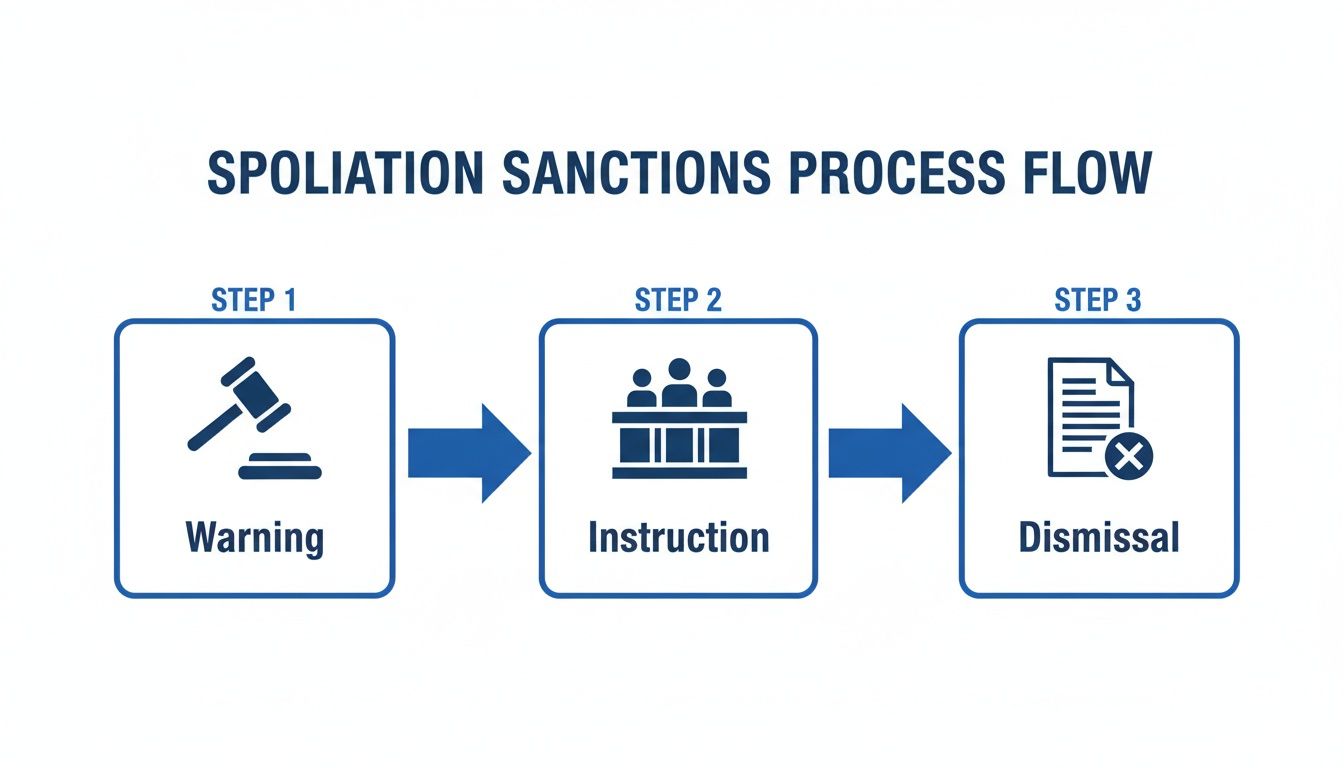
As you can see, the penalties get more severe with the offense. It can start with a warning, but it can escalate to the judge telling the jury to assume the missing evidence was bad for the other side—or even throwing out their defense entirely.
Organizing and Protecting Physical Items
Once you’ve collected physical evidence, it’s vital to store it properly to keep it in its original condition. For a deeper dive into best practices, this comprehensive guide to evidence storage offers some great tips. Proper handling is key to preventing the other side from claiming you tampered with the proof.
If you want a checklist tailored for crash victims, our guide explains in more detail what evidence you should preserve after a car accident in Tampa. Acting quickly and carefully is your best defense against having crucial proof disappear.
Our Strategy for Fighting Evidence Spoliation in Court
When we get even a whiff that the other side might be hiding or destroying evidence, we don’t wait. We go on the offensive immediately. This isn’t just about procedure for us; it’s a core litigation strategy aimed at exposing the truth and holding the at-fault party accountable for their actions.
Our first move is always to fire off a detailed, legally airtight preservation of evidence letter. This isn’t a friendly request—it’s a formal demand that legally obligates them to lock down every single piece of potential evidence. From that moment on, we work relentlessly to uncover what might have been conveniently “lost” or altered.
Uncovering the Truth and Seeking Justice
The discovery process is where we really start digging. We put defendants under oath and grill them about their evidence preservation policies and actions. This is often where their story starts to fall apart, revealing inconsistencies that can completely change the direction of a case.
If we confirm that evidence has been destroyed, we file aggressive motions for sanctions. We ask the court to bring down the hammer, seeking penalties that can give our clients a significant advantage—sometimes even winning the case outright.
A defendant who destroys evidence is showing their hand—they are afraid of what the truth will reveal. Our job is to turn that act of desperation into a legal liability they cannot escape.
This isn’t a one-pronged attack. We often bring in our own investigators to find sources of proof the other side thought no one would look for. Experts are also critical. They can help us demonstrate to the court precisely what the missing evidence would have proved, which is a powerful tool. You can learn more about this by understanding the role of an accident reconstruction expert witness.
While our fight is usually in civil court, we never forget that destroying evidence can be a crime. In one major case, a corporate paralegal was actually sentenced to 15 months in prison for deleting emails and data. Think about that—it’s not so different from a trucking company deleting damning dashcam footage or a property owner destroying shoddy repair logs. You can read more about how spoliation can become a crime on lewisbrisbois.com.
We are prepared to fight on every front to make sure our clients get the justice they deserve.
Questions We Hear All the Time About Evidence Spoliation
When you’re dealing with a personal injury claim, legal jargon like “spoliation of evidence” can feel overwhelming. It’s a complicated topic, but understanding it is crucial. Here are some straightforward answers to the questions we hear most often from our clients here in Florida.
What If the Other Side Destroyed Evidence by Accident?
Even if the evidence wasn’t destroyed on purpose, a Florida court can still take action. It’s a common misconception that only deliberate, bad-faith destruction gets penalized.
While the most severe sanctions are saved for those who intentionally hide the ball, a judge can still implement remedies to level the playing field. For instance, the court might bar the party who lost the evidence from making certain arguments at trial. The core issue is always the same: has the loss of that proof unfairly handicapped your ability to make your case? Simple carelessness doesn’t just get a free pass.
How Fast Do I Need to Act to Preserve Evidence?
Immediately. I can’t stress this enough—there is absolutely no time to waste.
Think about it: surveillance footage from a gas station or a storefront is often taped over within just a few days. Trucking companies have standard document destruction policies that can shred maintenance logs and driver records in a matter of weeks. That crucial piece of proof can vanish before you even know you need it.
The most powerful thing you can do is hire a personal injury lawyer right away. We will immediately fire off a legally binding preservation of evidence letter. This formal notice legally obligates the at-fault party to save everything related to the incident. Waiting even a few days could be the difference between having a winning piece of evidence and it being gone for good.
Could I Be Accused of Destroying Evidence?
Yes, and this is a point that catches many people by surprise. The duty to preserve evidence is a two-way street; it applies to everyone in a potential lawsuit, including you.
This means you absolutely must not repair your vehicle until your lawyer has had it professionally inspected and photographed by an expert. You need to document every dent and scratch.
It also means you can’t delete digital information related to the accident or your injuries. This includes:
- Text Messages: Don’t delete any texts discussing the crash, your pain, or your recovery.
- Social Media Posts: Avoid taking down any posts, pictures, or comments about the incident.
- Emails: Keep all electronic communications that might be even remotely relevant.
Your attorney will give you very specific instructions on what to save. Following that advice to the letter is vital to protect the integrity of your own claim.
If you’re worried that key evidence in your injury case has been lost or destroyed, you need a legal team that will dig for the truth. At Martin Hernandez, P.A., we don’t hesitate to file motions for sanctions to hold the other side accountable. We fight to level the playing field. Contact us today for a free consultation and let’s talk about how we can help.