
Let’s be honest, we all trust that other drivers on the road have insurance. But what happens when that trust is broken and the person who hits you has no coverage at all? That’s where uninsured motorist coverage comes in. Think of it as your own personal safety net, catching you when someone else’s irresponsibility leaves you in a bind.
Your Financial Shield Against Uninsured Drivers
Picture this: you’re driving down Dale Mabry, following all the rules, when suddenly another car blows through a red light and T-bones you. The other driver is clearly at fault. But then comes the gut punch—they don’t have a single dime of car insurance. Now who’s on the hook for your totaled car, the ER visit, and the paychecks you’re losing while you recover?
This is the exact nightmare scenario where uninsured motorist (UM) coverage proves its worth. It’s coverage you buy for yourself, on your own policy. In essence, your UM coverage steps into the shoes of the at-fault driver’s non-existent insurance policy, covering the damages they legally should have paid for.
Uninsured vs. Underinsured: A Key Distinction
People often lump these two together, but they cover slightly different situations. It’s crucial to know the difference.
- Uninsured Motorist (UM) Coverage: This is for when the at-fault driver is completely uninsured. It also kicks in for hit-and-run accidents where you can’t identify the driver who fled the scene.
- Underinsured Motorist (UIM) Coverage: This applies when the at-fault driver has insurance, but their policy limits are way too low to cover all your medical bills and losses. Your UIM coverage bridges the gap between their small policy and the full amount you’re actually owed.
To put it simply, UM is for drivers with zero insurance, and UIM is for drivers with not enough insurance. Both are designed to ensure you aren’t left holding the bag for an accident that wasn’t your fault.
This protection is more critical now than ever before. A study from the Insurance Research Council revealed that a staggering 15.4 percent of motorists are driving without insurance. That’s more than one in every seven drivers you share the road with.
Trying to figure out policy limits and coverage types can feel like a maze. But having solid UM coverage is a cornerstone of being financially protected. It’s a smart move to learn more about how much car insurance you should buy to truly safeguard your family. Without it, you’re placing your financial future in the hands of every stranger driving on Florida’s crowded roads.
How Uninsured Motorist Coverage Actually Works
So, an uninsured driver hits you. The big, immediate question is: who’s going to pay for this mess? The answer, thankfully, is hiding in your own auto insurance policy.
Think of your Uninsured Motorist (UM) coverage as a substitute. It literally steps into the shoes of the at-fault driver’s insurance company—the one that doesn’t exist—and pays you for your damages just like they were supposed to.
Without it, you’re left holding the bag. Your Personal Injury Protection (PIP) is your first line of defense, but it’s quickly exhausted. UM coverage is designed to kick in right where PIP stops, protecting you from the truly devastating financial fallout of a serious crash. It covers the big-ticket items: long-term medical treatment, lost income from being out of work, and the real-world cost of your pain and suffering. To get the full picture, it helps to understand how Florida’s no-fault insurance works and see how these policies fit together.
A Real-World Crash Scenario
Picture this: you’re stuck in rush hour traffic on I-275 in Tampa. Traffic slows, you brake, but the driver behind you doesn’t. You get rear-ended, hard.
The other driver is sorry, but they sheepishly admit they don’t have insurance. The shock wears off and the reality sinks in. Your neck is screaming, your car is a wreck, and your doctor is talking about months of physical therapy and significant time off work.
This is the exact moment your UM coverage becomes your lifeline. You’ll file a claim with your own insurance company. They will then act as if they were insuring the at-fault driver, stepping up to pay for the damages you’re owed.
Breaking Down the Two Types of UM Coverage
Uninsured Motorist coverage isn’t just one blanket policy. It’s typically broken down into two very different parts, and knowing the difference is crucial.
- Uninsured Motorist Bodily Injury (UMBI): This is the heart of the coverage. It covers the human cost of the crash—things like hospital bills, lost paychecks, and compensation for your pain, suffering, and any long-term disability.
- Uninsured Motorist Property Damage (UMPD): This part is all about your car. It pays to repair the damage or, if your car is totaled, gives you money toward a replacement.
In Florida, UMBI is king. While your collision coverage can also fix your car, only UMBI can compensate you for your physical injuries and the profound impact an accident has on your life.
How the Claims Process Unfolds
The first step after a crash is to notify your own insurance company that you’re opening a UM claim. You’ll need to give them the police report and prove the other driver was at fault and had no insurance.
Next comes the documentation. You’ll need to submit everything: every medical bill, every pay stub showing lost income, and all your doctor’s notes detailing your injuries and recovery plan. Your insurer will review all this to figure out how much your claim is worth.
Here’s the tricky part: even though it’s your insurance company, they are now on the other side of the table. Their goal is often to pay out as little as possible. They will scrutinize your claim just as an opposing insurance company would. This is why keeping perfect records is non-negotiable if you want to get the full and fair compensation you paid for.
Navigating UM Coverage Specifics In Florida
In Florida, every driver must have Personal Injury Protection (PIP) coverage, but that’s where the mandatory part ends for some of the most critical protections. This is especially true for uninsured motorist (UM) coverage. Unlike PIP, UM coverage is optional here, but there’s a huge catch: insurance companies are legally required to offer it to you. If you choose not to get it, you must officially reject it in writing.
There’s a very good reason for this law. The state knows you’re taking a massive financial risk by driving on roads filled with uninsured drivers. When you sign that rejection form, you’re formally acknowledging that you accept the consequences if an uninsured driver hurts you. It’s a decision that shouldn’t be taken lightly, especially when you consider the data behind Florida’s high number of uninsured drivers and what that means after a crash.
The Power of Stacking Your UM Coverage
One of the most important choices you’ll make with your UM coverage is whether to “stack” it. This single decision can be the difference between having enough money to recover and facing financial disaster after a serious accident.
- Non-Stacked Coverage: This is the most basic option. Your UM coverage is capped at the limit for the one car you were in during the crash. It doesn’t matter if you have three other cars on your policy; the limit for that one vehicle is all you get.
- Stacked Coverage: This is where you get real protection. Stacking lets you combine—or “stack”—the UM coverage from all the vehicles on your policy. This multiplies your available benefits, creating a much bigger financial safety net.
Think of it this way: Non-stacked coverage is like having a single fire extinguisher. Stacked coverage is like having an extinguisher in every room of your house. When a fire breaks out, you have far more resources to put it out.
How Stacking Works in a Real-World Scenario
Let’s say your family lives in Hillsborough County and you own three cars. You’ve been smart and put UM bodily injury (UMBI) coverage of $100,000 per person on each one.
One afternoon, an uninsured driver runs a red light and hits you, causing serious injuries. Your medical bills are quickly climbing past $100,000.
- With Non-Stacked UM: You’re limited to the $100,000 on the policy for the car you were driving. Once that money is gone, you’re on your own, no matter how high your medical bills or lost wages get.
- With Stacked UM: You can combine the limits from all three of your insured cars. Your total available coverage instantly becomes $300,000 ($100,000 x 3). This larger pool of money could be what saves you from financial ruin.
This image helps break down the basic components of your policy and the two main types of UM coverage you can choose.
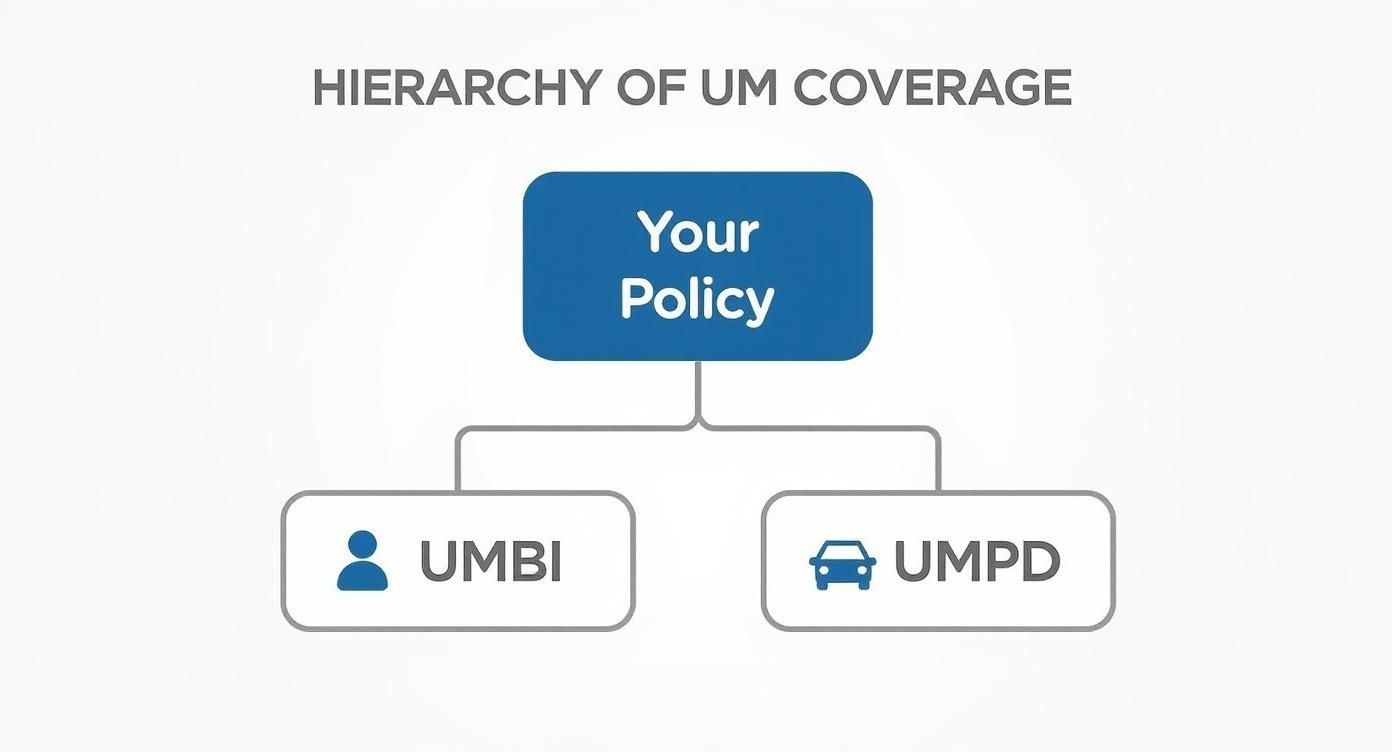
As you can see, the coverage for bodily injury and property damage are separate parts of your overall UM protection.
Choosing the Right UM Coverage Limits
So, how much UM coverage should you actually buy? A good rule of thumb is to match your UM limits to your own bodily injury (BI) liability limits—that’s the coverage that protects your assets if you cause an accident and injure someone else.
Think about it: If you feel it’s necessary to have $100,000 to protect someone else from your mistake, doesn’t it make sense to have at least that much to protect yourself from theirs?
Choosing the right limit is about safeguarding your own future. While lower limits might save you a little on your premium, they could leave you dangerously exposed to crippling debt. When you make this decision, think about your health insurance deductible, the income you’d lose if you couldn’t work, and the potential long-term costs of a life-changing injury. Skimping on UM is a gamble that every other driver on the road is as responsible as you are.
What to Do After a Crash with an Uninsured Driver
The minutes following a car crash are always a blur of adrenaline and confusion. But when you find out the other driver doesn’t have insurance, that confusion can quickly morph into a full-blown sense of panic. The most important thing you can do is take a deep breath, stay as calm as possible, and follow a few key steps to protect yourself and your right to file an uninsured motorist (UM) claim.
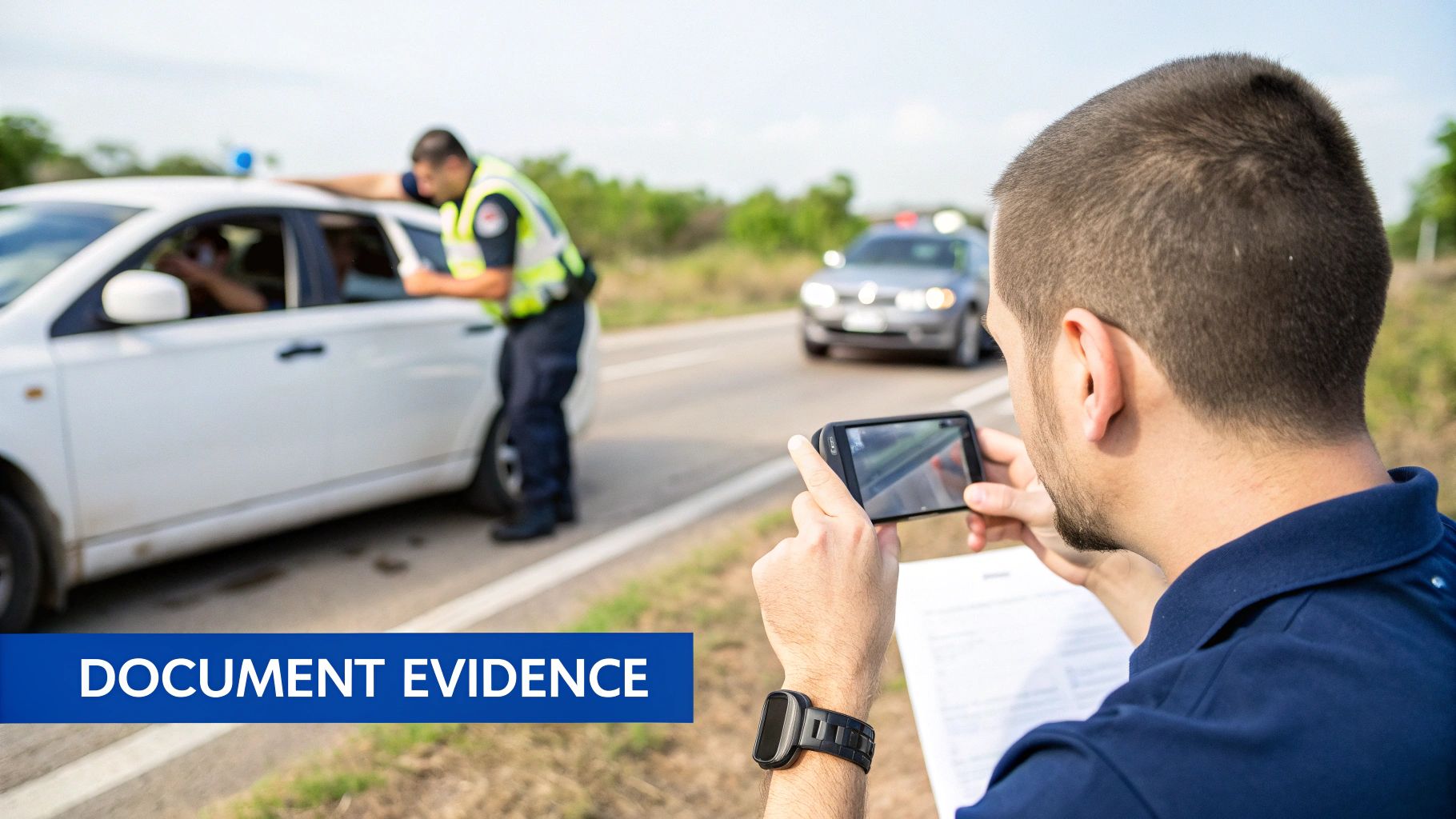
Regardless of the other person’s insurance situation, knowing what to do after a car accident is the first line of defense for your safety and any future claim. Your main goal is to create an official, undeniable record of what happened, who was there, and who was at fault. This documentation is the bedrock of a successful UM claim.
Your Immediate Action Plan at the Scene
What you do in the first hour after the crash can make or break your case. Think methodically, and focus on gathering the facts and protecting your rights.
- Call 911 Immediately. Your first call should always be to the police. An official police report isn’t just a good idea; for many insurance companies, it’s a non-negotiable requirement to even open an uninsured motorist claim. It provides an unbiased account of the crash, documents any witness statements, and, critically, confirms the other driver’s lack of insurance.
- Get the Other Driver’s Information. Even if they tell you they’re uninsured, you still need to get as much information from them as you can. Politely ask for their full name, home address, phone number, and driver’s license number. Be sure to also jot down the vehicle’s make, model, year, and license plate.
- Document Everything with Your Phone. Turn your smartphone into your best evidence-gathering tool. Snap photos of everything—both cars from every angle, the license plates, any debris or skid marks on the road, and nearby traffic signs or signals. If you have any visible injuries, take pictures of those, too. You can never have too much photo evidence.
Steps to Take in the Following Hours and Days
Once you’re safely away from the scene, the work to protect your claim continues. These next steps are just as crucial as what you did at the crash site.
- See a Doctor Right Away. Even if you feel okay, get a medical evaluation. The shock and adrenaline from a crash can easily hide serious injuries like concussions or whiplash that show up later. A medical record creates a clear, documented link between the accident and your injuries, which is absolutely vital for your claim.
- Notify Your Own Insurance Company. Call your insurer as soon as you can to report the crash and tell them you need to start a UM claim. Give them the police report number and all the details you gathered from the at-fault driver.
- Politely Decline a Recorded Statement. Your insurance adjuster will almost certainly ask you for a recorded statement about the accident. It’s in your best interest to politely refuse until you’ve consulted with a personal injury attorney. Insurers are trained to ask questions that can be used to take your words out of context and find reasons to limit or deny your claim.
Crucial Insight: The average uninsured motorist bodily injury (UMBI) claim payment is around $29,825, while property damage claims average about $4,000. These numbers show just how essential this coverage is for protecting you from massive medical bills, lost income, and car repair costs.
Ultimately, a car crash is chaotic. Having a mental checklist of what to do helps ensure you don’t overlook a small but critical step that could hurt your ability to recover financially. For a more comprehensive look, check out our guide on https://injurylawyersoftampa.com/what-to-do-after-a-car-accident/.
Common Tactics Insurers Use to Deny UM Claims
You’ve faithfully paid your premiums for uninsured motorist coverage. You did everything right, assuming your own insurance company would have your back after a crash. But here’s the reality many people discover the hard way: that’s often not the case.
When you file a UM claim, you’re technically in an adversarial relationship with your own insurer. Suddenly, their goal isn’t to take care of you; it’s to protect their profits. They have a whole playbook of tactics designed to pay you as little as possible—or nothing at all. Knowing what to expect is your first line of defense.
Questioning Your Injuries and Medical History
This is one of the most common and frustrating strategies. The insurance adjuster will try to poke holes in your injury claim, often by arguing your pain isn’t from the accident at all. They’ll dig deep into your medical records, searching for anything they can use against you.
- Blaming a “Pre-Existing Condition”: They might find a note about minor back pain from five years ago and claim that’s the real reason you need surgery now, not the rear-end collision.
- Pointing to a “Gap in Treatment”: If you waited a few days to see a doctor—maybe because you hoped the pain would go away—they’ll argue your injuries couldn’t have been that serious.
- Hiring Private Investigators: It’s not just in the movies. Insurers sometimes use surveillance to catch you doing everyday activities, like lifting a bag of groceries, and then present it as “proof” that you’re exaggerating your injuries.
The goal is to create doubt and chip away at the value of your claim, making it seem like your suffering isn’t their driver’s fault.
Using Your Own Words Against You
Soon after the crash, you’ll get a call from an adjuster who sounds friendly and concerned. They’ll ask for a recorded statement, framing it as a standard procedure. Be careful. This is a minefield.
Adjusters are trained to ask tricky, leading questions. They hope you’ll say something, anything, they can twist and use to undermine your claim down the road.
A polite “I’m okay, thanks for asking” can be documented as you admitting you weren’t really hurt. Saying “I’m not sure” about a detail can be used to attack your memory and credibility later.
You need to be extremely cautious in these conversations. As seen in some court cases denying uninsured motorist benefits, the situation can get complicated quickly, and what you say really matters.
The Lowball Settlement Offer
This tactic is as old as the insurance industry itself. A few days or weeks after the crash, you might get a settlement offer. It’s usually fast, and it’s almost always far less than you deserve.
The insurance company is preying on your stress. They know you have medical bills piling up and you might be out of work. Their check seems like a quick fix. But accepting it comes with a huge catch: you forfeit your right to seek any further compensation for that accident.
If you later discover you need surgery or long-term physical therapy, it’s too late. You’re on your own. This is why understanding these tactics—and knowing when to get help—is so critical.
How an Injury Attorney Maximizes Your UM Claim
https://www.youtube.com/embed/CXAUdOH_CiE
Trying to get your own insurance company to pay a fair uninsured motorist claim can feel like you’re fighting an uphill battle, alone. They have entire teams of adjusters and lawyers whose job is to protect the company’s profits. Hiring a skilled personal injury attorney is the single most effective way to level that playing field.
An attorney doesn’t just fill out paperwork. They launch a full-scale, independent investigation into the accident. We’re talking about digging into police reports, tracking down and interviewing witnesses, and even bringing in crash reconstruction experts to prove, without a doubt, that the other driver was to blame.
Calculating the True Value of Your Losses
This is where a good attorney really proves their worth. They understand that the true cost of an accident goes far beyond the initial hospital bills. Your insurer’s first offer is almost guaranteed to be a lowball number that doesn’t account for the long-term impact on your life.
A dedicated attorney builds a complete picture of your damages, often with the help of medical and financial experts. This includes:
- Future Medical Expenses: We look at the big picture—the potential surgeries, the months of physical therapy, the medications, and any long-term care you might need down the road.
- Lost Earning Capacity: If your injuries mean you can’t go back to your old job, or maybe can’t work at all, we calculate the total income you’ll lose over the rest of your working life.
- Pain and Suffering: This is a big one. We put a real number on the intangible damages like chronic pain, emotional distress, and the loss of enjoyment in your life. Insurers hate paying for this, but it’s a critical part of your claim.
The goal is simple: make sure you aren’t paying the price for someone else’s negligence five or ten years from now. An attorney fights for a settlement that covers not just today’s bills, but secures your future as well.
Acting as Your Advocate and Negotiator
Maybe the most immediate relief you’ll feel is when your attorney takes over all communication with the insurance company. No more stressful phone calls or confusing requests for information. This buffer protects you from accidentally saying something that an adjuster could twist to use against your claim.
They handle the deadlines, the mountains of paperwork, and the tough negotiations, freeing you up to focus on what actually matters—getting better. For a closer look at the tactics involved, check out our guide on how to negotiate with insurance companies.
The auto insurance market is huge and still growing, but that doesn’t mean every driver is covered. With more cars on the road and more accidents happening, getting hit by an uninsured driver is an all-too-common reality. An experienced attorney knows the landscape and is ready to counter every denial tactic in the book to get you the full compensation you deserve under your policy.
Got Questions About UM Coverage? We’ve Got Answers.
Even with a solid grasp of the basics, it’s natural to wonder how uninsured motorist coverage plays out in the real world. Let’s walk through some of the most common questions we hear from drivers across Florida.
Is UM Coverage Really Worth the Extra Money in Florida?
In a word: absolutely. Florida consistently has one of the highest rates of uninsured drivers in the entire country. Skipping UM coverage isn’t just a small risk; it’s a massive financial gamble.
Think of it this way: that small addition to your premium is your personal safety net. Without it, a single accident with the wrong person could leave you drowning in tens of thousands of dollars of medical debt and lost wages, with no one to hold responsible. When you weigh the minor cost against the potential for financial ruin, the choice becomes crystal clear.
How Does UM Work if I’m the Victim of a Hit-and-Run?
A hit-and-run is a nightmare scenario for any driver, but it’s exactly the kind of situation your UM coverage is built for. As far as your insurance policy is concerned, a “phantom” driver who takes off is treated just like a driver who stuck around but had no insurance.
To make a successful claim, you’ll need to follow a few key steps right away:
- Call the police immediately. A formal police report is non-negotiable for most insurers.
- Document everything. Try to find a witness or show physical evidence that proves another vehicle caused the crash.
- Notify your insurance company as soon as possible.
Your UM policy is designed to step in and cover your medical bills, lost income, and pain and suffering—just as it would if the at-fault driver had been identified. It’s the mechanism that prevents you from paying the price for someone else’s irresponsibility.
Will My Insurance Rates Spike if I File a UM Claim?
This is a huge worry for a lot of people, but thankfully, Florida law is on your side. Your insurance company is legally forbidden from raising your rates, dropping your policy, or hitting you with a surcharge for filing a UM claim, provided you were not at fault for the accident.
You’ve been paying your premiums for this exact protection. Using your UM coverage after being hit by an uninsured or hit-and-run driver isn’t asking for a favor; it’s exercising a right you’ve already paid for. The law makes sure you aren’t punished for it.
Trying to figure out an uninsured motorist claim while you’re focused on healing is overwhelming. The team at Martin Hernandez, P.A. is committed to standing up for accident victims in Tampa, making sure they get every penny they deserve. If an uninsured driver has injured you, reach out to us for a free consultation at https://injurylawyersoftampa.com.