
The first few moments after a car accident are chaotic. With your heart pounding and your mind racing, it’s tough to think clearly, especially if you’re on a busy road like I-4 or the I-75. But what you do right here, right now, matters immensely. Your top priority is simple: safety. First, check for injuries. Next, call 911 to get police and medics on their way. If it’s safe and possible, move your car off the road. These first steps are absolutely critical for your health and for protecting your rights down the line.
Your First Moves at the Scene of the Accident
It’s easy to feel overwhelmed in the aftermath of a crash. The key is to take a deep breath and focus on a few essential actions that can make a huge difference for your well-being and any future insurance claim.
Secure the Scene and Ensure Safety
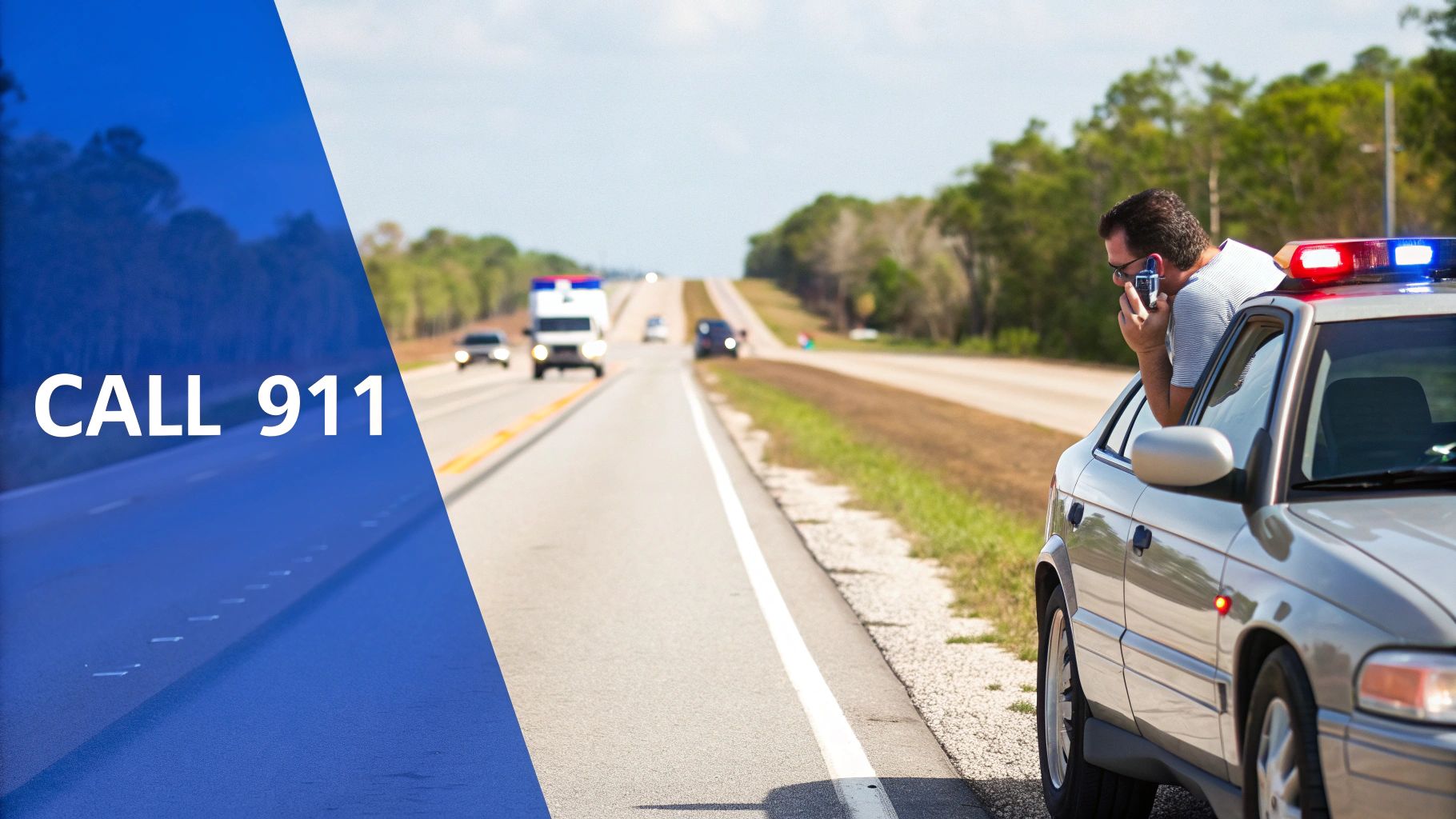
Before you do anything else, think about safety—for you, your passengers, and everyone else on the road. Flip on your hazard lights immediately. This small act is a powerful signal to other drivers, helping to prevent a second, often more dangerous, collision.
If the crash was minor and your car still runs, Florida law generally expects you to move it out of the flow of traffic. Pull over to the shoulder or find a nearby safe spot. This keeps traffic moving and lowers the risk of another accident.
However, if anyone is seriously hurt or the cars are too damaged to drive, leave them be. Don’t try to be a hero. Wait for the professionals. And never, ever try to move someone with a potential head or neck injury unless they’re in immediate danger, like from a fire.
Call 911 Without Delay
In Florida, calling 911 is mandatory after any crash involving injuries, a death, or property damage that looks like it’s $500 or more. Honestly, even if you think it’s just a fender bender, make the call. A police report is an objective, official record of what happened, and it’s an incredibly important piece of evidence for your insurance claim.
When you talk to the dispatcher, stay calm and provide clear information:
- Your exact location: Give the road name, the closest cross street, or a highway mile marker.
- A quick summary: Explain what happened and how many vehicles are involved.
- Any injuries: Mention if anyone is hurt, even if it seems minor at the time.
This call gets the right people heading your way to secure the scene and start the official documentation process.
After a car accident in Florida, the first actionable step—securing safety and calling 911—reflects a statewide reality: Florida averages roughly 400,000 reported crashes per year, so emergency response and on-scene procedures are essential skills for drivers to know.
Assess for Injuries and Administer First Aid
Once you’ve made the 911 call and the immediate area is safe, do a quick check on yourself and your passengers. Adrenaline is a powerful pain-masker, so you might not feel an injury right away. Look for obvious cuts and bruises, but also pay attention to signs of a concussion, like dizziness or confusion.
If you have first-aid training, you can offer basic help. But again, be cautious. Avoid moving anyone who might have a serious head, neck, or back injury.
Deciding where to get checked out is the next crucial step. It’s important to understand when to decide between urgent care and the emergency room for your specific situation. Remember, symptoms for whiplash or a concussion can take hours, or even days, to show up.
While waiting for help, you can start gathering your own evidence. Use your phone to take pictures of everything. We’ve put together a guide on how to take good photos after a car accident that walks you through exactly what you need to capture. This documentation can be incredibly valuable later on.
Gathering Evidence to Protect Your Claim
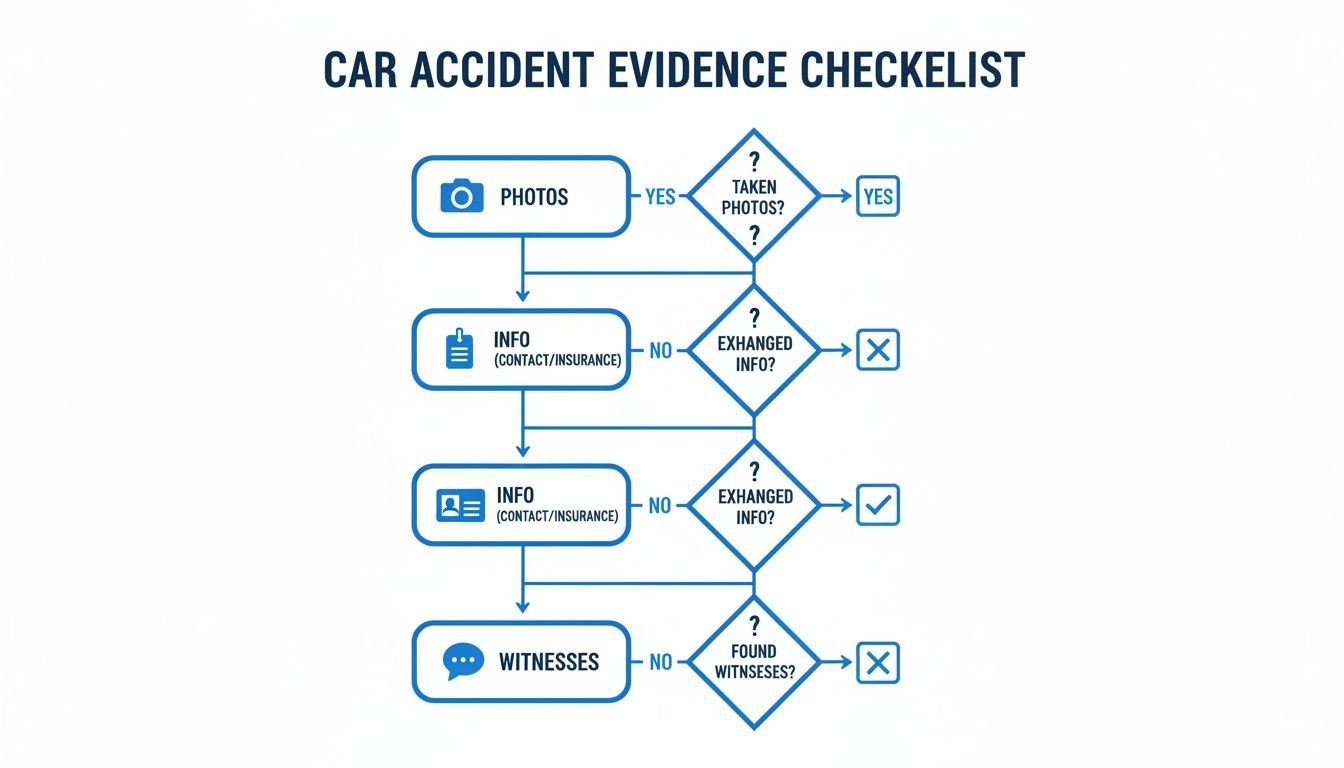
The first few minutes after a car wreck are chaotic, but what you do in that time can make or break your insurance claim later on. By taking a few key steps to document everything, you start building a strong case for yourself right from the beginning. This isn’t just about taking a quick picture; it’s about creating a complete, undeniable record of what happened.
Your phone is your best friend here. Before you do anything else, start taking photos.
What to Photograph at the Accident Scene
Think like a crime scene investigator. You can’t have too many pictures. The goal is to capture the scene from every conceivable angle so there’s no question about what went down.
Your photo roll should include:
- Damage to All Cars: Get wide shots of all the vehicles involved, then get up close. Take pictures of every single dent, scratch, and broken taillight on your car and theirs.
- The Big Picture: Step back to capture the entire scene. Get photos showing the final resting place of the cars, the layout of the intersection, and any nearby landmarks.
- License Plates: A clear, readable shot of every vehicle’s license plate is a must.
- Road Conditions: Was the road wet? Were there potholes or debris? Was it a construction zone? Snap photos of anything that might have contributed to the crash.
- Signs and Signals: Photograph stop signs, speed limit signs, and traffic lights. If the light is still functioning, show what color it is.
- Your Injuries: If you have any visible cuts, scrapes, or bruises, document them immediately. These photos can be incredibly important later.
- Skid Marks: Look for skid marks on the pavement. They help accident reconstruction experts figure out who was going how fast and who hit the brakes.
Exchanging Information the Right Way
Once you’ve documented the scene with photos, it’s time to swap information with the other driver. Keep it professional and stick to the facts. This is not the time to argue or get emotional.
Politely ask for and give them these key details:
- Name and Contact Info: Get their full name, address, and phone number.
- Driver’s License: Don’t just write it down; ask to see their license and take a quick photo of it.
- Insurance Card: The easiest way to get their insurance company and policy number right is to snap a picture of their insurance card.
- Vehicle Details: Jot down the make, model, color, and license plate number of the other car.
What you don’t say is just as important as what you do. Never, ever admit fault or apologize. Phrases like “I’m so sorry” or “I didn’t see you” can easily be twisted by an insurance adjuster to mean you’re accepting blame. Just exchange the necessary facts and leave it at that. For a more detailed checklist, check out our guide on what evidence you should preserve after a car accident in Tampa.
Finding and Speaking with Witnesses
An independent witness can be your most powerful asset. Because they have no skin in the game, their account of what happened is often seen as the most credible.
If anyone stopped or saw the crash, walk over and calmly ask for their contact information. You don’t need a full statement right there on the side of the road. Just say something simple like, “Hi, did you see what happened? I’d really appreciate it if I could get your name and number.” Most people are happy to help.
Why is this so critical in Florida? Because our state sees a staggering number of wrecks—over 396,000 reported crashes in a recent year. With hotspots right here in Hillsborough County, detailed evidence is your best defense. This is especially true with the alarming rise of hit-and-run incidents, which now top 100,000 annually in Florida, making the evidence you gather on the spot absolutely essential.
Navigating Florida’s No-Fault Insurance System
If you’ve just been in a car wreck in Florida, you’re about to encounter our “no-fault” insurance system. It can feel a bit backward at first. Essentially, no matter who caused the crash, you’ll turn to your own insurance company first to cover your initial medical bills and lost wages.
This system is designed to get money into the hands of injured people quickly, without waiting for a lengthy legal battle over who was at fault. The key to this whole process is your Personal Injury Protection, or PIP, coverage. Every single driver in Florida is required by law to carry at least $10,000 in PIP benefits. This is your first line of defense after an accident.
What Your PIP Coverage Actually Pays For
Now, that mandatory $10,000 policy isn’t a blank check. It’s designed to cover a percentage of your most immediate costs, up to that limit. Think of it as a crucial financial cushion while you get back on your feet.
Here’s exactly how it breaks down:
- Medical Expenses: PIP covers 80% of your “reasonable and necessary” medical treatment. This can include the ambulance, ER visit, follow-up appointments with your doctor, physical therapy, and even prescriptions.
- Lost Wages: If the crash leaves you unable to work, PIP will reimburse 60% of the income you’ve lost. For many people, this is the lifeline that keeps the bills paid during recovery.
- Death Benefits: In the tragic event of a fatality, PIP provides a $5,000 death benefit, separate from any medical or wage benefits already paid.
Understanding these percentages is critical. You are still on the hook for the remaining 20% of your medical bills and 40% of your lost wages, and those gaps can add up surprisingly fast.
The Critical 14-Day Rule
Listen carefully, because this is the single most important rule when it comes to your PIP benefits: You must seek initial medical treatment within 14 days of the accident.
This is not a suggestion; it’s a hard deadline. If you wait until day 15 to see a doctor, your insurance company can legally deny your entire PIP claim. I’ve seen it happen. Even if you feel okay, the adrenaline after a crash can easily mask serious injuries like whiplash or a concussion. Get checked out immediately.
Key Takeaway: The 14-day window is absolute. Miss it, and you could forfeit the $10,000 in benefits you’ve been paying for. Don’t risk it—see a doctor right away.
Unlocking Your Full PIP Benefits
Here’s another nuance many people miss: you don’t automatically get access to the full $10,000. Initially, your benefits are capped at just $2,500.
To unlock the full amount, a qualified medical professional—like a doctor, osteopathic physician, or advanced registered nurse practitioner—must formally diagnose you with an “Emergency Medical Condition” (EMC). An EMC is basically an injury serious enough that delaying treatment could put your health in real jeopardy. Once that diagnosis is in your medical records, you gain access to the full $10,000 PIP policy.
Beyond PIP, your personal health insurance may come into play. It’s a good idea to understand how your health insurance’s out-of-pocket maximum works, as this can also affect your total financial exposure after a serious crash.
Reporting the Crash to Police and Your Insurer
Once the immediate shock of a car crash wears off, you’ll need to deal with the official reports. Knowing when to call the police and how to talk to your insurance company isn’t just a good idea—in Florida, these are legal and contractual duties that protect you down the road. Getting these two reports right from the start is the foundation for a much smoother recovery.
When You’re Required to Get a Police Report in Florida
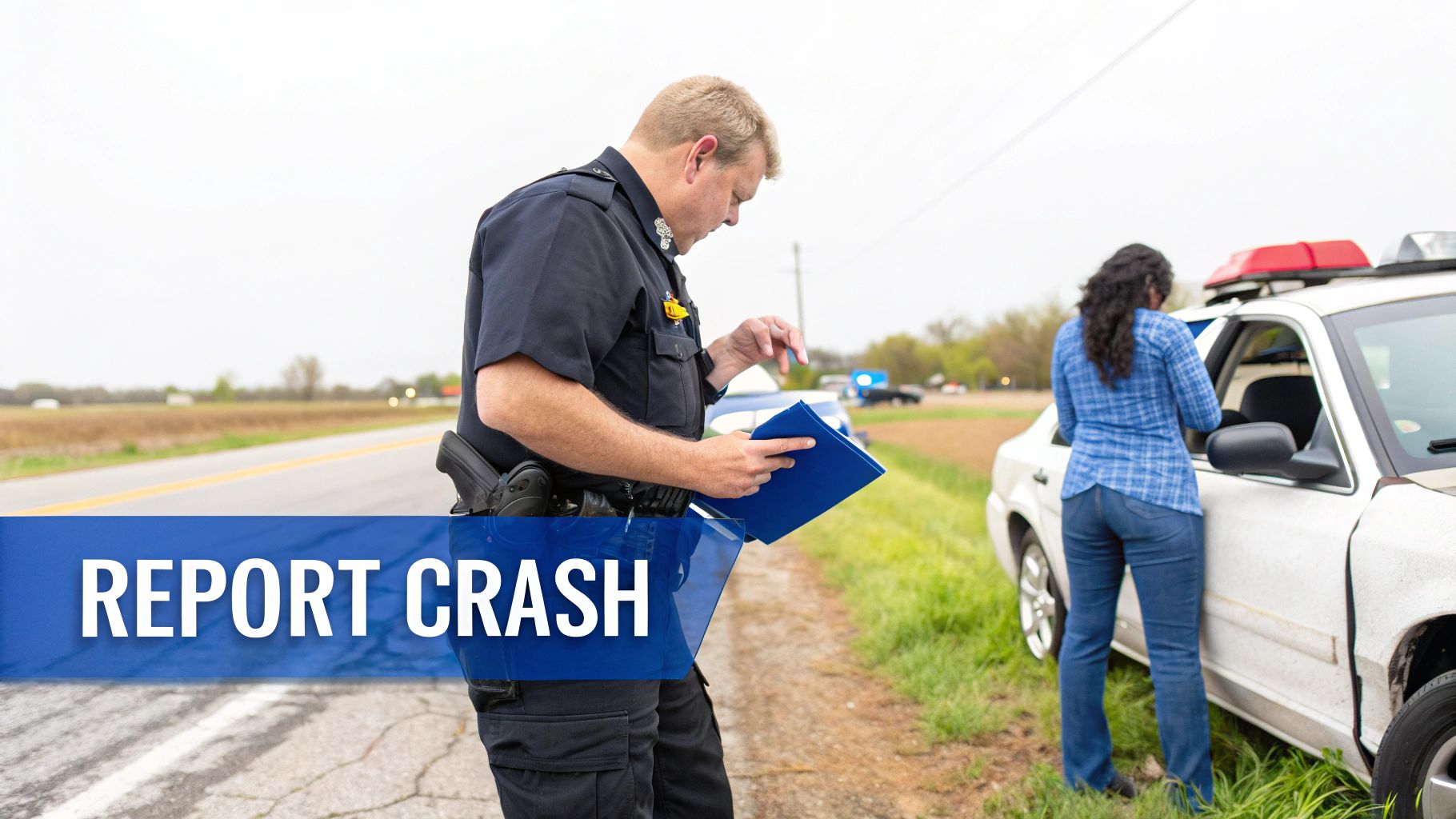
A lot of people think they can just swap insurance info after a minor fender-bender and be on their way. But Florida law is very specific about when you absolutely must involve law enforcement.
You are legally required to report a crash to the police if it involves any of the following:
- Any injury or death, no matter how insignificant it seems at first.
- A hit-and-run, where another driver illegally leaves the scene.
- A driver who appears intoxicated.
- Property damage that looks like it’ll cost $500 or more to fix.
Think about the cost of a modern bumper or headlight. It’s almost impossible to have a collision that doesn’t meet that $500 threshold. The smartest thing to do is always call the police. That official report becomes a neutral, powerful record of what happened, and it’s one of the first things insurance adjusters look for. For more on this, check out our guide on what to do after you call 911 from a car accident.
Notifying Your Insurance Company—Don’t Wait
Your auto insurance policy is a contract. Buried in the fine print is a requirement to report any accident promptly. If you wait too long, you could give your insurer a reason to deny your claim, leaving you on the hook for all the bills.
Most policies use vague language like “promptly” or “as soon as practicable,” but in my experience, this means within a day or two at the most. Don’t put it off.
Expert Insight: Prompt reporting to both the police and your insurer is crucial due to time-sensitive realities in Florida. The state’s high crash frequency means claim timetables are tight, and a quick police report aligns the factual record with your medical and repair timelines.
The First Call: What to Say and What Not to Say
That first phone call to your insurance agent or their claims hotline is a critical moment. You need to fulfill your duty to report the crash without saying something that could unintentionally harm your case later.
What you SHOULD say:
- “I need to report that I was involved in an accident.”
- Provide the basic facts: date, time, and location.
- Share the other driver’s information and the police report number, if you have it.
- Mention that you are seeking or planning to seek medical evaluation.
What you should NOT say:
- “It was my fault” or “I’m so sorry.” Never, ever admit fault. Liability is for investigators to determine.
- “I’m fine” or “I’m not hurt.” Adrenaline is a powerful painkiller. You might have serious injuries that won’t show up for hours or days. Simply tell them you’re getting checked by a doctor.
- Guess or speculate. Don’t estimate speeds or offer opinions on what you think happened. Stick to the hard facts you know for sure.
- Give a recorded statement. You are under no obligation to give a recorded statement on that initial call. You can politely decline and say you’d like to consult with an attorney first.
Understanding Your Legal Rights and Deadlines
Once the initial shock of the accident wears off, you’ll start thinking about the long road ahead. This is when you absolutely need to understand your legal rights, especially the deadlines that can make or break your ability to get compensated for your injuries in Florida. It’s about much more than just getting your car repaired; it’s about protecting yourself financially if your injuries are serious.
At this stage, knowing what to do after a car accident in Florida shifts from immediate, on-scene actions to crucial, strategic decisions. Your Personal Injury Protection (PIP) coverage is a fantastic safety net, but what happens when that $10,000 limit is eaten up by a single trip to the ER and a few follow-up visits? I see it happen all the time—people are left with a mountain of bills and a whole lot of stress.
Florida’s Statute of Limitations for Car Accidents
After a crash, the clock starts ticking immediately. Florida law sets a firm deadline, called the statute of limitations, for filing a personal injury lawsuit. If you miss this window, you lose your right to sue the at-fault driver for damages forever. It doesn’t matter how badly you were hurt.
For most car accident claims based on negligence, you have two years from the date of the wreck to file your lawsuit. Two years might sound like a long time, but it flies by. Building a solid case means tracking down all your medical records, hiring experts, and dealing with insurance companies—all of which takes time.
Waiting until the last minute is one of the biggest mistakes you can make. Evidence gets lost, witnesses forget key details, and a rushed legal strategy is almost always a weak one. To protect your rights, you need to act deliberately, well before that deadline gets close.
When a Lawsuit Becomes Necessary
The idea of filing a lawsuit can be daunting, I get it. But sometimes, it’s the only way to get the full and fair compensation you need, especially when your costs blow past what PIP covers. Your no-fault benefits are a starting point, but they were never designed to cover the full impact of a serious injury.
You should seriously consider a personal injury claim if you’re dealing with:
- Significant Medical Bills: Your treatment costs have soared past the $10,000 PIP limit.
- Serious or Permanent Injuries: You’ve suffered from things like herniated discs, broken bones, or a traumatic brain injury that will require long-term care or leave you with a permanent impairment.
- Substantial Lost Wages: Remember, PIP only covers 60% of your lost income up to its limit. A lawsuit can help you recover every dollar you’ve lost and will lose in the future.
A lawsuit opens the door to pursuing damages that your PIP policy simply won’t touch.
Recovering Damages Beyond Your PIP Coverage
The main reason to take legal action is to go after what we call non-economic and uncovered economic damages. These are the real-life consequences of a crash that disrupt your entire world, both financially and personally.
A personal injury claim allows you to seek money for:
- Pain and Suffering: This is a legal term for the physical pain, emotional trauma, and mental anguish the accident has caused you.
- Future Medical Costs: If you’re going to need ongoing physical therapy, another surgery down the road, or lifelong medical care, this helps cover it.
- Full Lost Wages: You can recover the other 40% of your income not covered by PIP, plus any loss of future earning ability if your injuries prevent you from doing your old job.
Trying to figure out when to take this step can be overwhelming. The best move you can make is to talk with an experienced Tampa-area personal injury attorney who can lay out your options and make sure every critical deadline is met, protecting your right to the compensation you deserve.
Common Questions After a Florida Car Accident
Once the initial shock of a car wreck wears off, the questions start flooding in. The whole process is a maze of insurance terms and legal rules most people never have to think about, and it’s completely normal to feel overwhelmed. Getting straight answers can make a world of difference, cutting down on stress and helping you make smart choices.
Let’s walk through some of the most common and urgent questions we hear from people trying to figure out what to do after a car accident in Florida.
What Happens If the Other Driver Is Uninsured?
It’s a nightmare scenario, but it happens all the time on Florida roads. You get hit by someone who is breaking the law by driving without insurance. When this happens, you have to turn to your own insurance policy to pick up the pieces.
Your first resource is your own Personal Injury Protection (PIP) coverage. This will cover a portion of your immediate medical bills and lost wages, but only up to your policy limit, which is typically $10,000. What happens when your injuries are more severe and the costs blow past that?
This is precisely why Uninsured/Underinsured Motorist (UM/UIM) coverage is so crucial. It’s not required in Florida, but I tell every single person I know to add it to their policy. UM/UIM acts as a stand-in for the insurance the at-fault driver should have had. It can cover everything from medical bills and lost income to the pain and suffering they caused you.
Without UM coverage, your only other move is to sue the driver directly. But think about it: if someone can’t afford basic car insurance, it’s highly unlikely they have the money or assets to pay a large court judgment. It can be a long, frustrating road that leads nowhere.
Do I Need to See a Doctor If I Feel Fine?
Yes. Don’t even hesitate. Getting checked out by a medical professional right after a crash is one of the most important things you can do—both for your health and for any future claim.
During a collision, your body is pumped full of adrenaline. It’s nature’s way of helping you deal with a traumatic situation, but it’s also fantastic at hiding pain. You could be walking around with serious injuries like whiplash, a concussion, or even internal bleeding and not feel a thing for hours or even days. A doctor can spot these hidden injuries before they get worse.
From a legal and insurance standpoint, this isn’t optional. Florida has a strict 14-day rule. You must get initial medical treatment within two weeks of the accident to use your PIP benefits. If you wait until day 15, the insurance company has every right to deny your claim flat out.
Going to a doctor right away also creates a clear, professional record that ties your injuries directly to the accident. That medical documentation is the cornerstone of any successful insurance claim or lawsuit.
Can I Recover Damages If I Was Partially at Fault?
In Florida, the answer is usually yes. Our state uses a legal standard called “modified comparative negligence.” In plain English, this means you can still get compensation from the other driver as long as you weren’t more than 50% responsible for causing the crash.
The catch is that your final payout will be reduced by whatever percentage of fault is assigned to you.
Let’s say you’re awarded $100,000 for your injuries, but a jury decides you were 20% at fault for the accident. Your award would be cut by that 20% ($20,000), so you would receive $80,000.
This is exactly why you should never admit fault or apologize at the scene. Determining who is at fault is a job for investigators and legal experts. A simple “I’m sorry” can be twisted and used against you later. It’s one of the biggest reasons people wonder if they should get a lawyer after a car accident; a good attorney will protect you from these pitfalls and fight to make sure fault is determined fairly.
Trying to navigate the aftermath of a car accident on your own is a tough road. The experienced team at Martin Hernandez, P.A. is here to answer your questions and fight for the full compensation you are owed. If you’ve been injured in a crash, contact us for a free, no-obligation consultation to understand your legal options. Visit us at https://injurylawyersoftampa.com to get started.