
The moments right after a car accident are chaotic. Your first instinct, and the right one, is to check on everyone. Are you okay? Are your passengers? What about the people in the other car? If anyone is hurt, even if it seems minor, your first call should be to 911.
Once that’s done, if it’s safe and the cars are drivable, try to move them out of the flow of traffic. The last thing you want is a second collision. Flick on those hazard lights immediately to warn other drivers.
Your First Moves After a Tampa Car Accident
In the minutes after a crash, your mind is racing. Adrenaline is pumping, and it’s easy to feel overwhelmed and confused. Knowing what to do isn’t just about ticking boxes on a list; it’s about protecting yourself—your health, your legal rights, and your financial well-being down the road.
Everything you do (or don’t do) at the scene sets the stage for what comes next, whether that’s a straightforward insurance claim or a more complicated legal battle. I’ve seen cases where a simple-looking fender-bender on a busy road like Dale Mabry Highway spiraled into major issues, from injuries that showed up days later to frustrating disputes with insurance adjusters.
Your absolute top priority has to be your health. Our bodies just aren’t built to handle the violent jolt of a collision, and the rush of adrenaline is notorious for masking serious injuries. That dull ache in your neck could be whiplash, and that slight headache might be a concussion. This is precisely why getting checked out by a doctor is something you should never, ever skip.
This visual guide offers a quick snapshot of the three most critical things to handle right away.
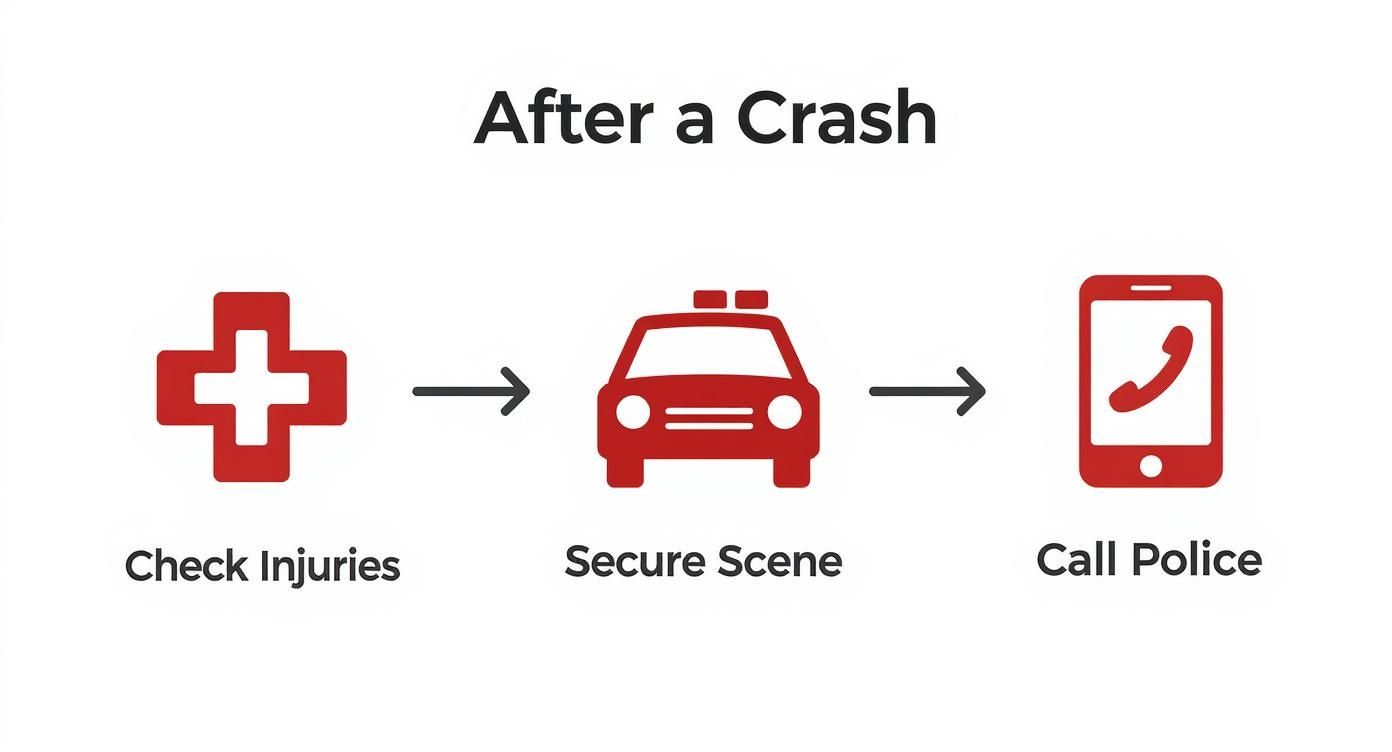
As you can see, it all comes down to taking care of people first, making the area safe, and getting an official report started. Everything else can wait.
To make this crystal clear, here’s a quick-reference table summarizing the most crucial actions to take in those first few minutes.
Immediate Actions at the Accident Scene
| Action | Why It’s Critical |
|---|---|
| Call 911 Immediately | Summons medical help for injuries and ensures police create an official accident report. |
| Secure the Area | Move vehicles if safe; use hazard lights to prevent further accidents and protect everyone. |
| Seek Medical Evaluation | Adrenaline can mask serious injuries. A doctor’s report links injuries directly to the crash for your insurance claim. |
Taking these steps provides a solid foundation for everything that follows, protecting both your health and your legal rights.
Don’t Wait to See a Doctor
Putting off a medical check-up is hands down one of the biggest mistakes people make after a crash. According to the World Health Organization, car accidents are a leading cause of death worldwide, and getting immediate medical care is proven to dramatically improve the outcome for injured victims.
Beyond the obvious health reasons, getting a medical evaluation right away creates an official record. This piece of paper is incredibly important because it directly links your injuries to the accident. In Florida, this documentation is essential for your Personal Injury Protection (PIP) claim and is the primary evidence you have to prove the extent of your damages.
Secure the Scene to Prevent More Harm
After you’ve handled the immediate medical situation, shift your focus to making the area safe. A crash on I-275 or another busy Tampa road is a recipe for a pile-up if you’re not careful. Cars are full of flammable fluids, and the risk of a secondary collision is very real.
If your car still runs, get it over to the shoulder. If it’s disabled, your hazard lights are the universal signal for other drivers to slow down and be cautious. It’s a simple action, but it can protect you, your passengers, and the first responders who are on their way to help.
Your safety and the safety of others is paramount. Never stand between active lanes of traffic or argue with the other driver in the middle of the road. Wait for law enforcement in a secure location, like on the shoulder or a nearby sidewalk.
Always, Always Call the Police
I don’t care if the damage looks like a minor scratch—you need to call the police and get an official report. That police report is a neutral, third-party account of what happened. Here in Florida, the law actually requires you to report any crash that involves injuries or has property damage estimated at $500 or more. Trust me, it doesn’t take much to hit that $500 threshold these days.
When an officer arrives, they will:
- Document the scene, including vehicle positions and road conditions.
- Interview you, the other driver, and any witnesses.
- Potentially issue a ticket if a clear traffic violation occurred.
This report becomes a critical piece of evidence for your insurance claim. To learn more about what to expect, read our guide on what happens after you call 911 from a car accident at https://injurylawyersoftampa.com/what-to-do-after-you-call-911-from-a-car-accident/. For more expert tips, you can also review these detailed first steps to take after an accident. Making that call ensures you have an official record backing up your side of the story.
How to Gather Crucial Evidence at the Scene
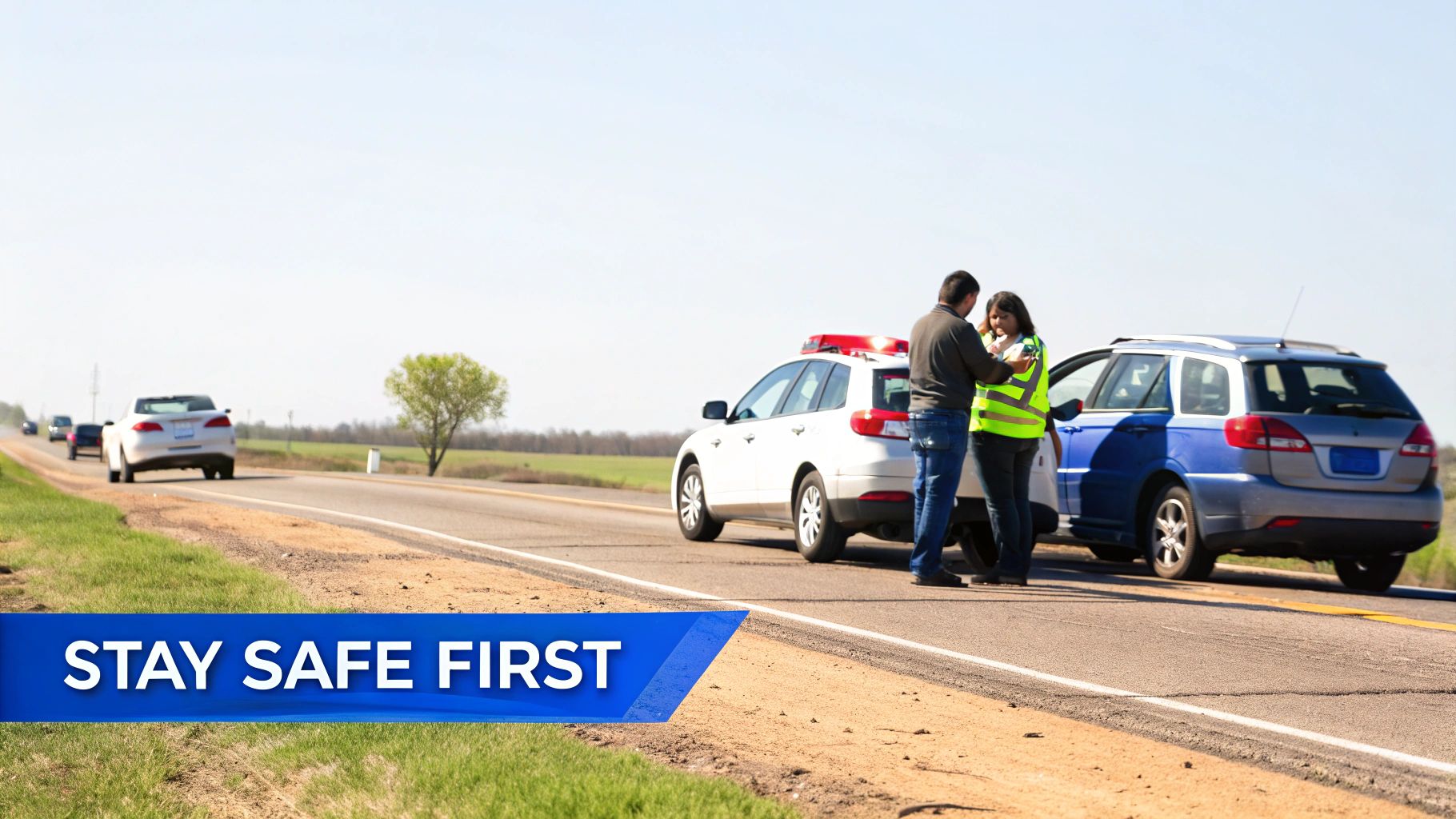
After you’ve made sure everyone is safe and help is on the way, your focus needs to shift. What you do in the next few minutes can make or break your insurance claim. Your smartphone is your best friend right now. It’s time to put on your detective hat and start documenting everything.
First, paint the whole picture. Walk around the scene (if it’s safe!) and take wide-angle photos from every possible direction. You want to show how the cars ended up, the layout of the intersection, and the general traffic conditions. Don’t forget to capture any nearby traffic lights, stop signs, or other signals that tell the story of the scene.
Once you have the overview, it’s time to zoom in on the details. This is where the real power of your evidence lies.
Your Essential Photo Checklist
A good set of photos can shut down arguments before they even start. You’re not just taking a picture of a dent; you’re building a complete visual record of what happened.
- Damage to All Cars: Get up close with the damage on every vehicle involved, not just yours. Take pictures from different angles—crouch down low, stand up high, get it all.
- License Plates: A clear, readable photo of each license plate is non-negotiable. It’s a simple way to confirm exactly who was involved.
- The Road Itself: Look for skid marks, debris scattered from the impact, or even potholes. These clues are what accident reconstruction specialists use to figure out speeds and points of impact.
- Weather Conditions: Was it pouring rain? Was the sun creating a blinding glare? Try to capture these conditions in your photos, as they can be a major factor in the crash.
The idea is to have so much visual information that anyone looking at the photos later can feel like they were standing right there with you. For a deeper dive, our guide on how to take good photos after a car accident has even more pro tips.
Here’s a piece of advice I always give my clients: you can’t take too many pictures. That tiny scratch you almost ignored? It could become a huge point of contention later. Document absolutely everything.
This isn’t just busywork. It’s about protecting yourself. In fact, a 2023 survey found that 78% of successful insurance claims were backed up by strong photographic evidence, which helped resolve things faster and with fewer disputes.
Collecting Information from Others
With your photos taken, it’s time to talk to people. This is purely a fact-finding mission. Now is not the time to debate who was at fault or get into an argument. Just stay calm, be polite, and gather the essentials.
You’ll need to get the following from the other driver(s):
- Full Name and Contact Info: Their phone number is a must.
- Insurance Card: Don’t just write it down—take a clear picture of their insurance card. It’s the easiest way to get the policy number and company right.
- Driver’s License Number: This officially identifies who was behind the wheel.
- Vehicle Details: Jot down the make, model, and color of their car.
Now, look around. Did anyone see what happened? Eyewitnesses are gold. Because they have no skin in the game, their account of the accident is incredibly powerful and credible.
Politely ask for their name and number. Just let them know your insurance company or attorney might want to call them for a clear, unbiased story. If the other driver’s version of events mysteriously changes down the road, a witness statement can be the one thing that sets the record straight.
Understanding Florida’s No-Fault Insurance Laws
If you’ve been in a car wreck in Tampa, you’ll quickly realize that navigating the aftermath is about more than just swapping insurance cards. You’ve got to understand Florida’s unique insurance system, which can be a real headache for both longtime residents and visitors.
The first thing to know is that Florida is a “no-fault” state. In plain English, this means you turn to your own car insurance first to cover your initial medical bills and lost wages, no matter who actually caused the crash. The whole point of this system is to get money into injured people’s hands faster and cut down on lawsuits over minor accidents.
Because of this law, every single Florida driver is required to carry a minimum of $10,000 in Personal Injury Protection, or PIP, coverage. Think of it as your first line of defense for covering your immediate expenses after a collision on a busy road like Dale Mabry or I-275.
The Role of Personal Injury Protection
Your PIP coverage is basically your financial first responder. It’s there to give you quick access to money for medical care and to help cover your bills if the accident puts you out of work.
Here’s exactly what your PIP policy is designed to pay for:
- 80% of your initial medical bills. This covers the whole spectrum of care, from the ambulance ride and ER visit to follow-up appointments with specialists or physical therapists.
- 60% of your lost wages. If a doctor puts you on a work restriction because of your injuries, PIP is there to help make up for the lost income.
But there’s a catch, and it’s a big one. You have a very strict deadline. Florida law gives you just 14 days from the date of the accident to get your first medical evaluation. If you see a doctor for the first time on day 15, your insurance company can legally deny all your PIP benefits, leaving you holding the bag for every dollar of your medical expenses.
This 14-day rule is non-negotiable. I’ve seen too many people lose out because they felt “okay” right after the crash and decided to wait. Getting checked out by a doctor within this two-week window is absolutely critical to protecting the benefits you’ve been paying for. It’s the single most common and costly mistake people make.
When PIP Is Not Enough
That $10,000 in PIP coverage sounds like a lot, but it can disappear in the blink of an eye, especially with serious injuries. A single trip to the emergency room, complete with an MRI or CT scan, can burn through most or all of it.
Once your PIP money is gone, or for damages it doesn’t cover (like the other 20% of your medical bills or your pain and suffering), you have to look beyond the no-fault system. This is where you might file a claim against the at-fault driver’s Bodily Injury (BI) liability insurance—assuming they have it. For a deeper dive into the specifics, you can learn more about how Florida’s no-fault insurance works from our experienced team.
Understanding Comparative Negligence
Another critical piece of Florida law is the comparative negligence rule. This legal concept comes into play whenever more than one person shares some of the blame for causing an accident.
Let’s say another driver blew through a red light and T-boned you, but you happened to be driving a few miles per hour over the speed limit. A jury could decide that the other driver was 90% at fault, but that you were 10% at fault for speeding.
Under Florida law, your final compensation would be reduced by your percentage of fault. If your total damages were $50,000, your award would be cut by that 10% ($5,000), meaning you’d walk away with $45,000.
This is precisely why the other driver’s insurance adjuster will look for any reason to pin some of the blame on you. A casual “I might have looked away for a second” can be twisted and used to slash the amount their company owes you.
To help clarify how these coverages fit together, here’s a simple breakdown of the two main types of insurance you’ll encounter.
Florida PIP vs Bodily Injury Liability Coverage
| Feature | Personal Injury Protection (PIP) | Bodily Injury Liability (BI) |
|---|---|---|
| Who It Covers | You and passengers in your car, regardless of fault. | Others you injure in an accident where you are at fault. |
| What It Covers | 80% of medical bills and 60% of lost wages, up to your policy limit (usually $10,000). | The other person’s medical expenses, lost income, pain, and suffering. |
| When It Applies | It’s the primary, automatic coverage for your own initial injuries in any Florida crash. | It only pays out when you are at fault and the other party’s injuries are serious enough to cross a legal threshold. |
Getting a handle on these two core principles—the 14-day PIP rule and comparative negligence—is absolutely essential. They are the rules of the road that will dictate how your car accident claim unfolds in Florida. The first step in protecting your rights is knowing how the system works.
Reporting the Accident and Handling Insurers
Once you’ve left the chaos of the crash scene, a different, often more confusing, challenge begins. Now you have to deal with official reports and insurance companies. Trust me when I say that how you handle these first few conversations can make or break your entire claim.
In Florida, the law is pretty straightforward. You must report any crash involving an injury, death, or property damage that looks like it’s over $500. Let’s be realistic—with the cost of modern car repairs, even a minor fender bender will easily clear that bar. Filing that report is your first official step toward getting things sorted out.
Get Your Hands on the Police Report
That police report is one of the most important pieces of paper you’ll deal with. It’s a neutral, third-party summary of what happened, complete with diagrams, witness info, and the officer’s initial take on who was at fault. Insurance companies live and breathe by these reports, especially when they’re making their first decisions about liability.
Getting a copy is simple enough. Here in Tampa, you can request it from whichever agency showed up—usually the Tampa Police Department or the Hillsborough County Sheriff’s Office. Just know it can take a few days for the officer to finalize the report and for it to become available.
Making the First Call to Your Insurance Company
You need to let your own insurance company know about the accident, and you need to do it quickly—ideally within 24 hours. Most policies actually require you to give them prompt notice. When you call, keep it simple, factual, and brief.
Stick to what you know for sure. Have this information ready:
- The date, time, and location of the crash.
- Names and insurance details for the other drivers.
- The police report number, if you have it yet.
Don’t guess or speculate about who was at fault or what might have happened. Just state the facts from your point of view. For instance, instead of saying, “He just flew out of nowhere,” a much better approach is, “I was driving through the intersection on a green light when another car entered from my left and hit my driver’s side door.” It’s factual and leaves no room for them to twist your words.
The golden rule when talking to any insurer: be truthful but don’t overshare. Never volunteer information they didn’t ask for, and absolutely never admit fault, not even a little. A simple, reflexive “I’m sorry” at the scene can be used against you to slash your settlement under Florida’s comparative negligence rules.
Dealing With the Other Driver’s Insurance Company
It won’t take long for the other driver’s insurance adjuster to call you. They will probably sound incredibly friendly and concerned, but never forget their job: to save their company money by paying you as little as possible. These adjusters are trained negotiators who know exactly what to ask to get you to hurt your own case.
When they call, be polite but firm. You can confirm basic information like your name and where the accident happened, but that’s it. They will almost certainly push you to give a recorded statement. Politely and firmly decline. You are under no legal obligation to give them one, and from my experience, it almost never helps you.
A simple, “I’m not ready to give a recorded statement right now” is all you need to say. It protects your rights without creating a fight. These tricky conversations are a huge reason why it’s so important to understand the risks of dealing with insurance companies after an accident on your own. A single wrong move in these early calls can cost you dearly down the line.
Deciding When to Call a Car Accident Lawyer
Let’s be honest: not every fender-bender in a Tampa parking lot needs a lawyer. If the damage is minimal, nobody’s hurt, and the other driver admits fault, you can likely handle the claim yourself. But the moment things get even a little complicated, the stakes can get very high, very quickly.
Knowing when to pick up the phone and call an attorney is one of the most critical decisions you’ll make post-accident. It’s not about being aggressive; it’s about leveling the playing field. The insurance company has a team of experts protecting their bottom line, and you deserve to have an expert protecting yours.
Clear Signs You Need Legal Advice
Some situations are immediate red flags. If any of these sound familiar, don’t wait to get legal advice. Hesitating can seriously harm your ability to recover what you’re owed.
- Any Type of Injury: If you or a passenger got hurt, you need to talk to a lawyer. Period. Injuries can have delayed symptoms and lead to staggering medical bills, lost time from work, and future health problems that a quick, lowball settlement will never cover.
- Disputes Over Fault: Is the other driver changing their story or trying to pin the blame on you? Legal help is a must. An attorney will use the police report, witness accounts, photos, and other evidence to build a case that shows what really happened.
- A Lowball Settlement Offer: Insurance adjusters are trained to make fast, cheap offers to close out claims. If the offer feels rushed or doesn’t even cover your known expenses, it’s a huge sign you need an advocate to fight for the compensation you actually deserve.
The most vulnerable time for an accident victim is in the first few days after the crash. An insurance company may pressure you to accept a settlement before you even know the full extent of your injuries. Never sign anything without fully understanding your rights and the long-term costs of your recovery.
Navigating Complex Insurance Issues
Sometimes, the accident itself is straightforward, but the insurance aftermath is a nightmare. These situations are frustratingly common here in Florida and require a solid grasp of state law to sort out.
One of the biggest headaches is dealing with an uninsured or underinsured motorist (UM/UIM). If the driver who hit you has no insurance or not enough to cover your damages, your own UM/UIM policy should kick in. An attorney can help you navigate this process, which often means fighting your own insurance company for a fair payout.
Similarly, if your claim is flat-out denied or the insurer is intentionally dragging its feet (a tactic known as “bad faith”), a lawyer can hold them accountable. They know the legal deadlines and strategies to force the insurance company to act fairly. If you find yourself in this boat, selecting the right professional is key. SnapClaim offers a helpful guide on how to choose a personal injury attorney.
The Strategic Value of Hiring an Attorney
An experienced car accident lawyer does so much more than just file paperwork. They take the entire weight of the claim off your shoulders, freeing you up to focus on what matters most: your recovery.
A good attorney handles all communication with adjusters, gathers and protects crucial evidence, and works with medical experts to calculate the true value of your claim. This isn’t just about your current medical bills; it includes future treatments, lost earning capacity, and fair compensation for your pain and suffering. They understand Florida’s statute of limitations and will ensure every deadline is met, protecting your right to sue if a fair settlement can’t be reached.
To learn more about what to look for, check out our guide on finding the best auto accident lawyer in Florida.
Common Questions After a Florida Car Accident
https://www.youtube.com/embed/1ibvx2qypg0
Once the chaos at the accident scene dies down, the real questions start to surface. The path forward can feel foggy, full of legal jargon and financial worries. Here are some of the most pressing concerns we hear from our clients in Tampa, along with straightforward answers from our experience.
How Much Is My Car Accident Claim Worth?
This is usually the first thing people ask, and the honest answer is: it depends entirely on your specific losses, or what the law calls “damages.” There’s no magic formula or online calculator that can give you an accurate number.
Your claim’s value is built by adding up two distinct types of damages:
- Economic Damages: Think of these as the calculable, out-of-pocket costs. We’re talking about every medical bill (from the ER visit to future physical therapy), wages you lost because you couldn’t work, and the cost to repair or replace your car.
- Non-Economic Damages: These are the very real, but less tangible, human costs of a crash. This category is meant to compensate you for the physical pain, the emotional trauma and anxiety, and the ways the injury has impacted your ability to enjoy your life.
A good attorney doesn’t just guess at these figures. We painstakingly document everything—medical records, expert opinions, pay stubs, and more—to build a comprehensive picture of everything you’ve lost.
An insurance company’s first settlement offer is almost never what your claim is truly worth. It’s a quick, low number designed to make you go away cheaply, not to cover your future medical care or long-term suffering.
How Long Do I Have to File a Lawsuit in Florida?
Florida law sets a firm deadline for taking legal action, called the statute of limitations. For the vast majority of car accident claims, you have two years from the date of the crash to file a lawsuit.
Don’t take this deadline lightly. If you miss it, even by a day, the courthouse doors will be closed to you permanently. You’ll lose your right to seek any compensation for your injuries. This is why it is absolutely critical to speak with an attorney long before that two-year clock runs out.
What if the Other Driver Was Uninsured?
It’s a frighteningly common scenario here. Florida has one of the highest rates of uninsured drivers in the nation. But if the at-fault driver has no insurance, you aren’t automatically out of luck.
This is precisely why Uninsured/Underinsured Motorist (UM/UIM) coverage exists. This is an optional part of your own auto insurance policy that we strongly recommend everyone carry. It acts as a safety net, stepping in to cover your medical bills and other damages when the person who hit you can’t. We can help you navigate the process of filing a UM claim with your own insurance company to get the benefits you’ve been paying for.
Should I Accept the Insurance Company’s First Offer?
In a word: no. The insurance adjuster’s first offer is a starting point, and it’s always a low one. Their job is to protect their company’s profits by paying out as little as possible. They are counting on you being stressed, in pain, and worried about mounting bills.
When you accept that offer, you sign a release giving up all rights to seek more money for this accident, forever. That’s a huge risk, especially if your injuries end up being worse than you first realized. Always have an experienced attorney review any offer before you even think about accepting it.
Trying to handle a car accident claim on your own is a tough road. The legal team at Martin Hernandez, P.A. is here to provide the answers and advocacy you need to fight for the full compensation you deserve. Contact us today for a free, no-obligation consultation.