
The moments after a collision with a commercial truck are jarring and chaotic. It’s not like a typical car accident; the sheer scale of a semi-truck changes everything. Knowing what to do in that initial shock is critical for your safety and your ability to recover financially later on.
Your First Moves After a Florida Truck Accident
What you do—and don’t do—in the first few minutes can make a world of difference. Every word you say and every step you take helps build the foundation for your physical recovery and any potential legal claim.
The process can feel overwhelming, but it boils down to a few key actions.

This really is the core of it: get safe, get help, and then wait for that help to arrive. Let’s break down what that looks like in the real world.
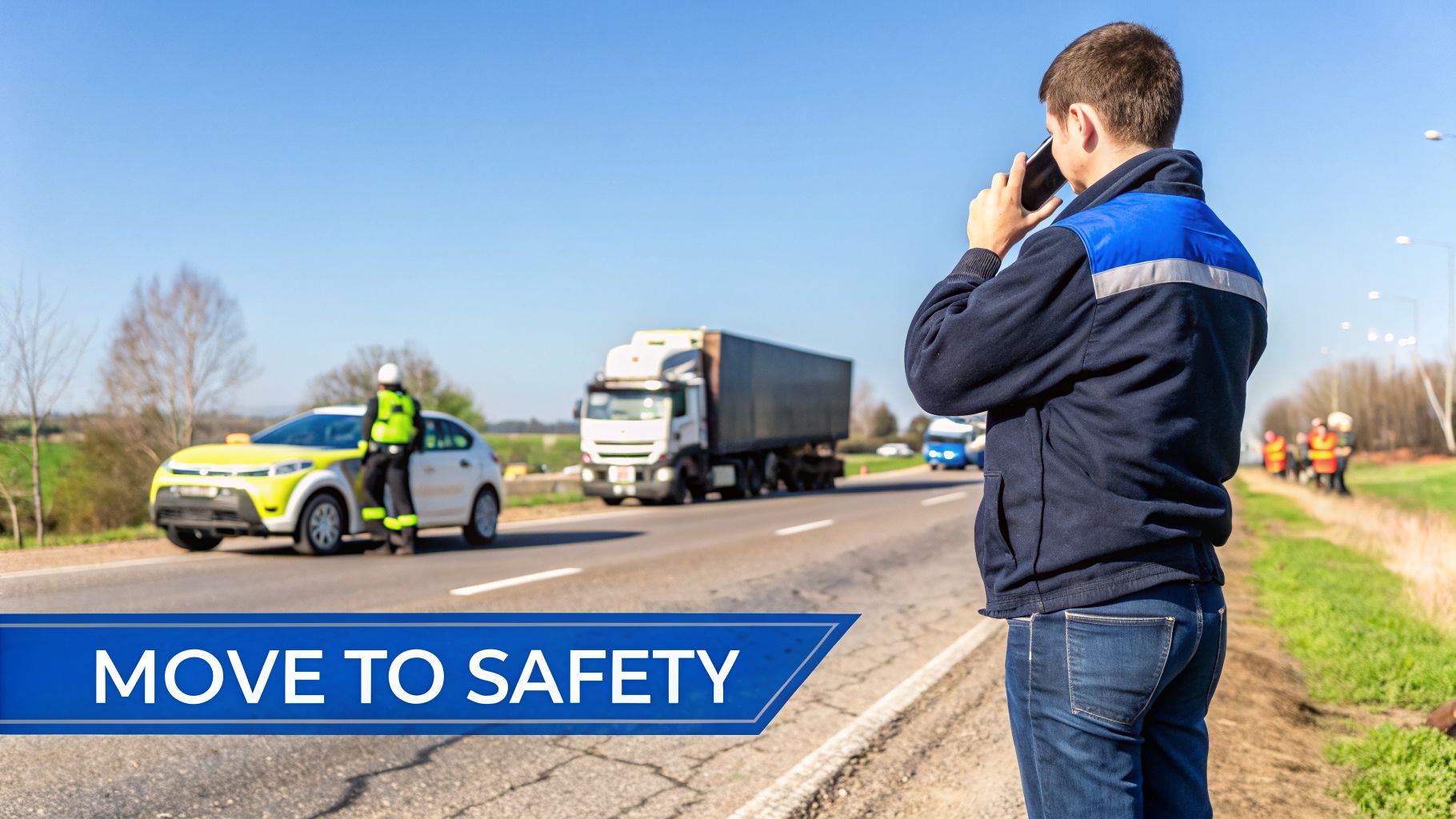
Prioritize Safety Above All Else
Before you do anything else, take a breath and assess your surroundings. Is your car in the path of oncoming traffic? If you can safely move it to the shoulder or a nearby side street, do it. Flip on your hazard lights immediately to warn other drivers.
But if you’re seriously injured or your vehicle is too damaged to move, don’t risk getting out. This is especially true on busy Florida highways like I-75 or I-4. Stay in your vehicle with your seatbelt fastened until first responders get there. It’s the safest place you can be.
Call 911 Without Delay
Dialing 911 is non-negotiable, even if the accident seems minor. This one call sets two crucial things in motion:
- It brings the police. An officer will create an official crash report, which is one of the most important pieces of evidence you can have. It provides an objective, third-party account of the scene, the vehicles involved, and any initial findings.
- It summons medical help. You need to be evaluated by paramedics. Adrenaline is a powerful pain-masker, and serious injuries like concussions or internal bleeding might not show symptoms for hours or even days. Refusing medical attention at the scene is a mistake insurance companies love to see—they’ll argue your injuries must not have been that bad or happened sometime after the crash.
A formal police report and an on-scene medical evaluation are the first two pillars of a solid personal injury claim. Without them, it’s just your word against a massive trucking company and their legal team.
Watch What You Say
In the aftermath of a crash, it’s human nature to be apologetic. Fight that urge. Never say things like “I’m so sorry” or “I didn’t see you,” as these can be twisted into an admission of fault.
When you talk to the police, stick to the facts. When you exchange information with the truck driver, give them only the essentials: your name, contact info, and insurance details. Don’t get into a discussion about what happened or how you feel. Remember, the driver, their company, and their insurer are not on your side. For a deeper dive, read our guide on the essential steps to take after you’re involved in a truck accident.
These accidents happen with alarming frequency. The Federal Motor Carrier Safety Administration (FMCSA) reports that large trucks are involved in nearly 494,000 crashes across the U.S. each year. These wrecks lead to around 5,700 fatalities and 110,000 injuries annually. Here in Hillsborough County, with major freight routes crisscrossing our community, those numbers feel very close to home. Taking these deliberate first steps is your best defense in those critical moments after a collision.
How to Gather Critical Evidence at the Scene
The moments after a truck crash are chaotic, but the scene itself is a treasure trove of evidence. This evidence is temporary. Once the vehicles are towed and the road is cleared, it’s gone forever. What you do in these first few minutes can make or break your case against a powerful trucking company.
Think of your smartphone as your most powerful tool. It’s time to become an investigator and meticulously document everything before it’s altered.
Your Photographic Checklist
There’s no such thing as too many photos. Your goal here is to paint a complete picture of what happened from every possible angle.
Here’s what you need to capture:
- Vehicle Damage: Get in close to photograph the damage on your vehicle and the truck. Then, step back and take wider shots to show the full scope of the impact in context.
- The Big Picture: Pan out and take photos of the entire scene. Show where all the vehicles ended up, nearby traffic signals or signs, and the overall layout of the road.
- Road Conditions: Are there skid marks? Debris from the crash? Potholes or a nearby construction zone? Snap pictures of anything that might have played a role.
- Weather and Lighting: Document the conditions. If it was raining, get a shot of the wet pavement. If the sun’s glare was a factor, try to capture it. If it was dark, show how poor the lighting was.
Capturing Truck-Specific Details
Commercial trucks are covered in identifying numbers and logos that are vital for your claim. This information helps us track down everyone who could be responsible—not just the driver, but the trucking company, the cargo owner, and even the company that handles their maintenance.
Make sure you get clear photos of:
- The truck’s license plate.
- The trucking company’s name and logo on the tractor or trailer.
- The USDOT number and any other identifying numbers on the side of the truck.
Think of these numbers as the truck’s fingerprint. They allow an attorney to pull up the company’s entire history—safety records, past violations, and insurance details—from federal databases. It’s evidence they can’t make disappear.
Finding Witnesses and Exchanging Information
Photos are powerful, but an eyewitness account from a neutral third party can be incredibly compelling. If anyone stopped and saw what happened, politely ask for their name and phone number. Their story can back up your version of events and cut through any lies the truck driver might tell.
When you speak to the truck driver, keep it short and professional. Just exchange the essentials:
- Your name and contact info
- Your insurance company and policy number
- Get the driver’s name, contact info, and their employer’s name
Do not talk about the crash. Don’t say you’re sorry, don’t guess about what happened, and never admit any fault. A simple “I didn’t even see him” can be twisted and used against you later by their insurance adjuster.
Trucking companies often have investigators on the way to the scene within the hour. Your job is to gather the raw facts before they get there and try to spin the story. The evidence you collect is your shield. Its preservation is absolutely critical, because if the other side destroys it, that can have serious legal consequences. You can learn more about this in our guide on what spoliation of evidence is.
Why Immediate Medical Care Is Non-Negotiable
In the moments after a crash with a massive commercial truck, your body is flooded with adrenaline. It’s a natural survival instinct, but it’s also incredibly misleading. Adrenaline can mask even severe pain, making you feel “okay” when you might be seriously hurt.
This is precisely why getting a full medical evaluation right after a truck accident isn’t just a good idea—it’s absolutely critical. What you might dismiss as minor soreness could be a sign of a much deeper problem. Trust me, walking away from the scene without being checked out by a professional is a huge gamble, both for your health and for your potential legal claim.

Uncovering Hidden and Delayed Injuries
I’ve seen it time and time again: many of the worst injuries from truck accidents don’t show up right away. Symptoms can take hours, days, or even a couple of weeks to fully surface. By that point, you can bet the trucking company’s insurer will be ready to argue that your injuries must have happened somewhere else.
Some of the most common delayed-onset injuries include:
- Whiplash: The violent jolt to your head and neck can lead to debilitating pain, stiffness, and headaches that creep in a day or two later.
- Concussions and Traumatic Brain Injuries (TBIs): You don’t have to be knocked unconscious to have a TBI. Watch for symptoms like confusion, dizziness, memory fog, or blurred vision that might develop gradually.
- Internal Bleeding: This is one of the scariest ones. Damage to internal organs is life-threatening and often has no immediate outward signs.
- Spinal Cord Injuries: Small fractures or herniated discs might not scream for attention at first but can worsen significantly over time, leading to chronic, debilitating pain.
Getting to a doctor immediately allows them to run the right diagnostic tests—like X-rays or a CT scan—to find these hidden issues before they escalate.
A doctor’s exam right after the crash creates an official, time-stamped record of your physical condition. This medical report becomes the single most powerful piece of evidence linking your injuries directly to the negligence of the truck driver or their company.
Building Your Case with Medical Records
From a legal standpoint, your medical records are the foundation of your entire injury claim. Without them, it’s just your word against a multi-billion dollar insurance company that has every financial incentive to deny or downplay what happened to you.
A prompt medical evaluation does two crucial things for your case. First, it establishes causation—proving the crash caused your injuries. Second, it documents the severity of those injuries, which is the key to calculating the compensation you rightfully deserve.
The Federal Motor Carrier Safety Administration (FMCSA) reports that large trucks are involved in nearly 500,000 crashes every year, leading to about 110,000 injuries. Here in Florida, with our busy highways, we see victims suffering from severe whiplash, fractures, and traumatic brain injuries all the time. Those medical records are everything, especially when you consider that insurers are known to dispute over 40% of soft-tissue injury claims that aren’t documented immediately. To learn more about how insurance works in these cases, read our detailed guide on Personal Injury Protection coverage in Florida.
Following Through with Your Treatment Plan
The work doesn’t stop after your first trip to the ER or urgent care. Following your doctor’s treatment plan to the letter is just as important. Insurance adjusters are trained to look for any excuse to argue that you weren’t really hurt or that you made your own condition worse.
Here’s what that means for you:
- Attend all your follow-up appointments, whether with your primary doctor or a specialist.
- Fill your prescriptions and actually take the medication as directed.
- Go to every single physical therapy or rehab session.
- Keep a simple journal to track your pain levels and how your injuries are affecting your day-to-day life.
Every missed appointment is a red flag to an insurer. They’ll use it to argue that you must have been feeling better and that any ongoing issues are your own fault. Consistent follow-through shows you’re serious about your recovery and creates a solid, unbroken chain of evidence. This meticulous record is your best weapon for getting the full and fair compensation you need for your medical care.
Handling Calls from Insurance and Trucking Companies
It won’t take long. Sometimes just hours after a serious truck accident, your phone will ring. The voice on the other end will sound incredibly friendly, concerned even. It will be an insurance adjuster from the trucking company, and you need to understand one thing immediately: they are not on your side.
Their job is to save their company money, period. Every question they ask is a calculated move, a carefully worded trap designed to get you to say something—anything—that can be used to minimize their financial responsibility. You’ve just been through a traumatic event; they do this for a living.

“Can We Get Your Recorded Statement?”
One of the first things the adjuster will ask for is a recorded statement. They’ll make it sound like a standard, harmless formality to “get your side of the story” and get your claim moving.
Politely but firmly say no.
Insurance adjusters are trained professionals. They know how to ask seemingly innocent questions that box you into a corner. A simple “How are you feeling today?” is a classic example. If you reply with a reflexive “I’m okay” or “Fine, thanks,” you can bet that will be noted. Later, when your real injuries become apparent, they’ll use your own words to argue that you couldn’t have been hurt that badly.
A recorded statement serves only one purpose: to give the insurance company ammunition to deny, delay, or drastically reduce your claim. In Florida, you are under no legal obligation to provide one to the other party’s insurer.
The Lure of the Quick Settlement
Another favorite tactic is the early, lowball offer. An adjuster might call within days of the wreck, dangling a check for a few thousand dollars. They know you’re stressed about medical bills and a damaged car, and they’re banking on you seeing it as a quick fix.
Taking that offer is a huge mistake. It almost never comes close to covering the actual cost of your injuries, especially since many serious conditions don’t show up right away. Once you sign their release, you sign away your rights forever. There’s no going back for more money when you find out you need surgery or months of physical therapy.
After you’ve handled the immediate aftermath at the scene and seen a doctor, dealing with insurance companies is the next hurdle. This step-by-step guide on filing an auto insurance claim provides some excellent foundational knowledge for this part of the process.
Your Script for That Inevitable Call
So, what exactly should you do when the adjuster calls? You don’t have to be confrontational, but you must be disciplined.
Keep the conversation incredibly brief and stick to the bare minimum facts. Here’s all you should ever provide:
- Your full name and contact info.
- The date and location of the crash.
- The make and model of your car.
That’s it. When they push for details about the accident, your injuries, or anything else, simply say: “I’m not discussing the details of the accident right now. Please direct all future questions to my attorney.”
Don’t apologize. Don’t guess about what happened. Don’t discuss your medical status. Just repeat that phrase if you have to, and then end the call. Your only job is to focus on getting better.
Let a legal professional handle the back-and-forth with the insurance company. By funneling all communication through your lawyer, you build a protective wall, ensuring your case is built on solid evidence, not a casual conversation designed to trip you up. To get a better sense of what’s happening behind the scenes, our guide on how to negotiate with insurance companies can shed some light on their strategies.
When to Hire a Tampa Truck Accident Attorney
A fender bender with another car is one thing. A collision with a fully loaded, 80,000-pound commercial truck is something else entirely. The stakes skyrocket, and the legal mess gets complicated—fast. This is why getting a Tampa truck accident attorney on your side isn’t a luxury; it’s a critical step to protect yourself and your family.
You have to understand, from the moment the crash happens, the trucking company and its insurance carrier are already in damage control mode. They often have investigators and lawyers on the way to the scene within hours, all working to shape the story and reduce their financial exposure. You need someone in your corner doing the same thing, just as quickly.
The Tangled Web of Fault and Federal Rules
Unlike a typical car crash, a truck accident often involves more than just one at-fault party. The blame can be spread across several companies and individuals, and a lawyer who’s been down this road before knows exactly where to dig.
Who could be on the hook?
- The Truck Driver: Was the driver texting, speeding, or pushing past their legal driving limits? Fatigue is a huge factor in these cases.
- The Trucking Company: Did the company cut corners on safety? Maybe they hired a driver with a bad record or pressured them to violate federal hours-of-service regulations to make a deadline.
- The Maintenance Crew: If the truck’s brakes failed or a tire blew out, the company responsible for its upkeep could be liable for shoddy work.
- The Cargo Loader: Cargo that isn’t properly secured can shift mid-transit, causing the driver to lose control. The company that loaded the trailer could be at fault.
- The Manufacturer: Sometimes, a defective part on the truck itself is the root cause, which brings the vehicle or parts manufacturer into the picture.
Untangling this requires more than just knowing Florida traffic laws. It demands a deep knowledge of the complex Federal Motor Carrier Safety Administration (FMCSA) rulebook. An attorney specializing in truck accidents can launch the right kind of investigation to identify every single party that shares responsibility.
Evidence Can Disappear. Fast.
In a truck accident case, some of the most important evidence has an expiration date. Trucking companies aren’t required to hold onto things like driver logs or maintenance records forever. If your attorney doesn’t move quickly, that proof can be legally destroyed.
A spoliation letter is one of the first and most powerful tools your attorney will use. It’s a formal legal demand that orders the trucking company to preserve every piece of potential evidence related to the crash. It stops them from conveniently “losing” or overwriting critical data.
This evidence is the lifeblood of your case: the truck’s “black box” data recorder, driver logbooks, maintenance reports, post-accident drug and alcohol test results, and shipping manifests. Without it, proving negligence is an uphill battle.
Don’t Go Up Against Corporate Giants Alone
Let’s be clear: trucking companies and their insurers are massive corporations. Their legal teams and adjusters are trained professionals whose entire job is to minimize payouts. They will try to get a recorded statement from you to twist your words later, or they’ll offer a quick, lowball settlement before you even know the full extent of your injuries and future medical needs.
An experienced lawyer completely changes the dynamic. They become your shield, handling all communication with the insurance companies so you don’t fall into their traps. They also bring in their own experts—accident reconstructionists, medical specialists, and financial analysts—to build a case that proves exactly what happened and what your claim is truly worth. We’re not just talking about your current medical bills; we’re talking about future surgeries, lost earning potential, and the real-world impact of your pain and suffering.
If you’re feeling overwhelmed and unsure what to do next, you can learn more about finding qualified truck accident attorneys near you right here on our site. Remember, time is not on your side. Florida has strict deadlines for filing a lawsuit, so acting quickly is essential.
Common Questions After a Florida Truck Accident
After a wreck with a commercial truck, it’s completely normal for your head to be spinning with questions. The path forward feels foggy, but getting clear, straight answers is the first real step toward taking back control. I’ve put together some of the most common questions we hear from victims just like you to help provide some much-needed clarity.
Every crash is different, of course, but having a solid grasp of these key issues will empower you to make smarter decisions for your health, your family, and your future.
How Long Do I Really Have to File a Lawsuit in Florida?
In Florida, the clock starts ticking the moment the accident happens. The state’s statute of limitations gives you two years from that date to file a personal injury lawsuit. This isn’t a suggestion; it’s a hard deadline.
Miss that two-year window, and the courthouse doors will almost certainly be closed to you forever. You’ll lose your right to seek any compensation. That’s why it’s so critical to talk to an attorney long before the deadline approaches—a thorough truck accident investigation takes time, and you can’t build a strong case overnight.
Should I Take the First Settlement Offer from the Insurance Company?
My advice? Almost never. That first offer from an insurer is rarely their best one. Think of it as a starting point—and a very low one at that. It’s a quick, lowball number designed to make your case go away before you realize what your claim is truly worth.
Insurance adjusters know you’re stressed about medical bills piling up and paychecks you’re missing. If you accept that initial offer, you sign away your rights to any future compensation. It doesn’t matter if your injuries end up being much worse than you first thought; the case is closed.
Always have a seasoned truck accident attorney look over any settlement offer before you even think about signing. We know how to calculate the real value of your claim, accounting for future surgeries, long-term care, lost earning potential, and the human cost of pain and suffering.
What if I Might Be Partially to Blame for the Crash?
This is a common worry, but it doesn’t automatically kill your case. Florida uses a modified comparative negligence rule. In simple terms, this means you can still recover damages even if you were partly at fault, with one major catch: you can’t be found more than 50% responsible for the accident.
If you are 50% or less at fault, your final compensation is just reduced by your percentage of blame. For instance, if a jury decides you were 10% at fault for the collision, your total award would be cut by 10%. Insurers love to exploit this rule by trying to shift as much blame as possible onto you to shrink their payout. Having a lawyer to fight back against these tactics is crucial.
How Much Does It Cost to Hire a Good Truck Accident Lawyer?
This is the best news I can give you. At our firm, we handle all truck accident cases on a contingency fee basis. We set it up this way so that anyone can afford to get top-tier legal help, no matter their financial situation.
Here’s what that means for you, plain and simple:
- You pay zero dollars upfront.
- We advance all the costs needed to investigate and pursue your case.
- We only get paid if we successfully recover money for you, and our fee is just a percentage of that recovery.
Put another way, if we don’t win, you don’t pay us a dime. This takes all the financial risk off your shoulders, so you can focus 100% on getting better while we handle the fight. You can often find more details on topics like this in legal resources like Justice Today’s blog, which explains these concepts well. Our approach ensures you have a dedicated advocate fighting for you from the very beginning.
If you’ve been hurt in a crash with a commercial truck, you don’t have to face the trucking and insurance companies alone. The legal team at Martin Hernandez, P.A. is ready to stand up and fight for the full and fair compensation you are owed. Contact us today for a free, no-pressure consultation to learn about your rights and options by visiting https://injurylawyersoftampa.com.