
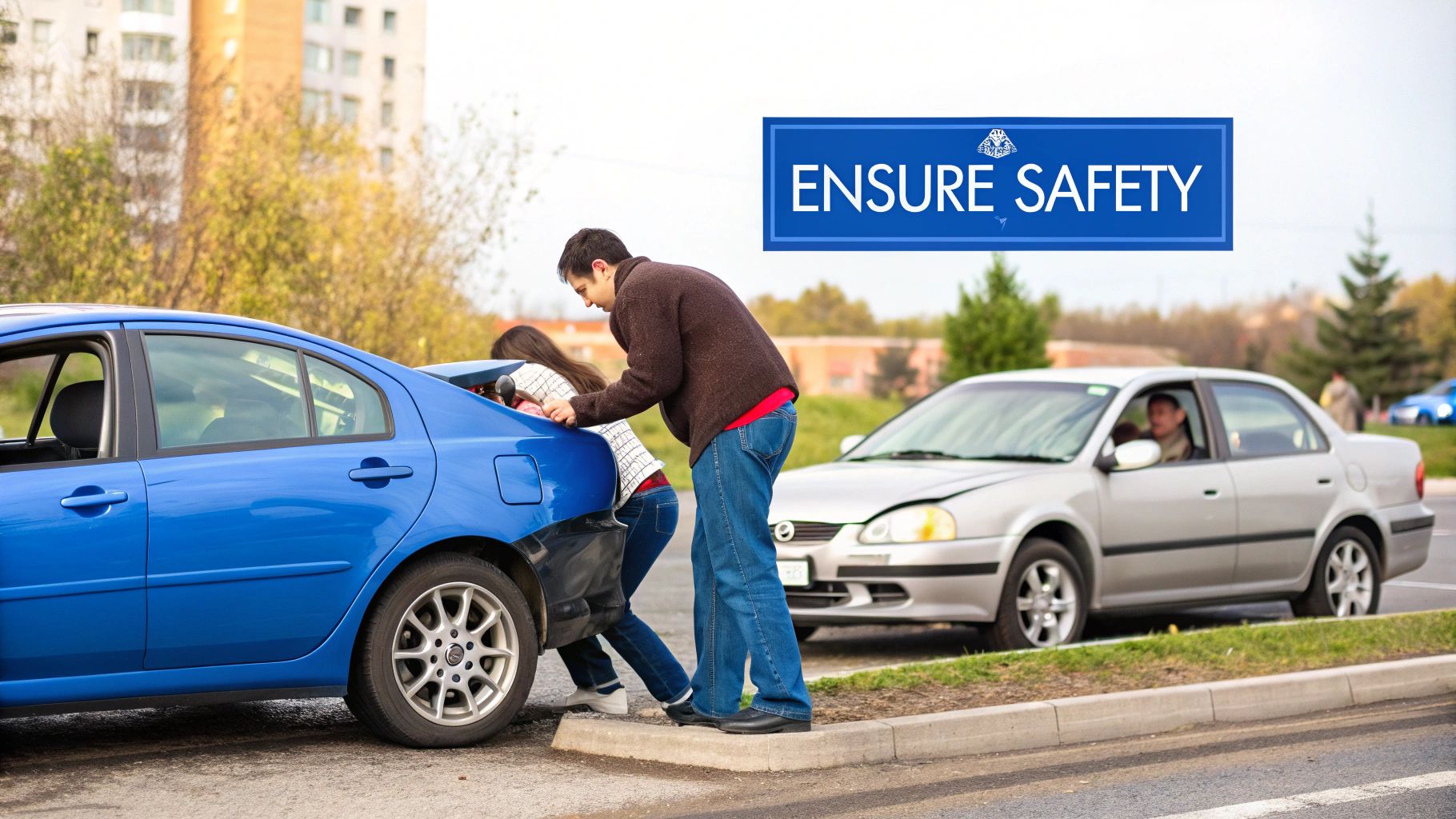
In the moments right after a car accident, everything feels chaotic. Your first moves are absolutely critical, and they all boil down to one thing: safety. You need to secure the scene to prevent another crash, check on everyone involved, and get emergency services on the way with clear information. How you handle these first few minutes lays the groundwork for everything that comes next, from your medical recovery to any potential legal claims.
First Steps at the Scene of the Accident
The minutes after a collision are a blur of adrenaline and confusion. It’s natural to feel completely overwhelmed, but knowing the right steps to take can protect both your health and your legal rights. Your actions on the scene are the first, and arguably most important, building blocks for a strong insurance claim.
This guide breaks down exactly what to do in those first critical moments.

As you can see, it’s a clear process: secure the area, check for injuries, and dial 911. These are the non-negotiable first actions to take control of the situation.
Prioritize Safety Above All Else
Before you do anything else, you have to prevent more harm. If the accident was minor and your car can still move, carefully drive it to the shoulder or a nearby safe spot, well out of the way of traffic. This one move can make a huge difference by reducing the risk of a secondary collision, which happens all too often on busy Florida roads.
Once you’re out of immediate danger, hit your hazard lights. This makes you much more visible, especially if it’s dark or the weather is bad. If you have reflective triangles or flares in your trunk, now is the time to use them. Place them well behind your vehicle to give other drivers plenty of warning.
Check on Everyone Involved
With the vehicles secured, your next focus is people. Check on yourself, your passengers, and then the people in the other vehicle. A simple, clear question like, “Is everyone okay?” is a good start. Even if you feel perfectly fine, be aware that adrenaline is a powerful painkiller and can easily mask serious injuries like whiplash or internal damage.
Here’s a critical rule I always tell my clients: never move someone who is seriously injured, complaining of neck or back pain, or unconscious. You could cause permanent paralysis by trying to move someone with a spinal injury. The only time you should ever attempt to move them is if there’s an immediate, life-threatening danger, like a vehicle fire.
Make the Call to 911
Even if an accident seems minor, calling 911 in Florida is always the smart move. In fact, you’re required to call law enforcement for any crash that involves an injury, death, or property damage that looks to be $500 or more. A police officer will arrive and create an official crash report, which is an essential piece of evidence you’ll need for your insurance claim.
When you call 911, be ready to give the dispatcher clear, simple information:
- Your exact location: Use street names, the nearest cross-street, a mile marker, or any easy-to-spot landmarks.
- A quick summary of the accident: Just the basics—what happened and how many cars are involved.
- Any known injuries: Let them know if anyone is hurt so they can dispatch the right medical help.
Giving accurate details helps the first responders get there faster. While you wait for them to arrive, don’t get into a debate about what happened or admit fault to the other driver. Stick to the facts. The actions you take at the scene are just the beginning; you can learn more about what evidence you should preserve after a car accident in Tampa to protect your rights.
Gathering Crucial Information and Evidence
Once you’ve made sure everyone is safe and the scene is secure, your focus has to shift. You need to become an investigator, right then and there. What you document in the first few minutes after a crash can make or break your entire case, whether it’s with an insurance company or in court. Memories get fuzzy fast, and once the cars are towed, the evidence is gone for good.
The key is to be methodical. That window of time while you’re waiting for the police is golden. Your smartphone is the best tool you have, so get it out and start using it.
Exchanging Key Information
This is the part where you need to interact with the other driver. It’s easy to get flustered, but try to stay calm, polite, and focused on getting the essentials.
The easiest way to avoid mistakes? Just ask to take a clear photo of their driver’s license and their insurance card. It’s much more reliable than trying to scribble down long names and policy numbers when your adrenaline is pumping.
Make sure you get this information from the other driver:
- Full Name and Contact Information: You’ll need their current address and a good phone number.
- Driver’s License Number: This is the most accurate way to identify them.
- Insurance Company and Policy Number: This is non-negotiable. You can’t start a claim without it.
- Vehicle Details: Get the make, model, color, and, most importantly, the license plate number of their car.
Be careful what you say here. Stick to the facts and avoid saying “I’m sorry” or anything that sounds like you’re admitting fault. An insurance adjuster can and will use those words against you later.
Using Your Smartphone to Document Everything
Photos and videos are incredibly powerful. They tell a story without bias and capture details you might not even notice at the time. Don’t just snap a couple of pictures—take way more than you think you need.
You’re trying to build a complete picture for someone who wasn’t there. We’ve put together a more detailed guide on how to take good photos after a car accident, which can really help you capture the most compelling images. A handful of good photos can be the difference between a quick settlement and a drawn-out fight.
Your photo and video log should cover:
- Damage to All Vehicles: Get close-ups of the damage on both your car and theirs. Then, step back and take wider shots to show the damage in context. Get every angle.
- The Overall Scene: Take pictures from different vantage points to show where the cars ended up after the crash.
- Road Conditions and Debris: Look for skid marks, broken glass, or any car parts on the road. Document it all.
- Relevant Surroundings: Photograph traffic lights, stop signs, speed limit signs, or anything that might have played a role, like a bush blocking a clear view.
- Visible Injuries: If you or a passenger has a cut, bruise, or scrape, take a picture of it right away. These things can heal or fade quickly, so a photo provides immediate proof.
Identifying and Speaking with Witnesses
A neutral witness is often your best asset. Their version of events can carry a lot of weight, especially if the other driver starts changing their story. The problem is, witnesses tend to disappear once they see police lights, so you have to move quickly.
Just walk up and politely ask, “Did you see what happened?” If they did, ask if they’d be willing to give you their name and number. Most people are happy to help if you just ask.
Jot down their contact info in your phone or on a piece of paper. A simple statement from an unbiased bystander can be the one thing that proves you weren’t at fault.
Reporting The Accident In Florida
Once you’ve handled the immediate aftermath at the scene, it’s time to deal with the official reporting. This isn’t just one phone call; it’s a two-part process that involves both the police and your insurance company. How you navigate these conversations is critical, as Florida has some very specific laws you need to follow.

Getting this part right is absolutely essential for protecting your rights and making sure your recovery process starts off on solid ground.
When To Report A Crash To The Police
You might be surprised to learn that not every little fender-bender in Florida legally requires a police report. That said, the threshold is so low that it’s almost always the best move to call them.
Under Florida law, you absolutely must report a crash to the local police, sheriff, or Florida Highway Patrol if it involves:
- Any injury or death. This includes even minor complaints of pain.
- Property damage that looks like it’s $500 or more. A broken headlight or a dented bumper on a modern car can easily hit this number.
- A hit-and-run driver.
- A driver who appears to be intoxicated.
When you really look at these rules, you can see why it’s a good idea to report nearly everything. An official police report creates an impartial, third-party record of what happened, which becomes a vital piece of evidence for your insurance claim down the road.
Notifying Your Insurance Company
Your next call should be to your own insurance agent. Pretty much every car insurance policy has a “notice clause” that requires you to report an accident promptly, no matter who you think was at fault.
If you wait too long, your insurance company could have grounds to deny your claim. When you make the call, just stick to the facts. Give them the date, time, location, and a simple description of what happened. Don’t guess about who was at fault or how badly you’re hurt—it’s too early to know for sure.
First responders often use specialized tools to manage these situations efficiently. For instance, many departments rely on platforms like the Resgrid Mobile Applications for Incident Management to coordinate and document crash scenes, ensuring all the critical data is captured accurately from the very beginning.
To help you keep track of these crucial first steps, here is a quick checklist of your reporting duties.
Florida Accident Reporting Checklist
To ensure you don’t miss any critical deadlines, here’s what you need to do and when:
- Call 911/Police: This should be done immediately at the scene. It is required by Florida law for any crash with injuries or significant damage, and it creates an essential official record.
- Notify Your Insurer: You should do this as soon as possible, ideally within 24 hours of the accident. This fulfills your policy’s notice requirement and helps prevent a potential claim denial.
- Provide Basic Facts Only: When you make that first call to your insurance company, stick to the known facts. Avoid speculating about fault or the extent of your injuries, as this could be used against you later.
- Get the Police Report Number: Be sure to get the report number from the officer at the scene. If you forget, you can call the police department later. You’ll need this number to get a copy of the official report for your claim.
Following these steps methodically will protect your rights and set the stage for a smoother claims process.
What You Need To Know About Florida’s No-Fault System and PIP
One of the biggest sources of confusion for Florida drivers is our “No-Fault” insurance system. The whole point of this system is to speed up the process for getting your initial medical bills paid, without having to wait for a fault determination.
This is where your Personal Injury Protection (PIP) coverage comes in. Every Florida driver is required to have it, and it’s your first line of defense for covering medical costs and lost income after a wreck.
Here’s a quick breakdown of how it works:
- Your PIP policy will cover 80% of your initial medical bills.
- It also covers 60% of any wages you lose because of your injuries.
- The standard PIP benefit is $10,000.
Key Takeaway: You always turn to your own insurance company first for immediate medical needs.
But “no-fault” doesn’t mean the at-fault driver gets off scot-free. If your expenses go beyond what your PIP covers, you absolutely have the right to file a claim against the other driver’s insurance. To get a more detailed look, our firm put together a guide that explains exactly what “no-fault” means in Florida and how it affects your case.
Why You Must Get Checked Out by a Doctor
Right after a car accident, your body is flooded with adrenaline. It’s a powerful natural painkiller that can easily mask serious injuries, making you feel perfectly fine when you’re actually hurt. This is why getting a medical evaluation is non-negotiable, even if you think the crash was minor and you feel okay.
So many common car crash injuries—like whiplash, concussions, or even internal bleeding—don’t show up right away. You could walk away from the scene feeling a little sore but otherwise fine, only to wake up a day or two later with severe pain, dizziness, or other frightening symptoms.
The Hidden Dangers of Delayed Symptoms
Putting off that initial doctor’s visit is a huge gamble. Soft tissue injuries, which affect muscles and ligaments, are notorious for having delayed symptoms. That “minor” neck ache you feel can easily turn into chronic pain and limited mobility if you don’t get it properly diagnosed and treated from the start.
But it’s not just about your health. Seeking prompt medical care creates an official, time-stamped record that directly connects your injuries to the accident. This piece of paper is the foundation of any insurance claim or legal action. Without it, you can bet the insurance adjuster will try to argue your injuries happened sometime after the crash, not because of it.
Florida’s Critical 14-Day PIP Rule
Here in Florida, we have another urgent, time-sensitive reason to see a doctor: the Personal Injury Protection (PIP) 14-day rule. This is a hard deadline you absolutely cannot miss.
Under our state’s no-fault insurance system, you are required to get initial medical treatment within 14 days of the accident to qualify for your PIP benefits. If you wait until day 15, you lose your right to that coverage. Simple as that. We’ve written a detailed guide explaining everything you need to know about the Florida PIP 14-day rule, and I highly recommend every Florida driver read it.
The law is completely unforgiving on this. It doesn’t matter how badly you’re hurt; if you miss that two-week window, you’re on the hook for medical bills that your own insurance policy was supposed to cover.
Key Takeaway: In Florida, seeing a doctor within two weeks isn’t just a smart health decision—it’s a legal and financial requirement to protect your right to your insurance benefits.
Building Your Case with Strong Medical Documentation
Think of your medical records as your best line of defense. They are powerful, objective evidence that tells the story of your injuries when an insurance company tries to minimize what you’ve been through.
A strong medical file will contain:
- Doctor’s Notes: Every detail from your first exam and all follow-up visits.
- Diagnostic Results: Copies of all X-rays, MRIs, or CT scans that document the physical damage.
- Treatment Plans: The official plan from your doctor outlining your path to recovery, whether it’s physical therapy, medication, or specialist visits.
- Billing Statements: A complete and organized record of every medical bill you receive.
This paper trail draws a clear, undeniable line from the moment of impact to your current physical condition. Statistics from organizations like the National Safety Council consistently show that the actions taken immediately after a crash dramatically influence both health outcomes and legal ones. Getting medical help is at the top of that list.
It’s also a good idea to understand what supplemental health insurance coverage might offer, as it can provide another layer of financial protection. In the end, putting your health first is the single most important thing you can do for your recovery and for the strength of your potential claim.
When to Contact a Personal Injury Attorney
After a car crash, you’re trying to heal, get your car fixed, and just get back to normal. The last thing you want is another full-time job managing an insurance claim. While a simple fender-bender might not need a lawyer, there are definitely times when trying to go it alone is a huge mistake.
The minute an insurance adjuster calls asking for a recorded statement or dangles a quick check in front of you, the game has changed. You’re now in a negotiation, and trust me, they have a lot more practice at this than you do.

Knowing the warning signs—the moments when you absolutely should call an attorney—can save you from making mistakes that could cost you thousands.
Red Flags That Signal You Need Legal Help
Some accidents are straightforward, but others can quickly turn into a legal maze. If you’re facing any of these situations, it’s a clear sign you need to talk to someone who does this for a living.
- Serious or Long-Term Injuries: If you’re dealing with broken bones, a concussion, or any injury that needs surgery or ongoing therapy, you can’t just guess what that will cost down the line. A good attorney brings in medical and financial experts to figure out the full value of your claim, including future treatments and what this injury means for your ability to work.
- Disputed Fault: Is the other driver pointing the finger at you? Is the police report vague or just plain wrong? This is when you need a professional investigator on your side. An attorney will dig for evidence—talking to witnesses, finding surveillance footage—to build a solid case that proves who was truly at fault.
- The Other Driver is Uninsured or Underinsured: You’d think making a claim with your own insurance company for an uninsured motorist (UM) incident would be easy. It’s often not. They can be just as difficult as the other guy’s insurer, trying to pay out as little as possible. An attorney fights to make sure you get the benefits you’ve been paying for all these years.
Key Takeaway: An attorney’s job is to level the playing field. We handle all the calls and paperwork with the insurance companies. This shields you from their pressure tactics and lets you focus on getting better.
The True Value of Professional Representation
A personal injury lawyer does a lot more than just fill out forms. We become your advocate, your strategist, and your shield, all with one goal: getting you the best possible outcome. We know the playbook insurance companies use to lowball claims, and we come prepared with the evidence and expert arguments to shut them down.
An experienced lawyer knows how to calculate the real scope of your damages, which is so much more than your current medical bills. We look at everything:
- Future Medical Expenses: Projecting the costs of future surgeries, physical therapy, and any long-term care you might need.
- Lost Wages and Earning Capacity: This covers not just the paychecks you’ve already missed, but also the income you stand to lose in the future because of your injuries.
- Pain and Suffering: Putting a number on the physical pain and emotional toll the accident has taken on you and your family.
Insurance adjusters are trained professionals whose job is to save their company money by settling your claim for the lowest amount possible. Without a lawyer, you’re at a serious disadvantage. We build a comprehensive demand package, backed by solid evidence, and we aren’t afraid to take your case to court if the insurer won’t be fair. That willingness to go to trial is often what gets them to offer what you truly deserve.
For a deeper look at this, check out our detailed guide on when to hire a personal injury lawyer.
Don’t Wait Too Long to Act
In Florida, the clock starts ticking the moment the accident happens. The state has a strict statute of limitations, which is just a legal term for a deadline. For most car accident and other negligence cases, you generally have two years from the crash date to file a lawsuit.
If you miss that deadline, your right to seek compensation is likely gone for good, no matter how strong your case is. Beyond that, evidence simply vanishes. Witnesses move away or their memories fade. Security camera footage gets erased. Calling an attorney quickly allows them to start investigating while the trail is still warm, preserving the crucial details that will make or break your claim.
Common Questions After a Florida Car Accident
The minutes, hours, and days after a car crash are a blur of adrenaline and confusion. Once the immediate chaos at the scene dies down, a whole new wave of questions starts to surface. Suddenly, you’re trying to navigate a maze of insurance jargon and legal deadlines, and getting clear, straightforward answers is critical.
Let’s cut through the noise and tackle some of the most pressing questions we hear from clients every day. Knowing what to do—and what not to do—can make all the difference for your recovery.
Should I Talk to the Other Driver’s Insurance Adjuster?
You can almost set your watch by it: soon after the accident, you’ll get a call from the at-fault driver’s insurance adjuster. They’ll probably sound friendly, concerned, and helpful. Don’t be fooled. Their one and only job is to protect their company’s profits by paying you as little as possible.
The adjuster will push for a recorded statement, hoping you’ll say something—anything—they can twist to their advantage. It’s incredibly easy to unintentionally downplay your injuries (“I’m a little sore, but okay”) or say something that sounds like you’re admitting partial fault for the crash.
Key Takeaway: You are under no legal obligation to give a recorded statement to the other driver’s insurance company. The best response is to politely decline and tell them your attorney will be in touch. This simple move is one of the most powerful ways to protect the value of your claim.
What If the Accident Was Just a Minor Fender-Bender?
Even if the damage looks superficial and you feel fine, you have to treat the situation seriously. For one thing, Florida law requires you to report any accident involving an injury or apparent property damage of $500 or more. A cracked bumper or even a deep scratch on a modern car can easily clear that bar.
More importantly, some of the most common car accident injuries—like whiplash, concussions, or soft tissue damage—don’t show up right away. You might walk away from the scene feeling fine, only to wake up the next day with blinding headaches or debilitating neck pain.
If you don’t document the incident properly, you open the door to major problems:
- The other driver could change their story and claim you caused more damage than you did.
- It becomes much harder to prove your injuries are from the crash if there’s no official report.
- You could lose your right to PIP benefits if you don’t get medical care within Florida’s strict 14-day rule.
No matter how minor it seems, always call the police, exchange information, and get a medical check-up.
How Does Florida’s No-Fault Law Affect My Case?
This is easily one of the most misunderstood aspects of Florida auto law. The term “No-Fault” doesn’t mean the at-fault driver gets off scot-free. It simply dictates how your initial medical expenses get paid.
Your own Personal Injury Protection (PIP) policy is the first line of defense, covering the first $10,000 of your medical bills and lost wages. The whole point is to get you immediate access to medical care without having to wait for the insurance companies to fight over who was at fault.
But that’s where its power ends. Once your injuries meet a specific legal threshold, you can—and should—step outside the No-Fault system and pursue a personal injury claim against the driver who caused the crash. To do this, your injury must be deemed permanent or involve significant and permanent scarring, disfigurement, or the loss of a bodily function. An experienced attorney can review your medical records to see if your case meets this “serious injury” threshold, allowing you to seek compensation for damages PIP never covers, like your pain and suffering.
What Steps Should I Take in a Hit-and-Run?
Getting hit by a driver who then speeds off is a uniquely frightening and frustrating experience. The most important thing is to stay calm and focus on the things you can control.
Here’s your immediate action plan:
- Jot Down Details: As soon as you can, write down every single thing you can remember about the other car—the make, model, color, and even a partial license plate number. Note which direction it was heading.
- Call 911 Immediately: Reporting the hit-and-run creates an official record and gets police on the case right away.
- Find Witnesses: Look around. Did anyone at the intersection or on the sidewalk see what happened? Ask them for their name and phone number.
- Scan for Cameras: Check nearby businesses, homes, or traffic light poles for security or traffic cameras that might have captured the incident.
After a hit-and-run, your own insurance policy is your lifeline. This is precisely why you have Uninsured/Underinsured Motorist (UM) coverage. It’s designed to step in and cover your damages when the at-fault driver can’t be found.
Trying to navigate the aftermath of a car accident on your own is overwhelming. You don’t have to do it alone. The legal team at Martin Hernandez, P.A. is here to answer your questions, deal with the insurance companies, and fight for the full and fair compensation you are owed. Contact us today for a free, no-obligation consultation to understand your rights and options.