
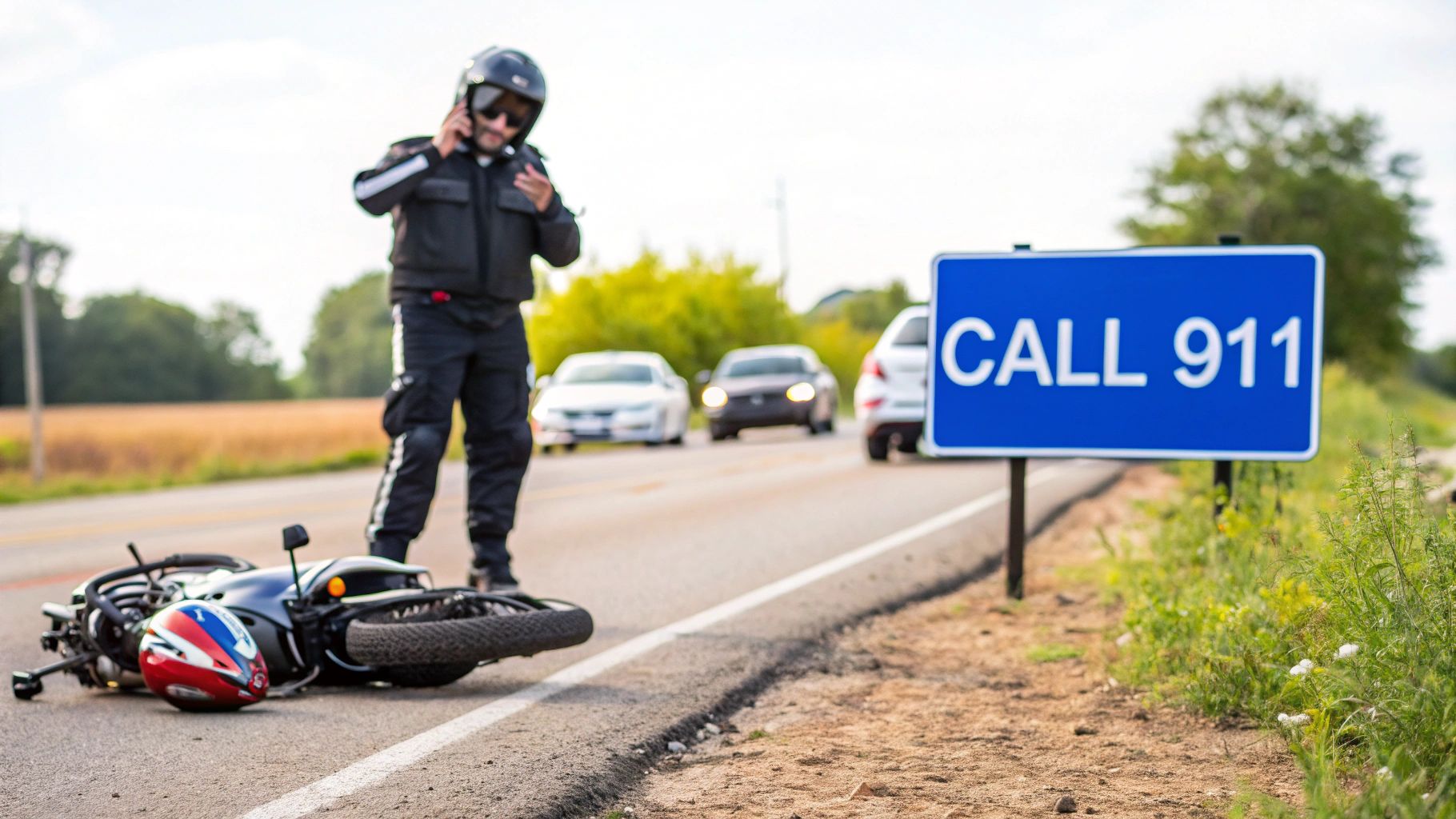
After a motorcycle wreck, the first thing on your mind has to be your safety and getting medical help. Adrenaline is a powerful drug and can easily mask serious injuries, so you need to call 911 right away. Don’t try to tough it out, even if the crash seems minor.
Once you’ve made that call and are safely out of the flow of traffic, that’s when you can start documenting what happened with your phone.
Your Immediate Actions At The Accident Scene
The first few moments after your bike goes down are a total blur. You’re dealing with confusion, a massive adrenaline dump, and very often, a lot of pain. What you manage to do in these critical minutes can make a huge difference for both your health and any future personal injury claim.
It’s almost impossible to think clearly in that kind of chaos, which is why knowing these steps beforehand is so vital for any rider in the Tampa area. How you respond right then and there sets the stage for everything that comes next.
Prioritize Your Health And Safety
Before you even think about your bike or the other driver, you have to assess your own body. Check yourself for injuries. If you’re seriously hurt or can’t move without intense pain, stay put. Don’t move. Just wait for the paramedics to arrive. Trying to stand up or walk with a potential spine injury or a broken bone can make things dramatically worse.
If you can move, get yourself to a safe spot immediately. That means getting to the shoulder, a sidewalk, or anywhere out of the path of traffic to avoid getting hit a second time. Leave your motorcycle where it is if moving it puts you at risk.
Adrenaline is a powerful pain masker. I’ve seen countless riders who felt “fine” right after a crash, only to find out hours later they were dealing with serious injuries like internal bleeding or a concussion. Never refuse a medical evaluation at the scene.
The vulnerability of riders is no secret, and the statistics are grim. In a recent year, a staggering number of motorcyclists died in crashes across the U.S. That figure represents a significant percentage of all traffic fatalities, even though bikes make up a small fraction of the vehicles on our roads. The fatality rate is shockingly high when compared to that of people in passenger cars.
This simple action plan breaks down the most important things to focus on right after a crash.
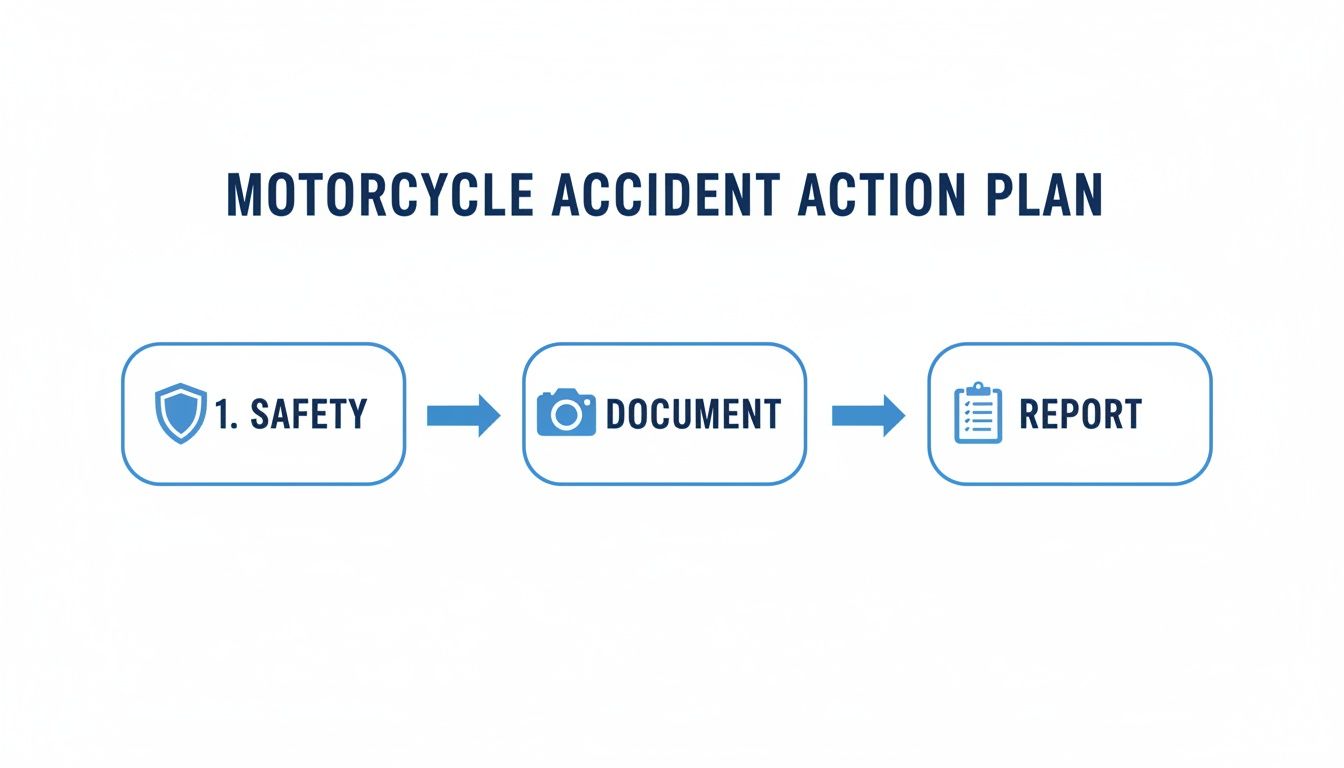
Keeping this “Safety, Document, Report” checklist in your head can give you a clear focus when you’re under extreme stress.
For a quick reference, here’s a summary of the most important things to do right at the scene.
At-Scene Action Plan Summary
- Check for Injuries: Your health is the top priority. Adrenaline can hide serious internal injuries.
- Call 911: This gets medical help on the way and creates an official police report of the incident.
- Move to Safety: Get out of traffic to prevent a second collision, which can be even more dangerous.
- Exchange Information: Legally required and necessary for insurance claims. Get names, insurance, and contact info.
- Document Everything: Photos of the scene, vehicles, and your injuries are powerful evidence.
- Get Witness Info: Independent witnesses provide a neutral account of what happened.
- Don’t Admit Fault: Avoid saying “I’m sorry.” It can be used against you, even if you were just being polite.
- Seek Medical Attention: Get checked out by EMTs at the scene and follow up with a doctor, even for minor pain.
These steps form the foundation of protecting both your physical well-being and your legal rights in the crucial moments following a collision.
What To Say And What To Avoid
After calling for help and getting to safety, you’re going to have to talk to the other driver and, eventually, the police. The words you choose matter a lot.
- Stick to the Facts: When you talk to the other driver or the police officer, just state the facts. “I was traveling south in the right lane, and the car pulled out from the side street.” Don’t guess, don’t get emotional, and don’t speculate on what you think happened.
- Avoid Admitting Fault: This is a big one. Never apologize or say things like “I’m sorry” or “I should have seen you.” Even if you’re just trying to be polite, insurance companies will twist those words into an admission of guilt.
- Exchange Information: Calmly get the essentials: names, phone numbers, driver’s license numbers, license plate numbers, and insurance policy information from the other driver. There’s no need to argue about who was at fault on the side of the road.
The basic rules for what to do after an accident are similar whether you’re on two wheels or four. In fact, our guide on what to do after a car accident in Florida has more general advice that’s useful for any motorist. The biggest difference for bikers is the much higher chance of serious injury and the unfair biases we often face. Staying calm and sticking to the facts at the scene helps build a credible foundation for your case from the very beginning.
Documenting Evidence And Interacting With Police
Once you’ve made sure everyone is safe, your focus needs to pivot immediately to evidence. The things you do and say in the moments after a crash will shape the official record that insurance companies and lawyers will pick apart later. It all starts with the police.
The police report becomes the foundation of your entire claim. When an officer from the Hillsborough County Sheriff’s Office or Tampa Police Department shows up, it’s time to cooperate fully. Give them a straight, factual account of what happened.
Try to avoid guessing about speeds, distances, or exact timing. If you’re not 100% sure about something, it’s better to say “I’m not sure” than to speculate. A guess that turns out to be wrong can create inconsistencies that insurance adjusters will use to challenge your credibility. Stick to what you know for a fact.
Your Role When Police Arrive
Before the officer leaves the scene, make it a point to get their name, badge number, and the official police report number. You’ll need this to get a copy of the report later, which serves as the official, third-party account of the accident.
But don’t rely solely on the police report. Your own documentation is just as critical, because the officer’s report might not capture every detail that matters. As the rider, you have a unique perspective that is absolutely essential for painting the full picture.
Start thinking like an investigator. What might an officer overlook? Jot down notes—mental or on your phone—about crucial factors:
- Road Conditions: Were there potholes, loose gravel, or oil slicks that contributed to the crash?
- Weather: Did a sudden downpour create a nasty glare or make the asphalt dangerously slick?
- Traffic Controls: Was a traffic light malfunctioning? Was a stop sign blocked by an overgrown tree branch?
- Sun Glare: Could the sun have been directly in the other driver’s eyes?
These aren’t just minor details; they can completely change the outcome of a case. Pointing out that a stop sign was hidden, for example, can be the key to proving the other driver was at fault.
After a crash, your memory is the sharpest it will ever be. Write down everything you can remember as soon as you can, no matter how small it seems. This immediate record is infinitely more powerful than trying to recall details weeks or even months down the road.
The Power Of An Independent Witness
While you’re gathering information, never underestimate the value of an independent witness. A neutral bystander who saw what happened can be a game-changer for your case because they have nothing to gain or lose.
Politely ask anyone who saw the crash for their name and phone number. You don’t need a full statement right there on the curb—just get their contact info so your attorney can follow up. Their testimony can shut down an insurance adjuster’s attempt to pin the blame on you, which is an all-too-common tactic used against bikers.
The need for this kind of solid proof is tragically constant. With multi-vehicle crashes making up a significant portion of rider fatalities, proving who was at fault is everything.
That’s why you must always call the police. In Florida, the law actually requires it for any crash with damages over $500.
This combination of the official report, your own notes, and witness accounts creates the strong foundation your legal claim needs. Once you have the police report in hand, the next challenge is making sense of it. Check out our guide on how to read a police accident report to learn how to decipher the codes and information it contains.
Navigating Medical Care And Proving Your Injuries
Unlike being inside a car, a rider’s body takes the full, brutal force of a collision. There’s no steel cage, no airbags, no seatbelts to absorb the impact. That’s exactly why getting a complete medical evaluation is absolutely non-negotiable, even if you feel like you just have a few scrapes and bruises.
The adrenaline that floods your system after a crash is a powerful painkiller. It can easily mask serious injuries—things like hairline fractures, internal bleeding, a concussion, or soft tissue damage that might not show symptoms for hours, or even days.
Why You Must Seek Immediate Medical Care
Delaying a medical check-up is one of the most damaging mistakes you can make for your health and your potential case. If you wait a week to see a doctor, an insurance adjuster will absolutely seize on that. They’ll argue your injuries couldn’t have been that serious, or even worse, that they happened after the accident and have nothing to do with the crash.
You survived the impact, but now a different kind of fight begins. Seeking immediate medical care is the first critical step in securing the compensation you’ll need to recover. Even if you think you’re fine, get checked out.
An immediate medical record creates a direct, undeniable link between the collision and your injuries. This is the bedrock of a strong claim.
A common insurance tactic is to downplay “soft tissue” injuries. But anyone who’s suffered through severe whiplash or a torn ligament knows the pain is very real and can be completely debilitating. Consistent medical documentation is your best weapon against this strategy.
Building Your Injury And Expense Dossier
From the moment you visit the ER or your family doctor, you need to start a dedicated file for everything related to your accident. This isn’t just about the big hospital bills; it’s about meticulously tracking every single cost, no matter how small it seems.
Think of this file as your evidence locker. It should include:
- Medical Bills: Keep copies of every bill from hospitals, doctors, chiropractors, physical therapists, and any specialists you see.
- Receipts: Save receipts for prescriptions, over-the-counter medications, braces, crutches, and any other medical supplies you have to buy.
- Proof of Payment: Document every single co-pay and deductible you have to pay out of your own pocket.
- Travel Costs: Keep a simple log of your mileage driving to and from doctor’s appointments. Those trips add up quickly and are a recoverable expense.
This detailed financial record is crucial for proving your economic damages. But real compensation goes beyond just what you’ve paid out. It also has to cover the human cost of the wreck.
Documenting The Human Impact
To capture the full scope of your suffering, start a simple daily journal. This doesn’t need to be some elaborate essay. Just a few notes each day can build a powerful narrative showing how the injuries have turned your life upside down.
Your journal should track:
- Pain Levels: Use a simple 1-10 scale to rate your pain each day.
- Physical Limitations: Note the things you suddenly can’t do, like lifting groceries, playing with your kids, or even just getting dressed without help.
- Emotional Toll: Be honest about feelings of anxiety, depression, frustration, or trouble sleeping. It all matters.
- Missed Activities: Write down when you had to miss work, cancel plans with friends, or give up hobbies you love because of your injuries.
Physical therapy and rehabilitation are often a huge part of recovery, and certain methods like Pilates for rehabilitation can be incredibly effective for rebuilding strength. Keep track of every appointment.
Together, your financial records and personal journal tell the complete story of the accident’s true cost. This gives your attorney the powerful evidence they need to fight for the full compensation you deserve. For Florida riders, it’s also important to know how medical expenses are handled, so you may want to review our guide on what PIP covers in Florida.
Why You Need A Tampa Motorcycle Accident Attorney
Let’s be blunt: insurance companies often walk into these situations with a bias against motorcyclists. It’s an unfortunate reality. They’ll look for any excuse to paint the rider as reckless or at least partially at fault, regardless of what the evidence shows. This is where a simple insurance claim quickly turns into a legal fight you don’t want to face alone.
If you’ve been seriously hurt, the other driver is trying to shift the blame, or an insurance adjuster is already hounding you for a recorded statement, those are red flags. Trying to navigate this minefield on your own puts your right to fair compensation at serious risk. Their team is trained to minimize payouts; you need an expert on your side, too.
When To Make The Call
Knowing the right moment to get a lawyer involved is key. You don’t have to wait until there’s a problem—in fact, being proactive can stop problems before they start.
It’s time to call a Tampa personal injury attorney if any of this sounds familiar:
- You’re Seriously Hurt: If your injuries mean a hospital stay, surgery, or a long road of physical therapy, the financial stakes are simply too high to go it alone.
- They’re Disputing Fault: The second the other driver or their insurer even hints that you were partially to blame, you need a professional to shut that down and defend your side of the story.
- The Adjuster is Pressuring You: Are you getting constant calls? Are they pushing for a recorded statement or dangling a quick, lowball settlement offer? Stop talking to them and call a lawyer.
- It’s a Complicated Mess: Cases involving uninsured or underinsured drivers, or policies from commercial vehicles, require a deep understanding of Florida’s complex insurance laws.
Bringing in an experienced attorney immediately levels the playing field. They take over all communications, shielding you from the high-pressure tactics of adjusters. This frees you up to focus on the one thing that truly matters: your recovery.
“Insurance adjusters are not your friends. Their job is to protect their company’s bottom line by paying out as little as possible. An attorney’s job is to protect your interests and fight for the maximum compensation you are legally owed.”
Preparing For Your First Consultation
The thought of meeting with a lawyer can feel intimidating, but that first conversation is usually just a relaxed, no-pressure chat. The goal is simple: for the attorney to understand what happened to you and for you to understand what your options are. You can make this meeting incredibly productive by grabbing a few key items beforehand.
Try to bring whatever you have from this list:
- The Police Report: Even just the official report number is a great start. A full copy is even better.
- Photos and Videos: Gather all the pictures and videos you managed to take at the scene.
- Medical Records: Any discharge papers from the E.R., initial doctor’s notes, or the first stack of medical bills are incredibly helpful.
- Insurance Information: Your own policy information and whatever details you got from the other driver.
Don’t sweat it if you can’t find everything. A good law firm has investigators who can help track down the rest. This initial batch of evidence just gives them a solid head start.
How A Contingency Fee Works For You
One of the biggest worries I hear from accident victims is about the cost of hiring a lawyer. Most reputable personal injury firms in Tampa, including Martin Hernandez, P.A., work on a contingency fee basis. This is a game-changer that gives everyone access to top-tier legal help, no matter their financial situation.
In simple terms, you pay zero upfront fees. The law firm advances all the costs of investigating your case, hiring experts, and pushing the claim forward. They only get paid if—and when—they win your case. Their payment is a percentage of the money they recover for you. If they don’t secure a settlement or verdict, you owe them nothing.
This structure means your attorney’s goals are perfectly aligned with yours: getting you the best possible result. An experienced local Tampa motorcycle accident attorney near me can provide exactly this kind of support.
Critical Mistakes That Can Harm Your Claim
In the chaotic moments after a motorcycle crash, it’s incredibly easy to make a simple mistake that can seriously damage your injury claim down the road. Your adrenaline is pumping, you’re in pain, and you’re definitely not thinking about the long-term legal consequences of every word and action.
Insurance companies count on this. They know you’re disoriented and vulnerable, and they often use this confusion to their advantage.
One of the most common—and most damaging—mistakes is saying “I’m sorry” at the scene. It feels like a natural, polite thing to say, but an insurance adjuster can twist that simple phrase into a full-blown admission of fault. Even if you were just expressing sympathy that the crash happened, you must avoid it. It’s a tough habit to break, but it’s essential for protecting your rights.
Dealing With The Other Driver’s Insurer
It won’t be long before you get a call from the at-fault driver’s insurance adjuster. This is a critical moment. The adjuster might sound friendly and genuinely concerned about your well-being, but their real job is to protect their company’s bottom line by paying you as little as possible.
They will almost certainly ask you for a recorded statement. Let me be clear: you are under no obligation to give them one. You should absolutely refuse to do so without your attorney. These adjusters are trained professionals skilled at asking leading questions.
They’re trying to get you to:
- Minimize your injuries (“So, you were able to walk around after the crash?”)
- Admit some level of blame (“Were you maybe going a little fast for the conditions?”)
- Contradict yourself in ways that can be used to discredit you later.
Your best response is to politely decline and inform them that your lawyer will be in touch. This one simple step stops them from building a case against you before you’ve even started building yours.
A recorded statement is a tool for the insurance company, not for you. It’s a formal interview where they control the questions and you’re on the spot. Never agree to one without your own legal counsel to protect you.
The Dangers Of Social Media And Quick Payouts
These days, what you share online can have a very real impact on your case. I always advise my clients to be incredibly careful with their social media accounts after an accident. Insurance companies hire investigators to scour Facebook, Instagram, and other platforms for anything that contradicts your injury claim.
Think about it. A photo of you at a family barbecue or even a simple post saying you’re “doing okay” can be completely taken out of context. The insurer will argue that if you’re well enough to be out and about, your injuries must not be as severe as you claim. The safest bet is to stop posting entirely until your case is closed.
Finally, never, ever accept the first settlement offer. That initial offer is almost always a lowball amount designed to cover your immediate medical bills and nothing more. It’s tempting, especially when you’re out of work and the bills are piling up, but it rarely accounts for the full, long-term cost of your accident, which can include:
- Future surgeries and physical therapy
- Lost future income and diminished earning capacity
- Permanent scarring or disfigurement
- The true value of your pain and suffering
Patience is key here. Giving your attorney the time needed to build a complete picture of your damages is the only way to get a fair settlement that covers everything you’ve lost.
After an accident, it’s easy to make a misstep that can jeopardize your ability to get fair compensation. Here’s a quick look at some common pitfalls I see and how to handle the situation correctly.
Post-Accident Pitfalls And How To Sidestep Them
- Mistake: Apologizing at the scene.
- Correct Action: Avoid saying “I’m sorry” or admitting any fault. Stick to the facts of what happened when talking to the police.
- Mistake: Giving a recorded statement.
- Correct Action: Politely decline the insurer’s request. State that your attorney will contact them to handle all communications.
- Mistake: Posting on social media.
- Correct Action: Set all your profiles to private or, even better, stop posting completely until your case is resolved.
- Mistake: Accepting the first offer.
- Correct Action: Never accept an initial offer without consulting your attorney. It’s almost certainly not enough to cover all your losses.
Avoiding these common traps is the first step toward building a strong case. Another critical element is making sure no evidence is lost or destroyed. You can learn more about the legal consequences of this in our article explaining what is spoliation of evidence.
Answers To Common Questions From Tampa Riders
After a motorcycle crash, you’re suddenly thrown into a world of legal jargon and insurance company tactics that can feel completely overwhelming. Riders in the Tampa Bay area often have the same urgent questions about how Florida law works and what they’re up against. Let’s cut through the noise and get you some straight answers.
How Long Do I Have To File A Motorcycle Accident Claim In Florida?
This is a big one. In Florida, the clock starts ticking the moment the accident happens. You generally have a two-year statute of limitations to file a personal injury lawsuit.
While two years might sound like a long time, it disappears faster than you’d think. Waiting is one of the biggest mistakes you can make. Key evidence, like security camera footage from a nearby business, gets recorded over. The memories of people who saw what happened start to get fuzzy. From an insurer’s perspective, a long delay can look like your injuries weren’t that serious to begin with. Getting an attorney involved right away means they can start gathering crucial evidence while it’s still fresh.
Does Florida PIP Insurance Cover My Motorcycle Accident Injuries?
Here’s a critical piece of information that catches a lot of riders off guard: Personal Injury Protection (PIP) insurance does not cover motorcycles in Florida. That mandatory $10,000 in medical and lost wage coverage you hear about for car accidents simply doesn’t apply to you.
So, what does that mean in the real world? It means you can’t just rely on your own policy for immediate medical bills like a car driver would. Your compensation for injuries has to come from the at-fault driver’s bodily injury liability insurance. Your own health insurance or any specific motorcycle Medical Payments (MedPay) coverage you might have are also potential sources.
What If The Other Driver Was Uninsured?
It’s a grim reality that Florida has one of the highest rates of uninsured drivers in the nation. For a motorcyclist, getting hit by someone without insurance—or without enough insurance—can be financially devastating.
This is precisely why Uninsured/Underinsured Motorist (UM/UIM) coverage is an absolute must-have for every single rider. If the at-fault driver is uninsured, your own UM policy is what will cover your medical bills, lost income, and pain and suffering, up to the limits you selected. A good attorney can help you file this complex claim against your own insurance company to make sure they honor the policy you’ve been paying for.
Don’t ever assume your insurance company will make a UM claim easy just because you’re a long-time customer. These claims can be just as tough as fighting the other driver’s insurer, and having an advocate on your side is vital.
The Other Driver’s Insurance Is Blaming Me. What Should I Do?
First, stop talking to their adjuster. Immediately. This is a classic insurance company strategy designed to reduce what they have to pay you, or even deny your claim outright.
Don’t argue with them or try to convince them they’re wrong. Just politely inform the adjuster that all future communication needs to go through your lawyer. Florida uses a comparative negligence system, which means they can reduce your settlement by the percentage of fault they can assign to you. An experienced motorcycle accident attorney knows how to fight back against these baseless accusations using police reports, witness testimony, and accident reconstruction to prove who was really at fault.
Navigating the aftermath of a motorcycle accident requires skill, experience, and a deep understanding of Florida law. The team at Martin Hernandez, P.A. is here to provide the aggressive, ethical advocacy you need to protect your rights and secure your future. For a free, no-obligation consultation to discuss your case, contact us today.