
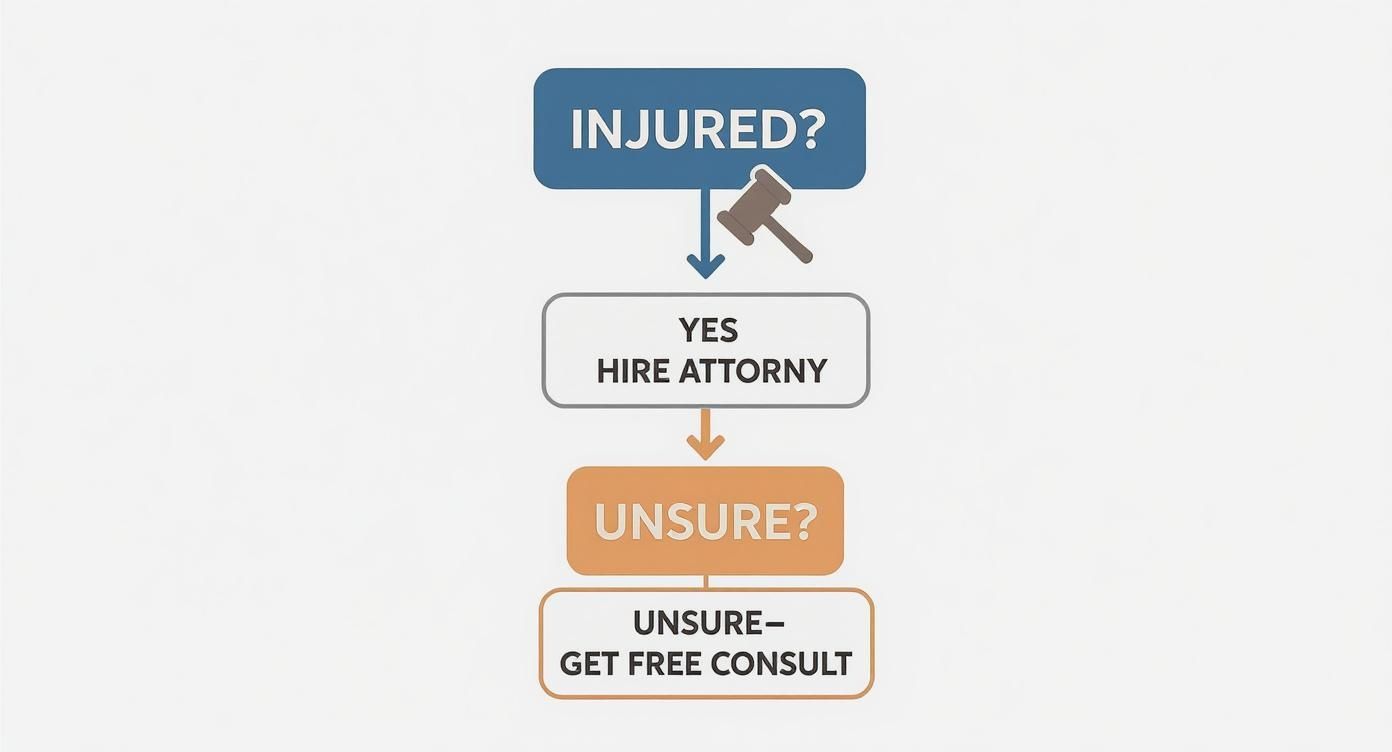
When you’re reeling from an accident, the last thing on your mind is legal paperwork. But the question of when to hire a personal injury attorney is one of the most important decisions you’ll make, and the answer is almost always the same: as soon as you are medically stable.
Acting fast isn’t about rushing to a lawsuit. It’s about protecting yourself. In the chaotic hours and days after an injury, it’s easy to make a mistake—like giving a recorded statement to an aggressive insurance adjuster or accidentally letting crucial evidence disappear. Getting a lawyer on your side early prevents these critical errors.
The Critical Window After a Florida Injury
Think of the aftermath of an accident like the scene of a crime. Evidence is fresh, witnesses remember details clearly, and the story is easier to piece together. The longer you wait, the more that evidence degrades.
An experienced attorney acts as your shield from day one. They immediately take over all communication with insurance companies, launch their own investigation, and make sure every legal deadline is met. This lets you step back from the stress and focus on what truly matters: your physical and emotional recovery.
Why Acting Fast Is Essential
In Florida, the clock starts ticking the second you’re injured. Key evidence, like security camera footage or skid marks on the road, can be gone in a matter of days or even hours. A prompt investigation by a legal team is often the only way to preserve it.
On top of that, Florida has strict deadlines for filing a lawsuit. If you miss this window, your right to seek compensation can be lost forever. Understanding the specific Florida statute of limitations for personal injury is non-negotiable, and it’s a detail your attorney will manage from the start.
The moments after an injury are confusing, but your actions during this time have a lasting impact. Engaging legal counsel early is not about being aggressive; it’s about being prepared and protecting your rights before they can be compromised.
You’re not alone in this. In the U.S., there are roughly 39.5 million injuries every year that are serious enough to require a doctor’s visit. That staggering number shows just how common these incidents are and why a proven system for navigating the aftermath is so important.
Red Flag Scenarios That Mean You Need an Attorney Now
Some situations are more complicated than others and scream for immediate legal advice. If you find yourself in any of the scenarios below, it’s a clear signal that you need to consult with an attorney right away.
Serious or Long-Term Injuries
If your injuries require surgery, hospitalization, or ongoing therapy, the stakes are too high. An attorney ensures your settlement covers future medical needs, not just today’s bills.
Fault Is Being Disputed
When the other party or their insurer tries to blame you, an attorney can gather evidence and build a strong case to prove who was actually responsible.
A Lowball Settlement Offer
Insurers often dangle a quick, small check, hoping you’ll take it and go away. A lawyer knows the true value of your claim and will fight for a fair amount.
Multiple Parties Are Involved
Accidents involving commercial trucks, construction sites, or multiple cars create a web of complex liability issues that demand professional legal expertise.
These red flags indicate that the insurance company has a strong financial incentive to pay you as little as possible. Having a professional on your side levels the playing field.
Navigating Florida’s Unique Insurance and Fault Laws
https://www.youtube.com/embed/XEEe5m3SHs0
Florida’s sunny exterior hides a complex web of insurance and fault laws that can easily trip up even the most careful person after an accident. The state has its own specific rules that govern everything from who pays your medical bills first to how long you have to file a claim.
Getting a handle on these rules is one thing, but knowing how to use them to protect your rights is another. This is exactly where an experienced attorney becomes your most important asset, especially right after an injury.
One of the most unforgiving rules is what’s called the statute of limitations. Think of it as a legal countdown timer on your right to file a lawsuit. For most personal injury cases in Florida, you have just two years from the date of the accident to take legal action. If you miss that window—even by a single day—the courthouse doors will almost certainly be closed to you forever, no matter how strong your case is.
Florida’s No-Fault System and PIP Rules
Many people get confused when they hear that Florida is a “no-fault” insurance state. It doesn’t mean no one is ever held responsible for causing a crash. It’s actually a rule about whose insurance pays first. In Florida, your own auto policy is the primary source for your initial medical bills, regardless of who was at fault.
This coverage is called Personal Injury Protection (PIP), and every Florida driver is required to have it. But here’s the catch: PIP comes with some very strict and urgent deadlines.
- The 14-Day Rule: You must get medical treatment from a qualified provider within 14 days of the accident. If you wait until day 15, your own insurance company can legally refuse to pay for any of your medical care.
- Coverage Limits: Standard PIP only covers 80% of your medical bills and 60% of your lost wages, and only up to a total of $10,000. For anyone with serious injuries, that money can run out in a flash.
- Emergency Medical Condition: To even get the full $10,000 in PIP benefits, a doctor has to certify that you have an “emergency medical condition.” If they don’t, your benefits can be capped at a mere $2,500.
These tight deadlines and coverage caps are a perfect example of why you can’t afford to wait. A good lawyer makes sure you meet every deadline and that your injuries are documented correctly so you get the full benefits you’ve been paying for.
Understanding Comparative Negligence
Even if the other driver ran a red light and T-boned you, their insurance company will still look for ways to blame you. They do this because of Florida’s comparative negligence law.
This rule works like a pie chart of blame. If a jury decides you were 20% responsible for the accident, whatever compensation you’re awarded will be cut by that same percentage.
Imagine a jury awards you $100,000 for your injuries, but also decides you were 20% at fault. Your final award would be slashed by $20,000, leaving you with only $80,000. It’s a go-to tactic for insurers to reduce their payout.
An experienced personal injury attorney knows how to fight back against these blame-shifting games. We gather the evidence—from traffic camera footage to accident reconstruction expert reports—to build a powerful case that minimizes any fault assigned to you and maximizes your financial recovery. This almost always involves tough negotiations, and you can get a better sense of that process in our guide on how to negotiate with insurance companies.
It’s also crucial to remember that your own actions can be scrutinized. For instance, there are significant legal risks associated with seat belt alarm deactivation, as something like not wearing a seat belt can dramatically affect how much fault is assigned to you in a crash. An attorney can help you navigate these complex details and build the strongest possible defense against an insurer’s attempts to use Florida’s laws against you.
Critical First Steps to Protect Your Claim
The moves you make in the first few hours and days after an accident can make or break your personal injury claim. Before you even think about hiring a lawyer, the actions you take—or don’t take—start building your case. It’s a lot like laying the foundation for a house; if you get it right from the start, everything that follows will be much more stable.
On the flip side, a few simple mistakes can put you on the back foot before you even have a chance to fight for what you deserve. Remember, the other driver’s insurance company is already looking for ways to pay you as little as possible. Protecting yourself right from the get-go is absolutely vital.
Prioritize Your Health and Document Everything
First things first: get medical attention. Your health is obviously the most important thing, but seeing a doctor also serves a crucial legal purpose. A trip to the emergency room, an urgent care clinic, or even your family doctor creates an official record of your injuries.
This medical documentation is the clearest way to connect your injuries directly to the accident. If you wait too long, an insurance company will almost certainly argue that you weren’t really hurt that badly or that something else caused your injuries.
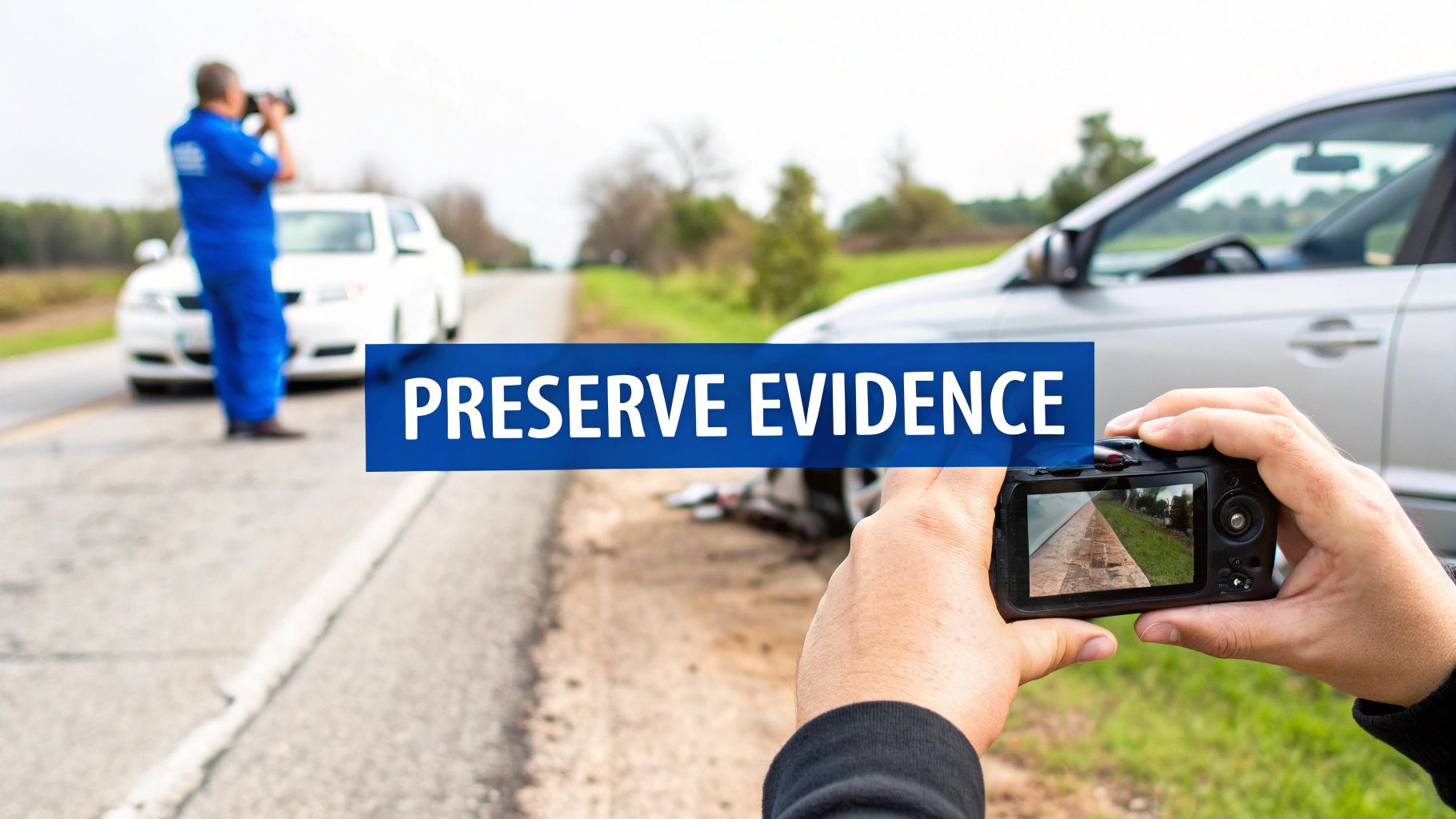
Once you’ve taken care of your health, your next priority is to gather and protect evidence. Evidence has a shelf life. Skid marks fade, cars get repaired, memories get fuzzy, and security camera footage gets erased. Right after an accident, you are often the only one in a position to capture these critical details.
To give your claim the strongest possible start, make sure you:
- Take Photos and Videos: Use your smartphone and don’t be shy. Get pictures of all the cars from every angle, the property damage, any skid marks on the road, traffic lights, and your own visible injuries.
- Get Witness Information: If anyone stopped to help or saw what happened, get their name and phone number. A statement from an independent witness can be incredibly persuasive when it comes to proving fault.
- Keep Every Piece of Paper: Start a folder for everything related to the accident. This means the police report, all medical bills, pharmacy receipts, and any letters or emails you get from insurance companies.
Every photo you take and every document you save becomes a building block for your case. An organized file with clear, factual evidence makes it much harder for an insurance adjuster to argue with the reality of what happened.
What Not to Do or Say After an Accident
What you don’t do is just as important as what you do. The insurance adjuster you’ll be dealing with is a trained professional whose entire job is to minimize how much money their company pays out. They will absolutely use your own words against you if you give them the opportunity. Until you have a lawyer, saying less is always more.
Steer clear of these common missteps that can seriously damage your claim:
- Never Admit Fault: Even a simple, polite “I’m so sorry” can be twisted into an admission of guilt. When you talk to the police, just stick to the facts. Don’t get into a debate about who was at fault with the other driver.
- Do Not Give a Recorded Statement: The other driver’s insurance company will call you, and they will push you to give a recorded statement. You have no legal obligation to do this. These calls are a tactic, plain and simple, designed to get you on record saying something that weakens your case. Just politely decline and tell them your attorney will be in touch.
- Stay Off Social Media: Don’t post anything about the accident, your injuries, or your recovery online. Insurance companies have teams that scour social media, looking for a photo or a post they can use to claim you aren’t as injured as you say you are.
These initial steps are all about protecting your rights. For a more detailed guide, check out our full breakdown on what to do after an accident in Florida. By taking these precautions, you ensure that when you’re ready to hire an attorney, you’re handing them a case that’s already built on solid ground.
Legal Fees and Your First Meeting: What You Really Need to Know
Let’s get one of the biggest worries out of the way right now: the cost. I can’t tell you how many times people have told me they hesitated to call a lawyer because they were afraid they couldn’t afford it. With medical bills stacking up and paychecks missing, the last thing you need is another bill.
But here’s the truth: personal injury law is structured so that anyone can get expert legal help, no matter what their bank account looks like. The system is designed to remove that financial barrier, so you never have to choose between getting justice and paying your rent.
The First Consultation Is a Two-Way Street
Your first step is always a free, no-obligation consultation. This isn’t a high-pressure sales pitch. Think of it as a strategy session where we both figure out the best path forward. It’s your opportunity to share what happened, in your own words, and get a straight answer about the strength of your case.
This meeting is really a two-way interview. You’re sizing us up, making sure you feel comfortable and confident in our ability to represent you. At the same time, we’re listening carefully to the details of your situation to see if it’s a case we believe we can win. It’s a frank, honest conversation meant to give you clarity, not to add to your stress.
How Do I Pay My Lawyer? Understanding the Contingency Fee
This is the most important part: almost every reputable personal injury firm works on a contingency fee agreement. The concept is simple, but powerful.
The bottom line is this: we don’t get paid unless you do. You pay zero money out of your own pocket to get started. Our firm covers all the upfront costs of building your case, from tracking down evidence and hiring investigators to paying for expert witness testimony.
Our fee is simply a percentage of the money we recover for you, whether that’s through a settlement or a jury verdict. If for some reason we don’t win your case, you owe us nothing. Not a dime. This model puts us on the same team. Our success is tied directly to your success, so we are completely motivated to get you the absolute best result possible.
Typically, contingency fees range from 33% to 40% of the total recovery. This structure means everyone has access to the justice system, not just those who can afford to write a big check. We go into much more detail on this topic in our guide on how contingency fees work in a car accident case.
How to Prepare for Your Free Consultation
To get the most out of our first meeting, it helps to come prepared. The more information you can share, the clearer our initial assessment will be. Gathering a few key documents beforehand helps us see the full picture of what happened and how it has impacted your life.
Here’s a quick checklist of what to bring if you have it. Don’t worry if you don’t have everything; just bring what you can.
Police or Accident Report
This gives us the official, third-party story of the incident, often including diagrams, witness info, and the officer’s initial thoughts on who was at fault.
Photos and Videos
Nothing tells a story like a picture. Visuals of the accident scene, property damage, and your injuries are incredibly powerful pieces of evidence.
Medical Records and Bills
This paperwork is the foundation of your claim. It officially documents your injuries and links them directly to the medical care you needed after the accident.
Insurance Information
Bring your policy details and any information you have on the at-fault party’s insurance. This helps us understand the coverage limits we’re working with.
Proof of Lost Wages
Recent pay stubs or a note from your employer showing your missed time and pay rate are crucial for us to calculate and recover your lost income.
Having this information on hand allows us to dive right in and give you concrete, actionable advice during your free consultation.
How a Trial-Ready Firm Gives You an Advantage

Knowing what to do after an accident is a great start, but the law firm you choose can completely change the outcome of your case. It’s a simple fact: not all personal injury attorneys operate the same way. Some are built to settle cases as quickly as possible, even if that means leaving your money on the table. Others, like us, prepare every single case as if it’s heading for a courtroom showdown.
At Martin Hernandez, P.A., we live in that second category. Our reputation as a trial-ready firm isn’t just a nice-sounding phrase—it’s a powerful strategy that puts our clients in a better position from day one.
The Power of a Trial-Ready Reputation
Insurance companies are massive, data-driven businesses. They keep detailed records on everything, including which law firms will take a lowball offer to avoid a fight and which ones are ready and willing to go to trial. That reputation becomes a powerful lever during negotiations.
Think of it like a game of poker. If your opponent knows you’re not bluffing and are prepared to go all-in, they’re far more likely to make a serious offer instead of risking a much bigger loss later. When an insurance adjuster sees our firm’s name on your file, they know their usual delay-and-deny tactics won’t work.
The interesting thing is that our readiness to go to trial often means our clients don’t have to. The credible threat of a well-argued court case forces insurers to negotiate fairly, leading to higher settlement offers without the long wait of a legal battle.
This whole approach is built on relentless preparation. From the moment you hire us, we’re gathering evidence, talking to experts, and building a case designed to persuade a local Tampa jury. You can learn more about this philosophy by reading our guide on how important trial experience is when hiring a personal injury attorney.
Bilingual Support for Tampa’s Diverse Community
A solid attorney-client relationship is built on clear, constant communication. In a diverse city like Tampa, language should never be a barrier to getting justice. That’s why we are proud to offer full bilingual support, making sure our Spanish-speaking clients feel informed and empowered every step of the way.
It means you can share your story, ask tough questions, and understand complex legal ideas in the language you’re most comfortable with. You’ll never be left in the dark or confused by legal jargon. We are committed to making sure your voice is heard and that you have total confidence in the strategy we’re building for you.
This personal touch ensures nothing gets lost in translation. It allows us to capture the full, nuanced impact the injury has had on your life—details that are critical for building a compelling and successful claim.
Access to a Network of Powerful Expert Resources
A strong personal injury case is rarely won on just one person’s story. It needs hard evidence and authoritative opinions from respected professionals who can break down the complex details for a judge and jury. An established firm brings a deep network of these experts to the table.
Our firm works with a wide range of specialists who provide the undeniable proof needed to win. This network includes:
- Accident Reconstructionists: These experts can scientifically recreate a crash scene to prove exactly how an accident happened and who was at fault.
- Medical Specialists: We consult with doctors, surgeons, and therapists who provide clear testimony on the severity of your injuries, the treatments you need, and what your future health looks like.
- Vocational Experts: If your injuries affect your ability to work, these professionals can assess your lost earning potential over your lifetime, a huge part of your total compensation.
- Economists: These experts provide concrete calculations on the full financial impact of your injury, from future medical bills to lost wages, making sure no expense is overlooked.
These experts aren’t just names in our address book; they are vital members of our legal team. Their testimony can dismantle an insurance company’s weak arguments and build the factual foundation needed to secure the maximum compensation you deserve.
Common Questions About Hiring an Injury Attorney
Making the call to hire a personal injury lawyer is a big decision, and it’s completely normal to have a lot of questions running through your mind. Let’s tackle some of the most common concerns we hear from people every day. My goal here is to give you clear, straightforward answers—no confusing legal talk—so you can feel confident about your next steps.
What Should I Do if the Insurance Company Already Made an Offer?
This happens all the time. Soon after the accident, you get a call from the other party’s insurance adjuster. They sound friendly, concerned, and then they hit you with a quick settlement offer. At first glance, the number might even seem reasonable.
Here’s a piece of advice from years of experience: treat that first offer with a healthy dose of suspicion. Insurers make these early offers for one reason—to get you to close your case for the lowest amount possible before you grasp the true cost of your injuries. Once you accept, you sign away your right to any more money, even if your medical condition gets worse down the road.
A fast settlement offer isn’t a gesture of kindness; it’s a calculated business move. The insurance company’s job is to protect its bottom line by settling your claim for pennies on the dollar. Never accept an offer or sign anything without speaking to an attorney first.
An experienced lawyer knows how to add up the full, long-term costs of an injury—things like future surgeries, lost earning potential, and the real impact on your quality of life. We can almost always negotiate a settlement that is substantially higher than that first number they throw at you.
How Long Will My Personal Injury Case Actually Take?
This is the million-dollar question, and the honest-to-goodness answer is: it depends. There’s no cookie-cutter timeline because every single case has its own unique set of facts. How long it takes really comes down to a few key things.
Here are the main factors that influence your case’s timeline:
- The Severity of Your Injuries: Cases with serious or permanent injuries take more time, and for good reason. We need to wait until you’ve reached what’s called Maximum Medical Improvement (MMI). That’s the point when your doctor says your condition is as good as it’s going to get. If you settle before reaching MMI, you could be left paying for future medical care out of your own pocket.
- The Complexity of the Case: A crash involving three cars is more complicated than a simple rear-end collision. When fault is disputed or multiple parties are involved, the investigation takes longer, and that extends the timeline.
- The Insurance Company’s Attitude: Some adjusters are reasonable and negotiate in good faith. Others will fight you on every single point, dragging their feet and hoping you’ll give up. A difficult insurer can add months to the process.
A straightforward case might wrap up in a few months, but a more complex one that has to go to trial could easily take a year or more. A good lawyer will be upfront with you about this from the start and keep you in the loop every step of the way.
What Is My Personal Injury Case Really Worth?
Figuring out what a case is worth is more of an art than a science. You can’t just plug numbers into a spreadsheet. It requires a deep dive into every single loss you’ve suffered, both the ones with a clear price tag and the ones that are much harder to quantify.
Calculating a claim’s true value is a detailed process. Beyond the specifics of injury law, it’s also helpful to have a grasp of some general legal principles that apply to many different situations. Here’s what we look at to determine what you should be compensated for:
- Economic Damages: These are the concrete financial losses you can prove with receipts and records. Think of all your past and future medical bills, the paychecks you lost while out of work, and any damage to your long-term ability to earn a living.
- Non-Economic Damages: These are just as real, but they don’t come with an itemized bill. This category is for your physical pain, emotional trauma, and the loss of enjoyment in life. It’s compensation for the ways the injury has fundamentally changed your day-to-day existence.
An experienced attorney pieces all of this together—your medical records, testimony from experts, and financial projections—to tell a compelling story. Our job is to make sure the insurance company or a jury understands the full picture of how this injury has impacted your life.
Can I Switch Lawyers if I am Not Satisfied?
Yes, you absolutely can. The relationship with your attorney is built on trust. If you feel like your lawyer is ignoring you, isn’t keeping you informed, or just isn’t fighting for you, you are not stuck.
Making a switch is usually a simple process. Your new lawyer will take care of the logistics, like notifying your old attorney and the court. In personal injury cases, the attorneys typically sort out the fees between themselves from the final settlement, so it shouldn’t cost you anything extra to move your case to a firm that’s a better fit.
Your case is far too important to leave with someone you don’t have confidence in. Don’t be afraid to make a change.
If you’ve been injured and are trying to figure out what to do next, you don’t have to go it alone. At Martin Hernandez, P.A., we give our clients clear answers and the aggressive, trial-ready representation they deserve. Contact us today for a free, no-obligation consultation to discuss your case at https://injurylawyersoftampa.com.