
The simple answer is this: you should hire a personal injury lawyer when your injuries are serious, liability is being questioned, or the insurance company starts giving you the runaround.
A minor fender-bender with no injuries? You can probably handle that yourself. But if you’re dealing with a serious accident in Florida, facing life-altering injuries and an insurance adjuster who won’t cooperate, you need an experienced advocate in your corner.
Key Signs You Need a Lawyer Right Away
The days following an accident are a blur. You’re trying to manage physical pain, emotional shock, and the complete disruption of your life. It’s completely normal to wonder, “Do I really need a lawyer for this?”
While every situation is different, there are some definite red flags that signal it’s time to call an attorney. Trying to navigate a serious claim on your own is a huge risk. Insurance companies are not on your side; they are businesses focused on protecting their profits. Their adjusters and lawyers are trained to pay out as little as possible. Going up against them alone puts you at a major disadvantage from the start.
When Professional Guidance Is Non-Negotiable
A lawyer becomes absolutely essential when the stakes are high and the path to fair compensation is blocked by legal hurdles. Spotting these signs early can make all the difference between a denied claim and getting the financial support you need to truly recover.
Here are the big ones:
- You Suffered Significant Injuries. If your injuries put you in the hospital, required surgery, or will need long-term physical therapy, calculating the true cost is incredibly complex. It’s not just about the current medical bills; it’s about future care, lost income, and your pain and suffering.
- Liability Is Disputed. The other driver is blaming you? Or maybe they’re denying they caused the accident at all? A lawyer is critical for gathering the evidence needed to prove fault under Florida’s tricky comparative negligence rules.
- The Insurance Company Is Uncooperative. If you get a lowball offer that feels insulting, an adjuster is pressuring you for a recorded statement, or your claim is being delayed for no good reason, these are classic signs you need backup.
This decision tree breaks down the key factors that point to needing professional legal help.
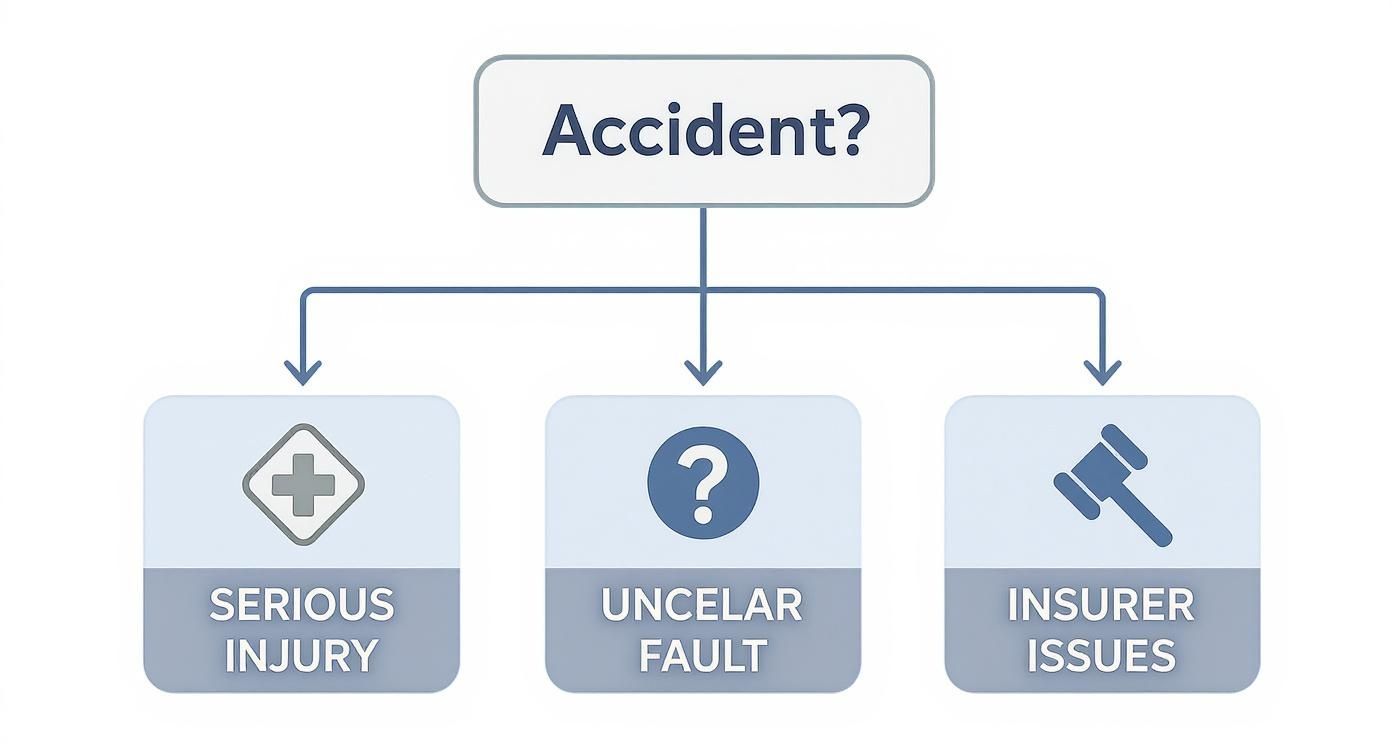
As you can see, the core issues—how badly you were hurt, arguments over who was at fault, and roadblocks from the insurer—are the main triggers for hiring an attorney.
A personal injury attorney’s job is to level the playing field. They protect your rights against massive insurance corporations and make sure your claim is valued for its true, long-term impact—not just the initial stack of bills.
Ultimately, the data shows that people who hire lawyers often achieve better results. You can learn more about how your chances of winning are better with a lawyer and see why that professional representation is so important. A good attorney handles everything—from the investigation to the tough negotiations—so you can focus on what truly matters: your recovery.
Why Serious Injuries Change Everything

If there’s one single factor that shifts the game from “I can handle this myself” to “I need a lawyer,” it’s the severity of your injuries. A minor fender bender that leaves you with a few bruises is one thing. But an injury that puts you in surgery, saddles you with chronic pain, or forces you out of work for months? That’s a completely different world.
When an injury is serious, it changes the entire legal and financial picture of your claim.
But what does “serious” really mean when it comes to a personal injury case? It’s not just about how much it hurts right now. It’s about the long-term consequences—the kind that demand far more than a quick check from the insurance company to cover your ER visit.
These are the injuries that are a clear signal: you need an experienced attorney in your corner.
Defining a Legally Significant Injury
When we evaluate a case, we’re looking for specific signs that an injury will have a lasting impact on a person’s life. These are the red flags that insurance companies also recognize, telling them a claim is more complex and potentially much more valuable.
A serious injury usually involves at least one of these factors:
- Surgical Intervention: If your injury was bad enough to require an operation, it’s automatically considered significant.
- Long-Term Medical Care: This isn’t just a few check-ups. We’re talking about months of physical therapy, ongoing appointments with specialists, or the need for pain management.
- Permanent Disability or Impairment: This could be anything from a permanent limp and loss of motion in your shoulder to a disability that fundamentally changes how you live your day-to-day life.
- Significant Disfigurement or Scarring: Visible, permanent scars, especially on the face, hands, or arms, can lead to substantial compensation for the emotional and social impact.
- Traumatic Brain Injuries (TBI): Even a supposedly “mild” concussion can have devastating, long-term cognitive and emotional effects that are incredibly difficult to prove without expert help.
In these situations, you have to think about the future. An insurance adjuster, however, is trained—and paid—to do the exact opposite. Their goal is to close your file for the lowest amount possible, not to ensure you’re financially stable five or ten years from now.
The True Cost of a Serious Injury
Think about a construction worker from here in Tampa who gets hurt in a car wreck on Dale Mabry Highway. The initial hospital bill is just the tip of the iceberg. The real costs stack up over time: months of lost income, the bills for physical therapy, the possibility of future surgeries, and the chronic back pain that means he can never go back to the job he’s done his whole life.
The initial settlement offer from an insurance company rarely accounts for the full, lifelong cost of a severe injury. A lawyer’s primary role is to build a case that demonstrates these future damages, ensuring you don’t pay for someone else’s negligence for the rest of your life.
A good attorney does more than just add up your current bills. We bring in medical and financial experts to project what you’ll need down the road. This involves calculating your lost earning potential, the cost of future medical care, and even the expense of modifying your home or car. To do this, we often rely on objective assessments like a functional capacity evaluation, which provides a detailed, impartial look at how an injury impacts your ability to work and live. This kind of evidence is vital for building a powerful claim.
Just as important, we calculate your non-economic damages—the legal term for your pain, suffering, and emotional distress. In Florida, this can be a huge part of your final compensation, but it requires skillful negotiation and rock-solid evidence. The quality of your medical records is everything here; you can learn more about the critical role of medical documentation in Tampa personal injury cases in our detailed guide. Without a lawyer, most people leave a shocking amount of money on the table because they simply don’t know how to prove and demand payment for what they’ve been through.
When It’s Your Word Against Theirs: Navigating Disputed Fault

What happens when the other driver flat-out denies they caused the crash? Or when the property owner insists your slip and fall was your own fault for not watching your step? Suddenly, your claim isn’t just about your injuries anymore—it becomes a battle over the facts.
This is a massive red flag. The moment fault becomes a point of contention, it’s time to bring in a personal injury lawyer. Trying to prove your case alone against a defensive driver and their insurance company is an uphill fight you’re not positioned to win. They will pull out all the stops to shift the blame to you, and in Florida, that tactic can completely derail your claim.
Florida follows a modified comparative negligence rule, and it’s a game-changer. In simple terms, if you’re found to be partially at fault for the accident, your compensation gets reduced by that same percentage. But here’s the critical part: if a jury decides you were more than 50% responsible, you can’t recover a single penny.
How Comparative Negligence Plays Out
Let’s say you’re in a multi-car pile-up on I-275 here in Tampa. The other driver’s insurer might argue that even though their client made a dangerous lane change, you were going a few miles over the speed limit. They’ll try to pin 20% of the blame on you for that.
If your total damages—medical bills, lost income, and pain—add up to $100,000, that 20% fault assessment slashes your recovery by $20,000. You’d only walk away with $80,000. And if they convince a jury you were 51% at fault? You get nothing. This is exactly why insurance adjusters fight so hard over liability; every percentage point of fault they can push onto you is money they save.
When liability is contested, your case transforms into a puzzle. A lawyer’s job is to find and assemble every single piece of evidence to build a clear, undeniable picture of what truly happened and who is responsible.
This is where an attorney’s investigative skills are absolutely essential. They become your personal detective, dedicated to piecing together the true story of how the other party’s negligence caused your injuries.
Building a Case That Proves Fault
A good lawyer knows the police report is just the starting point—it often doesn’t tell the whole story. Establishing who was truly responsible is a meticulous process that requires a professional to manage it.
Your legal team will get to work immediately to find and preserve evidence that can disappear fast, including:
- Witness Statements: Tracking down and interviewing everyone who saw what happened before their memories start to fade.
- Surveillance Footage: Hunting for video from nearby businesses, traffic cameras, or even a Ring doorbell that might have caught the whole thing on camera.
- Accident Reconstruction Experts: For serious crashes, these specialists analyze skid marks, vehicle damage, and other physical evidence to scientifically prove how the accident unfolded.
- Cell Phone Records: Using a subpoena to get records that can show a driver was texting or distracted right at the moment of impact.
Think about a slip and fall at a local Tampa store. The owner might claim you were wearing the “wrong shoes” or were just clumsy. A skilled lawyer will dig for maintenance logs, interview former employees about known hazards, and find security footage showing that a spill was left on the floor for hours without any warning signs. This kind of detailed work is what dismantles the other side’s excuses. You can read more about how fault is determined in Tampa car accidents and the evidence needed to build a winning case.
On top of the injuries, accidents often involve intricate vehicle damage. Sometimes, winning a fault dispute involves understanding complex vehicle systems like ADAS to demonstrate how a car’s advanced safety features—or lack thereof—contributed to the crash. Without an attorney to spearhead this complex investigation, you run the very real risk of being unfairly blamed and losing out on the compensation you deserve.
Dealing with Uncooperative Insurance Companies
After a serious accident, you’d think your insurance company—or the at-fault party’s—would be there to help. The reality is often quite different. Insurance companies are businesses, and their goal is to protect their profits, which means paying out as little as possible on claims. This is where the real fight for fair compensation begins.
The insurance adjuster might sound friendly and genuinely concerned on the phone, but make no mistake: they are a trained negotiator working for the other side. Their job is to find any reason to downplay, delay, or flat-out deny your claim. Recognizing their tactics is one of the biggest signs that you need a lawyer in your corner.
Red Flags That Signal Trouble
When an insurance company starts putting up roadblocks, it’s a clear signal you need a professional advocate. An attorney can step in immediately and handle all communications, protecting you from the pressure and preventing you from saying something that could unintentionally hurt your case.
Keep an eye out for these common red flags from an insurance adjuster:
- A Quick, Lowball Settlement Offer: They might dangle a check in front of you just days after the accident. This is a classic move to get you to settle before you even know the full extent of your injuries or future medical costs.
- Demanding a Recorded Statement: Adjusters often push hard for a recorded statement. They’re hoping you’ll say something they can twist later, like minimizing your pain or accidentally suggesting you were partly at fault.
- Unexplained Claim Denials: You might get a denial with a vague or confusing reason. They are banking on you being too overwhelmed to fight back.
- Stalling and Delay Tactics: Dragging out the process is a deliberate strategy. They hope to wear you down financially and emotionally, making you desperate enough to accept any low offer they throw your way.
When you hire an attorney, you level the playing field. You are no longer one person going up against a massive corporation. You have a seasoned professional who speaks their language, knows their playbook, and understands exactly how to counter their tactics.
Your lawyer becomes both your shield and your sword. They protect you from the adjuster’s manipulative strategies while aggressively fighting for the full compensation you deserve. This matters to people. In fact, a recent consumer survey found that nearly 40% of people said experience and a strong track record were the most important factors when choosing a law firm. It shows that when the stakes are high, victims want proven expertise on their side.
When Your Own Insurance Company Is the Problem
It can be incredibly frustrating when your own insurance company starts giving you the runaround. This often happens if you need to file a claim under your uninsured or underinsured motorist (UM/UIM) coverage, a common scenario here in Florida. You’ve faithfully paid your premiums for this exact protection, but when you need it most, your insurer may suddenly treat you like an adversary.
They might start questioning the severity of your injuries or disputing the value of your case—all in an effort to avoid paying what your policy promises. An attorney is crucial for holding your own insurance company accountable and forcing them to honor the contract you have with them. We gather the medical records, expert opinions, and evidence needed to prove your damages and fight for the benefits you are owed.
You can learn more about how to negotiate with insurance companies in our detailed guide. Trying to fight a resistant insurer on your own, even your own, is a battle you don’t have to face alone.
Protecting Your Rights Before Time Runs Out

After an accident, your focus is rightfully on getting better. But in the background, a legal clock starts ticking from the moment of injury. This is Florida’s statute of limitations, and it’s a non-negotiable deadline for filing a lawsuit.
Think of it like a closing window of opportunity. Once that window shuts, your right to seek compensation in court is gone for good, no matter how clear-cut your case might be. Waiting too long is one of the most heartbreaking and preventable mistakes an injury victim can make.
Understanding Florida’s Critical Deadline
For most personal injury cases in Florida—think car crashes or slip and fall incidents—you generally have two years from the date of the accident to file your lawsuit. Two years can feel like a lifetime, but it evaporates quickly when you’re juggling doctor’s appointments, physical therapy, and the stress of recovery.
This isn’t just a guideline; it’s a hard legal cutoff. Miss it, and you lose your right to sue, period. That’s why acting fast is so vital to protecting your claim.
The statute of limitations is an unforgiving legal barrier. Moving quickly gives your legal team the runway they need to investigate, build a powerful case, and file it properly before that window slams shut.
But it’s not just about a future court date. The real race against time starts immediately, and it’s all about preserving the evidence needed to win your case.
Why Early Action Is Key to a Strong Case
A successful personal injury claim is built on a foundation of solid proof, and unfortunately, that proof starts to disappear almost instantly.
Witness memories get fuzzy. Surveillance video gets deleted on a loop. The accident scene gets cleaned up. An experienced attorney knows this and acts as a preservationist from day one.
Hiring a lawyer right away allows them to:
- Secure Perishable Evidence: Your lawyer can fire off legal notices to businesses, forcing them to save security camera footage before their system automatically erases it.
- Interview Witnesses Promptly: They can find and talk to witnesses while the accident is still vivid in their minds, locking in their testimony with signed statements.
- Document the Scene: An investigator can be sent to photograph the scene, capturing crucial details like skid marks, property damage, or the hazard that caused you to fall before it’s repaired or removed.
- Identify All Responsible Parties: A prompt, thorough investigation often uncovers that more than one person or company was at fault, which can be critical for ensuring you’re fully compensated.
Without this immediate action, crucial evidence can vanish forever, crippling your ability to negotiate a fair settlement with the insurance company.
To get a more detailed look at these legal timelines, you can learn about the Florida statute of limitations for personal injury and see why every single day counts. Don’t let the clock run out on your right to justice.
How a Lawyer Actually Builds Your Case
Knowing when to hire a lawyer is the first step, but understanding what we do next is just as important. Once you decide to bring an attorney into the picture, we start turning the chaos of medical bills, confusing paperwork, and your personal worries into a structured, powerful legal claim. This isn’t just about making a few phone calls; it’s a methodical process designed to build a rock-solid case for the compensation you deserve.
The very first thing we do is launch a full-scale investigation. While your job is to focus on getting better, our job is to act like your own private detective team. We get our hands on the official police reports, track down and interview witnesses while their memories are still fresh, and secure critical evidence like surveillance footage from nearby businesses. Getting this done fast is key. It ensures the story of your accident is built on hard facts, not just your word against theirs.
Gathering and Organizing the Proof
A huge part of our work is collecting and organizing every single document related to your accident and injuries. We’re not just making a pile of paper; we’re weaving together a story that proves exactly what you’ve lost.
This documentation phase is meticulous and usually involves:
- All Medical Records: From the first ambulance ride and ER visit to every follow-up appointment and physical therapy session. We gather every report, bill, and doctor’s note to create a clear timeline of your injuries and the treatment you’ve needed.
- Proof of Lost Income: We’ll get the records from your employer to document every single dollar you’ve lost because you couldn’t work. This includes regular pay, but also missed overtime, bonuses, or even lost promotions.
- Expert Consultations: For more severe injuries, we bring in the heavy hitters. This means consulting with medical specialists, life-care planners, and economists who can testify about the long-term financial impact of your injury, including the cost of future surgeries or a permanent loss of earning ability.
This mountain of evidence becomes the foundation of your claim and gives us the leverage we need when we go head-to-head with the insurance company.
You Don’t Pay Unless We Win: The Contingency Fee
One of the biggest worries people have is the cost of hiring a lawyer. That’s why personal injury law works on a contingency fee agreement. It’s a system built to give everyone a fair shot at justice, no matter what’s in their bank account.
The concept is simple but powerful: You pay absolutely nothing upfront. Our fee is a percentage of the money we recover for you. If we don’t win you a settlement or a verdict at trial, you don’t owe us a dime in attorney’s fees.
This model puts us on the same team. Your interests and our interests are perfectly aligned because our success is tied directly to yours. It takes all the financial risk off your shoulders, so you can get expert legal help without any out-of-pocket stress.
The personal injury legal industry is a big one, generating $57.3 billion in revenue in 2024 with nearly 400,000 claims filed each year. The contingency model is what makes it possible for everyday people to access this system. You can learn more about personal injury law statistics to see the full scope. Ultimately, this structure gives you the power to stand up to massive insurance companies on a level playing field, knowing your attorney is just as invested in the fight as you are.
Common Questions About Hiring an Injury Lawyer
Even when you’re sure you need help, it’s completely normal to have questions. The idea of hiring an attorney can feel like a huge step, but it’s often the single most important one you can take to protect your future. Let’s walk through some of the questions we hear most often from people who have been injured.
Can I Hire a Lawyer If I Was Partially at Fault?
Yes, absolutely. Florida law recognizes that accidents are often complex, not black and white. Our state uses a modified comparative negligence rule.
In simple terms, this means you can still get compensation as long as you weren’t more than 50% responsible for the accident. But there’s a catch: your final settlement will be reduced by whatever percentage of fault is assigned to you. Insurance companies know this, and their primary goal is often to shift as much blame onto you as possible to reduce their payout. Having a skilled lawyer is critical here to gather the right evidence and build a case that tells the true story of what happened.
How Much Does It Cost to Hire a Lawyer?
This is usually the first thing people worry about, and the answer should bring some immediate peace of mind. Reputable personal injury attorneys, including our firm, operate on a contingency fee basis.
What does this mean? It’s simple: you pay zero upfront costs. There are no hourly bills or retainers. Your lawyer’s fee is just a pre-agreed-upon percentage of the money they win for you. If you don’t get a settlement or a favorable verdict, you don’t owe your attorney a fee.
This system levels the playing field, ensuring everyone can afford top-tier legal help, no matter their financial situation.
Is It Too Late If I Already Spoke to the Insurer?
No, it’s not too late—but you need to act now. Anything you’ve already said to an insurance adjuster can be twisted and used against you, which is why it’s so important to stop any further direct communication.
The moment you hire an attorney, they become a shield. They will immediately notify the insurance company to direct all future calls, emails, and questions to them. This stops you from accidentally saying something that could damage your claim. Your lawyer will work to handle any issues from past conversations and will manage the entire process from that point forward, making sure you’re protected.
Trying to piece things together after an accident in Tampa is tough, but you aren’t on your own. The team at Martin Hernandez, P.A. is here to answer your questions and fight for the compensation you rightfully deserve. Get in touch for a free, no-pressure consultation to learn about your rights and next steps. Visit us at https://injurylawyersoftampa.com to get started.