
TL;DR:
- Thorough documentation is essential in injury claims because it proves the crash, injuries, and damages. Proper records prevent insurers from undervaluing or disputing your claim, increasing your chances of fair compensation. Early, organized, and complete evidence, including reports, photos, medical records, and a pain journal, strengthens your case and reduces settlement risks.
Thorough documentation is the foundation of every successful injury claim, connecting your injuries directly to the accident and proving the full extent of your damages. If you’re reading this after a crash, the records you collect right now will determine how much compensation you can realistically recover. Insurance companies are businesses. They look for any reason to reduce what they pay you. Your documentation is the counter to every tactic they use. The industry term for this process is “evidence preservation,” and it covers everything from police reports to your personal pain diary.
Why documentation matters in injury claims
Documentation in injury claims is defined as the organized collection of records, reports, and evidence that proves three things: the crash happened, your injuries resulted from it, and those injuries caused measurable losses. Without it, your claim rests on your word alone.
Comparative negligence laws reduce settlement offers proportionally to assigned fault. A 30% fault assignment reduces your settlement by 30% of its total value. That means a single gap in your liability documentation can cost you thousands of dollars before negotiations even begin.
Early records carry the most weight. Emergency room reports and ambulance records establish your injury severity at the moment of impact. They create a baseline that insurers cannot easily dispute, and they anchor every medical record that follows. Starting strong matters more than any single piece of evidence you gather later.

What types of documentation are essential after a car accident?
Standard car accident claims require at least five primary documentation categories. Each one serves a distinct purpose in building your file.
- Police and incident reports. The official crash report establishes the facts of the accident, including date, location, parties involved, and any citations issued. This is often the first document an adjuster reviews.
- Medical records. This category includes emergency room reports, diagnoses, treatment notes, physical therapy logs, prescription records, and all medical bills. The records must form a clear, unbroken timeline from the day of the crash forward.
- Photographic evidence. Photos of the accident scene, vehicle damage, road conditions, and your visible injuries taken as close to the time of the crash as possible carry significant weight. Injuries like bruising and swelling fade quickly, so photograph them daily in the first week.
- Witness information and statements. Names, phone numbers, and written or recorded statements from anyone who saw the crash give your account independent support. Adjuster skepticism drops sharply when a neutral third party corroborates your version of events.
- Financial loss records. Pay stubs, employer letters confirming missed work, repair estimates, receipts for out-of-pocket medical expenses, and transportation costs all document your economic damages. These records answer the question of what the accident actually cost you.
A complete injury claim file should allow you to answer five key questions with documents: Did the crash happen? Were you injured? Did the crash cause those injuries? What did it cost you? Are there unresolved medical issues still ahead? If any of those questions lacks a clear documentary answer, your claim has a vulnerability.
How do insurance companies evaluate injury claims using documentation?
Insurance adjusters evaluate claims by looking for reasons to pay less, not more. Insurers use claims evaluation software that reviews diagnosis codes, treatment duration, injury classifications, and billing patterns to generate an internal case value. That number becomes their starting offer.
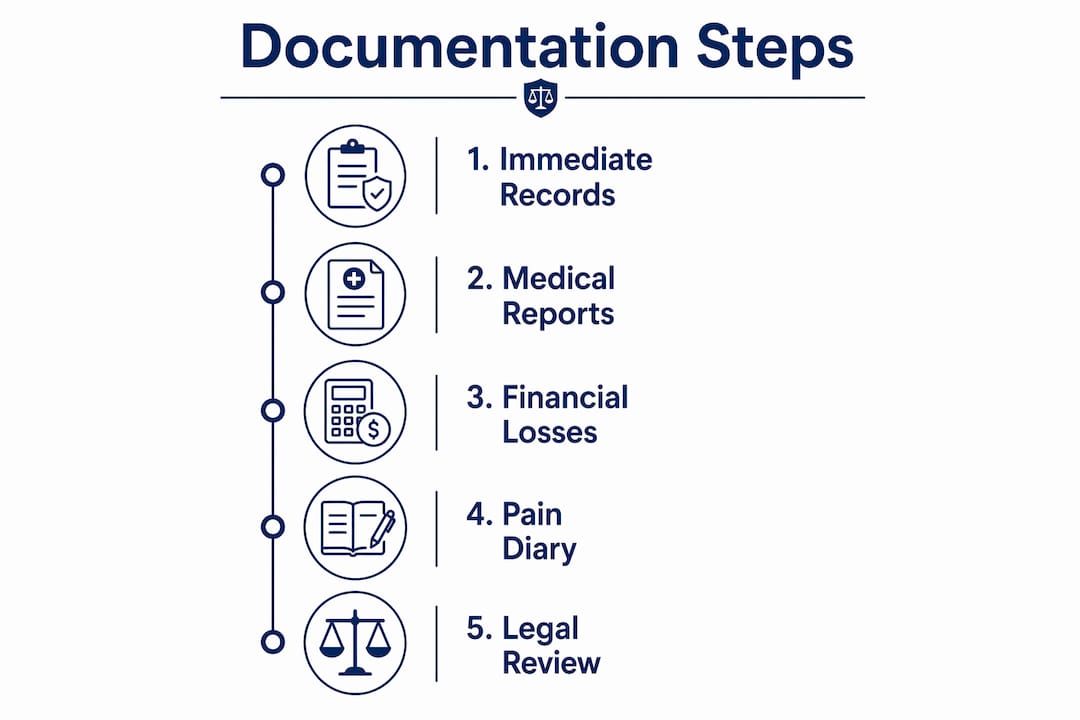
The adjuster’s primary targets are treatment gaps and pre-existing conditions. A gap of even a few weeks in your medical care gives the insurer grounds to argue that your injury resolved on its own or was unrelated to the crash. Consistency in your medical records matters more than the volume of records. A clear, chronological narrative of care is harder to attack than a thick but disorganized file.
Well-documented financial losses and pain impacts shift the negotiation dynamic. Organized, thorough evidence increases the insurer’s perceived risk of going to trial, which typically produces higher settlement offers. Adjusters know that a well-prepared claimant is more likely to hire an attorney and push the case to court. That risk calculates directly into what they offer you.
Pro Tip: Before speaking with any insurance adjuster, review your documentation file and identify any gaps. Adjusters are trained to ask questions that expose inconsistencies. Knowing your own record protects you.
Soft tissue injuries like whiplash face a default low-value categorization from most insurers. Documenting daily pain levels, functional limitations, and emotional impacts shifts the adjuster’s assessment beyond the objective medical bills and forces them to account for the full human cost of your injury.
Common documentation pitfalls that can reduce your claim value
Most claims that settle for less than they are worth share the same preventable documentation errors. Recognizing them early gives you time to correct course.
Gaps in medical treatment. Missing even a single physical therapy session can be used by an insurer to argue that your injury resolved or that you failed to mitigate your damages. Attend every scheduled appointment and document any cancellations with a written reason.
Late or inconsistent care. Waiting days or weeks after the crash to seek medical attention gives insurers a causation argument. The longer the gap between the accident and your first medical visit, the easier it is for them to claim your injuries came from another source.
Failure to document pain and lifestyle impacts. Medical bills prove costs. They do not prove suffering. If you stopped coaching your child’s soccer team, stopped sleeping through the night, or needed help with basic tasks, those facts need to be recorded somewhere. A pain diary fills this gap.
Settling before treatment is complete. Settling before completing medical treatment typically leaves you personally responsible for any future medical expenses related to the injury. Once you sign a release, the insurer owes you nothing more, regardless of what complications develop.
Insufficient proof linking injuries to the accident. Your doctor’s records must explicitly connect your diagnosis to the crash. A record that lists a herniated disc without referencing the accident gives the insurer room to argue the condition is pre-existing.
Pro Tip: Ask your treating physician to document the mechanism of injury in every visit note. A simple phrase like “consistent with motor vehicle accident trauma” in each record closes the causation gap.
Practical tips for maintaining strong documentation throughout your claim
Strong documentation does not happen by accident. It requires a consistent habit from the day of the crash through the final settlement.
Start a recovery journal immediately. Write a brief daily entry covering your pain level on a scale of 1–10, specific limitations (could not drive, could not lift groceries, slept only three hours), and any emotional effects like anxiety or depression. This journal creates evidence of subjective damages that medical bills alone cannot capture.
Organize records in a single, secure location. Use a physical binder or a secure cloud folder with clearly labeled sections: police reports, medical records, bills, correspondence, photos, and financial losses. Disorganized files slow your attorney down and create the appearance of a weak claim.
Collect accident scene evidence promptly. Skid marks fade, debris gets cleared, and witnesses move on within hours. Take photos from multiple angles, note weather and lighting conditions, and get witness contact information before you leave the scene if your physical condition allows.
Keep a summary sheet updated. One page listing your key dates (crash date, first medical visit, diagnosis dates, missed work days), total medical costs to date, and primary contacts (treating physicians, adjuster name and claim number, your attorney) gives anyone reviewing your file an instant orientation.
Consult an attorney before communicating with the insurer. The role of documentation in insurance disputes extends to every written and verbal statement you make. Adjusters record calls and use your words against you. An attorney reviews your file and advises you on what to say and what to withhold.
Presenting evidence strategically over the negotiation timeline also applies pressure. Releasing your strongest documentation in stages, rather than all at once, keeps the insurer uncertain about what else you have. This is a recognized negotiation technique that experienced personal injury attorneys use to maximize final offers.
Key Takeaways
Proper documentation is the single most effective tool for protecting your injury claim value, because it closes every gap an insurer would otherwise use to reduce your settlement.
| Point | Details |
|---|---|
| Start documenting immediately | Emergency room records establish injury severity and anchor your entire claim timeline. |
| Cover all five categories | Police reports, medical records, photos, witness info, and financial losses each serve a distinct purpose. |
| Maintain treatment consistency | Even short gaps in care allow insurers to argue your injury resolved or was unrelated to the crash. |
| Document pain and lifestyle impacts | A daily recovery journal creates evidence of subjective damages that medical bills cannot show. |
| Never settle before treatment ends | Early settlement leaves future medical costs uncovered and permanently closes your claim. |
What I’ve seen documentation do for real clients
I’ve handled enough injury cases in Tampa to tell you that the difference between a fair settlement and a lowball offer almost always comes down to the file, not the facts. Two clients can have the same type of crash, the same diagnosis, and the same treating physician. The one with organized, gap-free records and a pain journal walks away with a significantly better outcome.
The misconception I hear most often is that documentation is something you worry about later, after you’ve recovered. That thinking costs people money. By the time you feel ready to gather records, treatment gaps have already formed, photos have been lost, and witnesses have forgotten details. The insurer has already built their case around your silence.
What I tell every client is this: treat your documentation like your medical treatment. It is not optional, and it does not pause when you’re having a hard week. The steps in a personal injury lawsuit move faster and more favorably when your file is ready at every stage. Adjusters respond differently to a claimant who clearly has their evidence in order. They know the litigation risk is real.
The claimants who struggle are the ones who relied on the insurance company to be fair. Documentation is how you stop relying on fairness and start relying on facts.
— Martin Hernandez
How Martin Hernandez, PA can strengthen your injury claim
If you’ve been injured in a car accident in Tampa or Hillsborough County, the quality of your documentation file will shape every conversation you have with the insurance company.
Martin Hernandez, PA reviews your existing records, identifies gaps that could reduce your claim value, and guides you through gathering the evidence you still need. The firm prepares every case for trial, which signals to insurers that a weak offer will not end the matter. If you’re unsure where your claim stands, start with a clear understanding of personal injury law fundamentals and then reach out for a consultation. You pay nothing unless your case is won.
FAQ
Why does documentation matter so much in injury claims?
Documentation proves the three elements every claim requires: the crash occurred, your injuries resulted from it, and those injuries caused measurable losses. Without organized records, an insurer can dispute any one of those elements and reduce your settlement.
What is the most common documentation mistake after a car accident?
Gaps in medical treatment are the most damaging error. Insurers treat inconsistent records as evidence that injuries resolved or were unrelated to the crash, which directly lowers claim value.
Should I settle my injury claim before finishing medical treatment?
No. Settling before treatment is complete typically leaves you responsible for all future medical costs related to the injury. A signed release closes your claim permanently, regardless of complications that develop afterward.
How does a pain diary help my injury claim?
A daily pain journal documents subjective damages like suffering, sleep loss, and functional limitations that medical bills cannot capture. Soft tissue injury claims in particular benefit from this record because insurers default to low valuations without it.
When should I contact a personal injury attorney about my documentation?
Contact an attorney before speaking with an insurance adjuster. An attorney reviews your file, identifies weaknesses, and advises you on what to say to protect your claim from the first conversation forward.
Recommended
- The Role of Medical Documentation in Personal Injury Cases in Tampa: a Guide to Building a Strong Claim
- The Role of Documentation in Insurance Disputes – Personal Injury Lawyers of Tampa
- How to Document Losses in an Insurance Dispute – Personal Injury Lawyers of Tampa
- How to Prove Pain and Suffering in a Florida Injury Claim – Personal Injury Lawyers of Tampa