
Losing someone you love because of another person’s carelessness is a devastating experience. In these situations, a wrongful death lawsuit in Florida provides a legal avenue for families to find a measure of justice and regain some financial footing. It’s a civil claim designed to hold the at-fault party accountable for the immense void their actions have created.
What is a Wrongful Death Claim Under Florida Law?

The simplest way to think about it is this: a wrongful death claim is essentially the personal injury lawsuit the person would have filed themselves if they had survived. Since they can no longer speak for themselves, Florida law empowers their family and their estate to pursue the case on their behalf.
The entire claim hinges on proving that another party’s negligence, recklessness, or intentional act was the direct cause of the death. It’s important to understand this isn’t a criminal case—it’s a civil action. The goal isn’t jail time; it’s about securing financial compensation for the family to help cover the staggering emotional and economic losses they now face.
Common Causes of Wrongful Death
These tragedies can spring from almost any scenario involving negligence. The ripple effects of a single incident can profoundly impact a spouse, children, and parents for the rest of their lives. Some of the most frequent events that lead to a wrongful death lawsuit in Florida include:
- Motor Vehicle Accidents: This is a major category, covering fatal crashes with cars, commercial trucks, motorcycles, and pedestrians.
- Medical Malpractice: Tragic outcomes resulting from mistakes made by doctors, surgeons, nurses, or other healthcare providers.
- Premises Liability: When unsafe property conditions, like a slip and fall hazard or inadequate security, lead to a person’s death.
- Defective Products: A flawed or dangerous product—from a faulty airbag to a malfunctioning medical device—that causes a fatal injury.
The Role of the Personal Representative
One of the most important procedural rules in Florida is who actually files the lawsuit. Individual family members don’t file separate claims. Instead, the case is brought forward by the personal representative of the deceased person’s estate.
A personal representative (sometimes called an executor) is the person legally appointed to manage the deceased’s final affairs. They are either named in the person’s will or, if there isn’t one, appointed by a probate court.
This individual files a single lawsuit on behalf of both the estate itself and all the surviving family members who qualify as beneficiaries under the law. They are the official plaintiff who steers the legal process, and any money recovered is later distributed to the family and the estate as dictated by Florida statutes. This system streamlines the process, ensuring everyone is represented in one unified case.
Who Can File a Wrongful Death Claim in Florida
When a family is reeling from a sudden, tragic loss, one of the most pressing questions is, “Who can actually take legal action?” Florida has a very specific answer to this. The state’s laws are set up to prevent a free-for-all where multiple family members might file competing lawsuits, creating chaos and confusion.
Instead, Florida law puts one person in charge: the personal representative of the deceased person’s estate.
Think of the personal representative as the designated quarterback for the legal team. They are the only person legally allowed to file the wrongful death lawsuit in Florida. Their role is to bring a single, unified claim on behalf of everyone who has been harmed by the death—both the estate and the surviving family members.
If your loved one left a will, they probably named their personal representative (sometimes called an executor) in that document. If there’s no will, the probate court will step in to appoint someone, usually a spouse, adult child, or another close relative. This system creates an orderly process right from the start.
The Role of the Personal Representative
Being the personal representative is a serious job with a lot of responsibility. This person isn’t filing the lawsuit for themselves; they are acting in a position of trust for the benefit of all survivors and the estate.
Their key duties include:
- Opening an estate for the deceased in probate court.
- Selecting and hiring a qualified wrongful death attorney.
- Working with the attorney to collect essential evidence like medical records and funeral bills.
- Acting as the point person for all major decisions during the lawsuit.
- Once the case is resolved, ensuring any settlement or jury award is distributed correctly to the survivors according to Florida law.
This central authority is vital for navigating the complexities of a wrongful death case from start to finish.
Who Are the Survivors Entitled to Compensation?
While the personal representative is the one who files the suit, the money recovered is for the “survivors.” Florida’s Wrongful Death Act is very clear about who fits this description and has a right to compensation.
Under Florida Statute 768.18(1), survivors are defined as the decedent’s spouse, children, and parents. The definition can also extend to any blood relatives or adoptive siblings who were financially dependent on the person who died.
The law prioritizes the closest family members. For a more detailed breakdown, you can learn more about who can file a wrongful death lawsuit in Florida and see how the state defines these family relationships.
The type of compensation a survivor can receive depends heavily on their relationship to the deceased.
- Spouse: A surviving husband or wife can seek damages for the profound loss of companionship and protection, as well as for their own mental pain and suffering. They can also claim lost financial support.
- Minor Children: For the law’s purposes, this means children under the age of 25. They can recover damages for losing their parent’s guidance, instruction, and companionship, along with their mental pain and suffering.
- Parents: A parent can claim damages for their mental pain and suffering, but only if there is no surviving spouse or minor children.
- Dependent Relatives: Other family members, like a sibling or grandparent, can only be considered survivors if they can prove they relied on the deceased for financial support or services.
This structure is designed to ensure that those who felt the loss most directly are the primary beneficiaries in a wrongful death lawsuit in Florida. Knowing where you stand in this legal framework is the first crucial step toward getting the justice your family needs.
Florida’s Statute of Limitations and Negligence Rules
https://www.youtube.com/embed/LuJYDXPiiD8
Time is a cruel and unforgiving opponent in any legal battle, and that’s especially true when you’re grieving a profound loss. When it comes to a wrongful death lawsuit in Florida, the state sets a very firm deadline, known as the statute of limitations. It’s absolutely critical for families to understand this timeline to make sure their chance for justice isn’t lost.
In nearly all situations, the estate’s personal representative has just two years from the date of the person’s death to get a lawsuit filed. That might sound like a lot of time, but the reality is that a proper investigation—finding out what really happened, gathering the right evidence, and identifying everyone who should be held accountable—can easily eat up months. If you miss that two-year deadline, the court will almost certainly throw the case out, and the family will be permanently blocked from seeking compensation.
Are there exceptions? Yes, but they are incredibly rare and you should never count on one applying to your situation. Think of the two-year window as a hard-and-fast rule. This is why it’s so important to speak with an attorney as soon as you feel able. Our guide on how long you have to file suit after a Florida auto accident dives deeper into these critical timelines.
Understanding Florida’s Negligence Rule
Beyond the ticking clock, another major piece of the puzzle is Florida’s rule on shared fault. It’s called modified comparative negligence, and it’s something the defense will almost always try to use if they can. This rule addresses situations where the defense claims your loved one was partially to blame for the accident that took their life.
Let’s use a real-world example. Imagine a devastating car crash where your family member was killed. The other driver was clearly at fault for running a red light, but perhaps your loved one was going slightly over the speed limit.
A jury might decide the other driver was 90% responsible, but assign 10% of the fault to your loved one. Under Florida’s rule, any financial award the family receives would be reduced by that percentage. So, if a jury awarded $1,000,000 in damages, that amount would be cut by 10% ($100,000), for a final recovery of $900,000. It’s a system designed to make sure the final outcome reflects the full picture of what happened.
The 51% Bar to Recovery
This is where things get really serious. In March 2023, Florida law changed dramatically, moving from what was called a “pure” system to the “modified” system we have now. This single change has massive implications for anyone filing a wrongful death lawsuit in Florida.
Under the current law, if your loved one is found to be 51% or more at fault for the incident, the family is completely barred from recovering any damages. Nothing. It’s an all-or-nothing cutoff.
This change puts an even greater burden on your attorney to build a rock-solid case proving the other party was primarily at fault. Before this law, a family could still recover something even if their loved one was found to be, say, 70% responsible (they’d just get 30% of the award). Now, once the fault assigned to your loved one crosses that 51% line, the entire claim disappears.
This is why having an experienced legal team is non-negotiable. We have to be prepared to fight back against any attempt by the defense to unfairly shift blame and protect your family’s right to the compensation you deserve.
What Kinds of Damages Can You Recover in Florida?
When a family is shattered by a sudden, preventable death, no amount of money can ever fill that void. That’s a simple, human truth. However, a wrongful death lawsuit in Florida does two critical things: it provides a path to financial stability for those left behind and holds the responsible parties accountable.
The compensation you can recover—legally called “damages”—is meant to cover both the financial and emotional wreckage. Florida law splits these damages into two main buckets. The first covers losses felt directly by the surviving family members. The second deals with the financial losses suffered by the deceased person’s estate. It’s important to understand both to see the full picture.
Damages Paid Directly to Survivors
This is the most personal part of the compensation. It’s designed to address the deep, intangible ways the death has impacted the immediate family. This isn’t just about a lost paycheck; it’s about the loss of a human being and the future you were supposed to have together.
Survivors can seek damages for:
- Loss of Companionship and Protection: A surviving spouse can claim compensation for the loss of their partner’s love, companionship, and emotional support. This is the law’s way of recognizing that a profound personal bond was destroyed.
- Mental Pain and Suffering: This covers the immense grief, sorrow, and emotional trauma suffered by the surviving spouse, minor children, and sometimes parents. Our guide on how to calculate pain and suffering damages digs deeper into this complex but essential part of a claim.
- Loss of Parental Guidance: Minor children (anyone under the age of 25 in Florida) can recover damages for the loss of a parent’s guidance, instruction, and nurturing.
- Lost Support and Services: This is the nuts-and-bolts value of what the deceased provided. It includes their financial support, of course, but also the value of services they performed, like handling childcare, home repairs, or managing the family finances.
The whole point of survivor damages is to acknowledge the human cost of a wrongful death. It’s the legal system’s attempt to place a value on the guidance of a parent, the companionship of a spouse, and the emotional bedrock that has been ripped away forever.
Damages Paid to the Estate
The second category of damages is meant to repay the estate for the financial losses the deceased person suffered because of the wrongful act. A good way to think about it is this: these are the economic damages the person could have claimed for themselves if they had survived. This money goes into the estate and is then distributed to heirs, either through a will or according to state law.
These damages almost always include:
- Lost Earnings and Benefits: This is a calculation of the income the deceased would have reasonably earned from the date of their injury until their natural death, with their own living expenses subtracted. It also includes the value of lost benefits like health insurance or retirement plans.
- Medical Expenses: Any hospital bills or other medical costs racked up between the final injury or illness and the moment of death can be recovered by the estate.
- Funeral and Burial Expenses: The reasonable costs of a funeral and burial can be paid back to the estate or directly to the family member who paid them.
The final value of a wrongful death case can swing dramatically depending on the specific facts. For example, recent data shows that wrongful death cases in the Orlando area averaged around $2,210,342 in compensation, while cases in Tallahassee averaged $1,588,920. The rest of Florida saw an average of about $1,795,545. These numbers show just how much local economic factors and the unique details of each tragedy matter, which is why a thorough and expert calculation of all damages is so important.
The Timeline of a Wrongful Death Lawsuit
Losing a loved one is disorienting and painful. When that loss is due to someone else’s negligence, the legal journey that follows can feel overwhelming. Knowing what to expect can give your family a sense of control during an incredibly difficult time. It’s important to understand that a wrongful death lawsuit in Florida is a marathon, not a sprint. The process is deliberate, with each step building on the last.
Let’s walk through the typical phases of a case, from the first investigation to the final resolution.
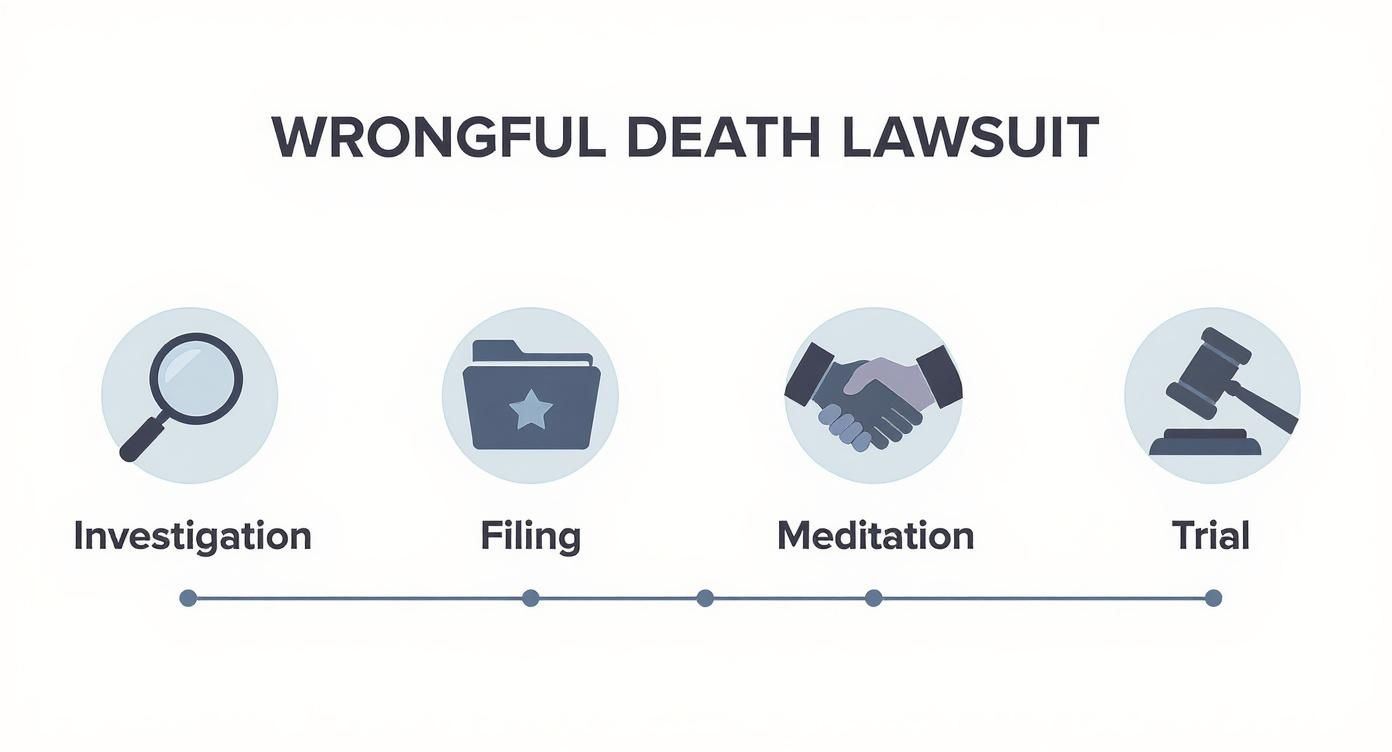
As the visual shows, a wrongful death case moves methodically. It starts with deep fact-finding and progresses toward negotiations and, only if necessary, a trial. Here’s a closer look at what each stage involves.
Initial Investigation and Evidence Gathering
This is where the groundwork for your entire case is laid. It begins the moment you partner with an attorney and involves a relentless effort to uncover every critical fact.
During this foundational phase, we gather all available evidence: police reports, photos from the scene, medical records, witness statements, and expert opinions. The mission is twofold: to prove who was at fault and to fully document the immense loss your family has suffered. A key step before ever filing in court is often sending a demand letter to the responsible party’s insurance company, which formally outlines the case and can sometimes kickstart settlement talks.
Filing the Lawsuit and The Discovery Phase
If the insurance company isn’t willing to offer a fair settlement, the estate’s personal representative will formally file the lawsuit. This is the official starting pistol for litigation, setting firm deadlines for the defendant to respond.
Once the suit is filed, the case moves into what’s known as the discovery phase. Be prepared, as this is often the longest and most detailed stage of the entire process. It’s a formal period where both sides are legally required to share information and evidence under oath.
Discovery involves several key tools:
- Interrogatories: These are written questions that the other side must answer in writing, under oath.
- Requests for Production: We formally ask for relevant documents, which could be anything from company safety manuals to vehicle maintenance logs.
- Depositions: This is out-of-court testimony. Lawyers from both sides question witnesses—including you, the defendant, and experts—under oath, with a court reporter transcribing every word.
The whole point of discovery is to eliminate surprises. It forces all the cards onto the table, giving both sides a clear picture of the evidence. This clarity is crucial for accurately valuing the case and often paves the way for a fair settlement.
Mediation and Settlement Negotiations
The reality is that very few wrongful death cases actually end up in a courtroom. In Florida, well over 90% of these claims are resolved out of court, most often through a process called mediation. In fact, it’s a mandatory step in most civil cases here.
Mediation is a structured, confidential negotiation session. You, your attorney, the other party, their attorney, and a neutral mediator all meet to try and find a resolution. The mediator’s job isn’t to pick a side but to help both parties communicate and find a path toward a settlement agreement. It’s a far less stressful and costly alternative to a public trial. Having an idea of how long it can take to settle a claim can help set realistic expectations for this phase.
Trial and Resolution
If all attempts at a fair settlement fail, the case will be scheduled for trial. Here, both sides present their cases to a judge and jury. We will present evidence, call witnesses to testify, and make our closing arguments. The jury then deliberates to decide who is liable and what amount of damages should be awarded.
Whether the case concludes with a settlement or a jury verdict, reaching a final resolution marks the end of a long and emotionally taxing journey. It provides the financial stability and sense of justice your family needs to begin moving forward.
When Medical Malpractice Leads to Wrongful Death
It’s hard to imagine a more painful scenario. The person you trusted with your loved one’s life—a doctor, a surgeon, a nurse—makes a mistake, and now your family is left grieving. This sense of betrayal adds a uniquely sharp edge to an already unbearable loss.
A wrongful death lawsuit in Florida that stems from medical malpractice isn’t just another personal injury case; it’s one of the most complex legal battles a family can face. The rules are different, and the burden of proof is significantly higher than in a typical negligence claim.
Unlike a car crash where the at-fault driver is often clear, medical negligence revolves around a specific legal idea called the “standard of care.” This isn’t about demanding perfection from doctors. Instead, it’s about competence. The standard of care is simply the level of skill and caution that a reasonably careful healthcare professional, with similar training, would have used in the same situation.
Proving that a doctor or hospital fell short of this standard is the heart of the fight. A bad outcome, unfortunately, isn’t enough. Your legal team has to draw a direct line, showing that the medical provider failed to act with reasonable care and that this specific failure caused your loved one’s death.
Florida’s Tough Pre-Suit Hurdles
Before a medical malpractice lawsuit can even get through the courthouse doors in Florida, the law puts up some serious roadblocks. This mandatory “pre-suit” process is designed to weed out weak claims, but for grieving families, it’s a major hurdle to clear right at the start.
The single most important step is getting a sworn affidavit from a qualified medical expert. And this can’t be just any doctor. The expert must practice in the same specialty as the healthcare provider you are suing. So, if the case involves a cardiac surgeon’s error, the affidavit must come from another qualified cardiac surgeon.
This expert has to meticulously review the medical records and then state, under oath, that they believe the defendant breached the standard of care, and that this breach was the likely cause of death. Without that expert opinion, your case stops before it can even begin.
This initial investigation is time-consuming and costly. It underscores why you absolutely must work with an attorney who has deep, proven experience in medical malpractice wrongful death claims. They will have the financial resources and the network of trusted medical experts required to properly build your case from day one.
Connecting the Dots: Negligence and Causation
Once you clear the pre-suit hurdles and file the lawsuit, the real work of proving negligence begins. This means digging into the details to show exactly how a healthcare provider’s action—or inaction—led to a fatal result.
Some of the most common grounds for these cases include:
- Misdiagnosis or Delayed Diagnosis: Failing to spot a life-threatening illness like cancer, a blood clot, or heart disease when there was still time to treat it.
- Surgical Errors: A devastating mistake during a procedure, like damaging a nearby organ, leaving a surgical tool inside the patient, or a fatal anesthesia error.
- Medication Errors: Prescribing or giving the patient the wrong medication, the wrong dose, or a drug they have a known allergy to.
- Birth Injuries: Negligence during labor and delivery that tragically results in the death of the baby or the mother.
Medical malpractice is a tragically common basis for wrongful death claims. According to recent medical malpractice statistics, in 2023, there were roughly 11,440 claims filed nationwide, leading to payouts of about $4.8 billion. While the average settlement landed around $420,000, the high stakes are clear, with about 1,300 of these claims settling for over $1 million.
Winning these cases requires a team that understands both medicine and the law inside and out. It takes a lawyer who can work with top-tier experts to translate complicated medical jargon into a clear, compelling story for a judge and jury. We cover the critical role of medical documentation in Tampa personal injury cases more thoroughly in this guide.
Florida Wrongful Death Lawsuit FAQs
Even with a good grasp of the basics, families grappling with an unexpected loss often have very specific, pressing questions. Let’s tackle some of the most common ones we hear when people are considering a wrongful death lawsuit in Florida.
How Much Does It Cost to Hire a Wrongful Death Lawyer?
This is usually the first question on everyone’s mind, and the answer brings some relief. In Florida, wrongful death attorneys almost always operate on a contingency fee basis.
What does that mean for you? It means you don’t pay a single dollar in attorney’s fees upfront. Your lawyer’s fee is simply a percentage of the total compensation they recover for your family. If they don’t win your case, you owe them nothing. This structure removes the financial risk and allows you to seek justice without any upfront cost.
What Is the Difference Between a Wrongful Death and Survival Action?
It’s easy to get these two terms mixed up. In Florida, they aren’t separate lawsuits but are instead combined into one single case. Think of them as two different types of damages you’re claiming in that one case.
- A “wrongful death” claim is about the survivors’ losses. It’s meant to compensate the family for their own pain, suffering, grief, and the loss of their loved one’s companionship and support.
- A “survival action” claim focuses on the losses the deceased person experienced before they passed away. This compensates the estate for things like the final medical bills, lost wages between the injury and death, and their own pain and suffering.
Can I File a Lawsuit for the Death of an Unborn Child?
Yes, tragically, this is a situation Florida law addresses. A wrongful death claim can be brought for a viable unborn child. The critical word here is “viable,” which legally means the child had developed to the point where they could have survived outside the womb when the negligence occurred.
The law, however, is very specific about the damages available in these heartbreaking cases. Generally, the parents can only recover compensation for their own mental pain and suffering. The estate typically cannot claim what the child might have earned over a lifetime. As you navigate the complexities of a wrongful death claim, a common question arises regarding how to find qualified legal representation. Further insights can be found regarding finding qualified personal injury attorneys.
At Martin Hernandez, P.A., we understand the immense weight you are carrying. If your family has suffered a devastating loss in the Tampa area, we are here to provide the experienced and compassionate legal guidance you deserve. Contact us today for a free, no-obligation consultation to discuss your case and learn how we can help you seek justice. https://injurylawyersoftampa.com