
When you lose a loved one because of someone else’s carelessness, figuring out what to do next feels overwhelming, if not impossible. A wrongful death lawyer in Tampa can be a guide for families trying to make their way through Florida’s complex legal system, helping them find justice and a measure of financial security. This isn’t just about a lawsuit; it’s about holding the responsible party accountable for the profound loss they’ve caused.
What Is a Wrongful Death Claim in Tampa
Losing a family member is a devastating experience. That pain is magnified when you know the death could have—and should have—been prevented. In Florida, a wrongful death claim is a type of civil lawsuit that can be filed when a person dies due to the negligence, wrongful act, or breach of contract by someone else.
It’s important to understand this isn’t a criminal case. A criminal case is brought by the state to punish the wrongdoer with penalties like jail time or fines. A wrongful death claim, on the other hand, centers on the very real financial and emotional void the death has left for the surviving family. The goal is to secure compensation for the losses the family is now forced to endure.
Think of it like this: a single reckless decision can trigger a domino effect of tragedy. A distracted driver on Dale Mabry Highway, a business owner who ignored a dangerous condition on their property, or a doctor who made a critical, preventable mistake. Each of these scenarios can shatter a family’s world in an instant.
The Purpose Behind a Wrongful Death Lawsuit
So, why file a lawsuit? It really comes down to two things: accountability and stability.
First, it’s about justice. A wrongful death lawsuit is a formal, legal way to hold the negligent person or company responsible for the incredible harm they’ve inflicted. For many families, just getting that acknowledgment can be a vital part of the healing process and provide a sense of closure.
Second, it’s about protecting the family’s financial future. The sudden loss of a loved one almost always brings a heavy economic burden. A successful claim helps manage these overwhelming costs and gives the family a foundation to rebuild upon.
This legal action addresses several critical needs:
- Covering immediate expenses like funeral and burial arrangements.
- Replacing the income and financial support the deceased would have provided.
- Recognizing the profound loss of companionship, guidance, and parental care.
- Securing the future for a surviving spouse or dependent children.
A wrongful death claim isn’t about putting a price tag on a human life. It’s about acknowledging the value of everything that was taken away—the support, the love, the future—and making sure the family left behind isn’t crushed by a financial burden on top of their grief.
Walking this path requires a skilled wrongful death lawyer in Tampa who not only knows the law inside and out but also understands the human toll these cases take. An experienced attorney will explain your family’s rights, determine who can file the claim, and start building a powerful case to get the full compensation you deserve.
Who Can Actually Claim Damages in a Florida Wrongful Death Lawsuit?

After a loved one is suddenly taken, one of the first questions families face is a practical but painful one: who has the legal right to take action? Florida law has very specific rules for this.
A wrongful death claim isn’t filed directly by the family members who are grieving. Instead, the law requires the deceased person’s personal representative to file the lawsuit. Think of this person as the legal quarterback for the case. They are often named in the person’s will, but if there isn’t a will, the court will appoint someone—usually a close family member—to fill this crucial role.
But here’s a key point: the personal representative doesn’t file the suit for themselves. They are acting on behalf of the estate and the “survivors,” who are the family members most directly harmed by the loss.
Identifying the Survivors in a Tampa Wrongful Death Claim
So, who does Florida law consider a “survivor”? This isn’t just a casual term; it’s a legal one with a strict definition. Understanding where you stand is a critical first step.
The law generally recognizes these individuals as survivors:
- The Spouse: A surviving husband or wife is at the top of the list.
- Minor Children: In Florida wrongful death cases, this includes any child under the age of 25.
- Adult Children: Children over 25 can be considered survivors, especially if there is no surviving spouse.
- Parents: Parents who have lost a minor child are survivors. If the deceased was an adult, their parents might also qualify if there are no other survivors.
- Dependent Relatives: Other blood relatives (like a sibling or grandparent) could qualify, but they must prove they were financially dependent on the person who died.
It’s not enough to simply be related. Your relationship must fit into one of these specific legal categories under the Florida Wrongful Death Act to be eligible for compensation.
Connecting Survivors to the Damages They Can Recover
Florida law also recognizes that every family member experiences a loss differently. A spouse’s pain is unique, as is the loss felt by a young child who has lost a parent. Because of this, the type of compensation—or “damages”—a survivor can seek is directly tied to their relationship with the deceased.
Here’s a general look at how it works:
- Surviving Spouse: Can claim damages for lost companionship, mental pain and suffering, and the loss of the support and services their partner provided.
- Minor Children: Can seek compensation for losing a parent’s guidance, instruction, and companionship, along with their own pain and suffering. They can also claim damages for lost financial support. To get a deeper understanding, you can learn more about who can file a wrongful death lawsuit in Florida in our detailed guide.
- Parents of a Minor Child: Can recover damages for their immense mental pain and suffering.
- All Survivors: Every eligible survivor can claim the value of lost support and services from the time of the fatal injury until the death, plus interest.
This system is designed to match the legal remedy to the real-world harm each person has suffered. A skilled Tampa attorney will dig deep to document every facet of that loss—from the lost income to the empty chair at the dinner table—to ensure the claim truly reflects the full and devastating impact on your family.
Navigating Florida’s Statute of Limitations for Your Claim
In the fog of grief after losing a family member, it’s understandable that legal deadlines are the last thing on your mind. Time can feel like it’s standing still. But in the eyes of the law, a clock starts ticking the moment your loved one passes away, and this is one of the most unforgiving parts of a wrongful death claim in Florida.
This deadline is called the statute of limitations. Think of it as a legal countdown timer. For most wrongful death cases in Florida, your family has just two years from the date of your loved one’s death to file a lawsuit.
That isn’t a suggestion; it’s a hard and fast rule. If you miss that two-year window, the courthouse doors will be permanently closed to your case. Your family will lose its right to seek justice and financial compensation, no matter how strong your claim might have been.
Why Acting Quickly Is So Important
Two years might sound like a lot of time, but building a powerful wrongful death case is an incredibly detailed and front-loaded process. An experienced wrongful death lawyer in Tampa knows that the real work has to start immediately. Waiting can seriously damage your case before it even gets off the ground.
Taking immediate action allows your legal team to get a jump on things.
- Preserve Critical Evidence: Key evidence doesn’t last forever. Security camera footage gets overwritten, vehicle “black box” data can be lost, and physical evidence from an accident scene can disappear. Acting fast means we can secure this information before it’s gone.
- Interview Witnesses: A person’s memory is sharpest right after an event. We need to speak with witnesses while the details are still fresh in their minds to get the clear, credible testimony needed to build a strong case.
- Identify All Responsible Parties: Sometimes, the obvious at-fault party isn’t the only one. A quick and thorough investigation can uncover other people or companies that share the blame, which is absolutely vital for maximizing your family’s financial recovery.
- Put Opposing Parties on Notice: Formally notifying all potential defendants and their insurance companies prevents them from later claiming ignorance. More importantly, it legally requires them to preserve documents and evidence related to the incident.
The statute of limitations is more than just a date on the calendar. It’s the legal gatekeeper to your family’s right to justice. Waiting to contact an attorney puts you at a significant disadvantage, as evidence and opportunities can be lost forever.
Setting Realistic Expectations for Your Case Timeline
While the deadline to file is short, the legal journey itself is a marathon, not a sprint. It’s important for families to understand that these cases require patience. A successful outcome depends on a methodical, step-by-step approach.
Most wrongful death lawsuits in Florida take between one to three years to resolve from the day they are filed. While settlement data shows that many cases settle within six months to two years, more complex situations can certainly take longer.
The legal process moves through several distinct phases, each with its own timeline:
- Initial Investigation and Evidence Gathering: This is what we start on day one. It involves tracking down every necessary document, interviewing witnesses, and bringing in the right experts to analyze what happened.
- Filing the Lawsuit: Your attorney will draft a formal complaint—the document that tells your family’s story and outlines the legal claims—and file it with the Hillsborough County court. This officially kicks off the lawsuit.
- The Discovery Phase: This is usually the longest part of the process. It’s where both sides exchange all their information, take depositions (sworn testimony under oath), and formally request documents to build their arguments.
- Negotiation and Mediation: The vast majority of wrongful death cases are resolved out of court through settlement negotiations or a formal process called mediation.
- Trial: If the other side refuses to offer a fair settlement, your case will be prepared for trial, where a jury will hear the evidence and decide the outcome.
Understanding these stages helps set clear and realistic expectations from the very beginning. For a deeper dive into this critical deadline, you can read also about the Florida wrongful death statute of limitations in our dedicated article.
Understanding the Damages in a Tampa Wrongful Death Case
It’s impossible to put a price on a human life. We all know that. But when a family is reeling from a sudden, preventable loss, the law has to find a way to provide financial stability and hold the at-fault party accountable.
The legal term for this compensation is damages. In a Florida wrongful death claim, damages are meant to cover the full spectrum of a family’s loss—from the stack of medical bills on the kitchen table to the profound, personal grief that follows.
The law in Florida approaches this by splitting the damages into two main buckets. Think of it as looking at the loss from two different angles: first, what the deceased person’s estate lost financially, and second, what the surviving family members have personally lost. A dedicated wrongful death lawyer in Tampa will build a case that meticulously details both sides of this devastating equation.
Damages Awarded to the Estate
This first category is all about the direct, calculable costs that the estate had to shoulder because of the wrongful act. It’s the “dollars and cents” part of the equation—the concrete financial hit.
These damages typically cover:
- Final Medical Expenses: Any hospital stays, surgeries, or other treatments between the moment of injury and the time of death.
- Funeral and Burial Costs: The reasonable expenses needed to lay a loved one to rest with dignity.
- Lost Wages and Benefits: Any income the person lost from the time they were injured until they passed away.
- Loss of Net Accumulations: This is a big one. It’s a forward-looking calculation of what the deceased would have likely saved and accumulated over a full lifetime, minus what they would have spent on their own living expenses.
Essentially, these damages answer the practical question: What did this wrongful act cost the estate in real money? We work with financial experts to nail down these numbers, making sure no expense is missed.
Damages Awarded to the Survivors
While the estate’s damages are about numbers on a spreadsheet, the damages for survivors get to the very human heart of the tragedy. This is where the law acknowledges the deep emotional wounds and the loss of a unique, irreplaceable relationship.
Florida law allows family members to seek compensation for their own personal losses, which are often intangible but incredibly real.
The most profound losses are rarely found on a balance sheet. The law recognizes that the loss of a parent’s guidance, a spouse’s companionship, and the daily presence of a loved one carries immense weight, and these non-economic damages are meant to acknowledge that reality.
Survivors can often claim damages for:
- Loss of Companionship and Protection: This is for a surviving spouse who has lost their partner, their confidant, and their protector.
- Loss of Parental Companionship, Instruction, and Guidance: For minor children, this acknowledges that they’ve lost far more than a provider; they’ve lost a parent’s wisdom, love, and guidance.
- Mental Pain and Suffering: This compensates the spouse, minor children, and sometimes parents for the immense grief and emotional anguish they’ve been forced to endure.
- Lost Support and Services: This covers the value of everything the deceased provided, from their income that paid the bills to the services they performed around the house.
Putting a total value on a claim is part science, part art. It’s not just about adding up receipts. It’s about weaving a compelling story backed by hard evidence from economists, vocational experts, and the family’s own testimony.
When done right, the results reflect this detailed work. While every case is unique, settlement data from across the state shows that Florida wrongful death lawsuit settlements can range widely, with many averaging over $1 million. You can discover more about these settlement ranges and the factors involved.
How a Trial-Ready Tampa Law Firm Builds Your Case
Building a wrongful death claim that gets real results isn’t about just filing paperwork. It’s an aggressive, front-loaded process that starts the moment you hire a lawyer. A truly experienced wrongful death lawyer in Tampa works from a trial-ready mindset, meaning every single step is taken as if your case will end up in front of a Hillsborough County jury.
This approach changes the entire dynamic. Instead of just reacting to what the insurance company does, your legal team sets the pace. They control the story and build a fortress of evidence designed to stand up to the toughest scrutiny. It’s the difference between asking for a fair settlement and demanding one from a position of absolute strength.
The First 48 Hours: Immediate and Decisive Action
The time right after a fatal accident is a frantic, critical window for locking down the truth. A trial-ready firm doesn’t sit around waiting for the official police report. They move fast, deploying their own resources to get ahead of the narrative and secure evidence that can literally vanish overnight.
This initial sprint usually involves:
- Dispatching Investigators: We send seasoned investigators straight to the scene. Their job is to photograph everything, measure skid marks, and document conditions before they’re cleaned up or changed.
- Securing Perishable Evidence: We take immediate legal steps to preserve the most crucial items, like the vehicles from a car crash, a faulty product, or the surveillance footage that most businesses erase within days.
- Interviewing Witnesses: Finding and speaking with eyewitnesses while the event is still fresh in their minds is absolutely vital. This is how we capture the unbiased, credible accounts of what really happened.
These first moves lay the foundation for everything that follows. Hesitating even a few days can mean losing the one piece of evidence that could have proven fault beyond a shadow of a doubt.
The chart below shows how we take a case from identifying all the different losses—for both the estate and the survivors—to calculating the final compensation value.
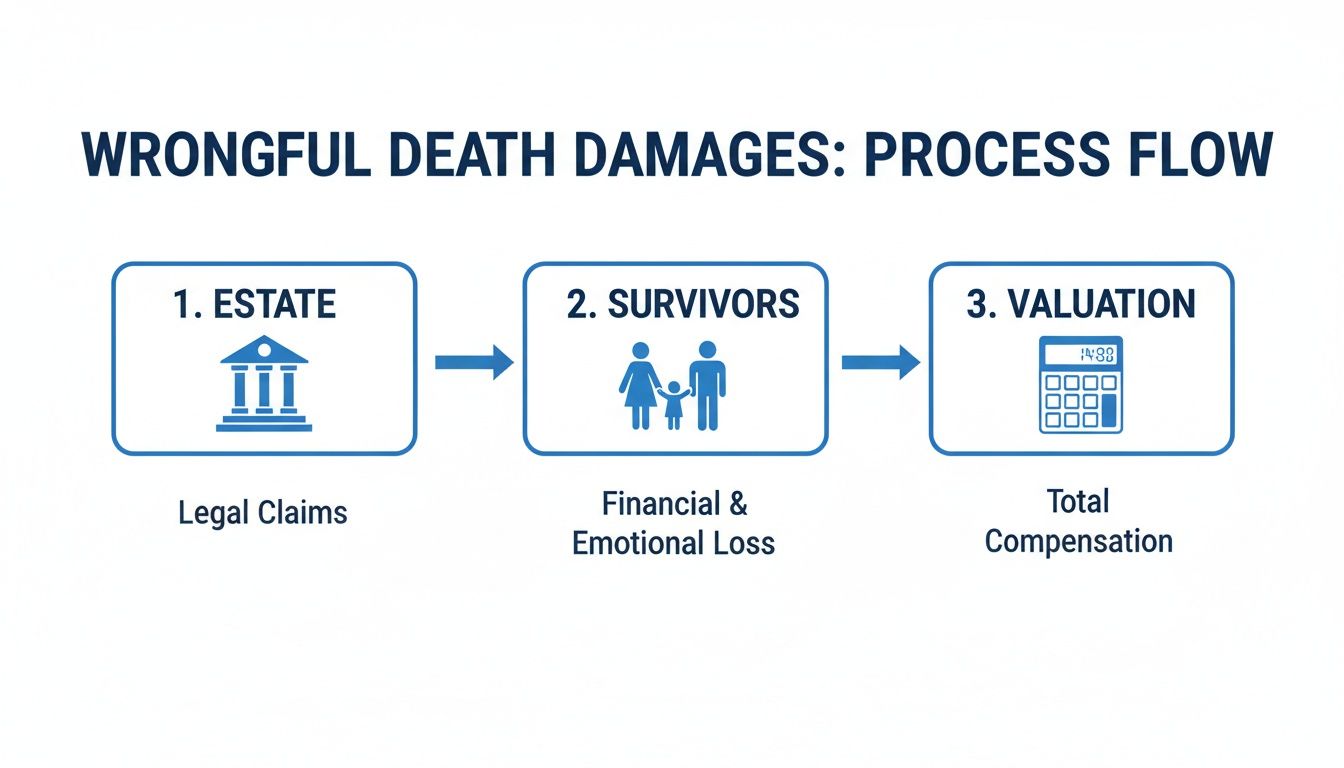
As you can see, a powerful case accounts for both the tangible, financial losses to the estate and the deeply personal, human losses the family endures to arrive at a full and fair claim.
Assembling a Team of Expert Witnesses
A wrongful death claim is rarely won with just family testimony. You need objective, scientific, and financial proof from respected professionals who can break down complex issues for a judge and jury. A top-tier Tampa firm has a deep bench of trusted experts ready to analyze the evidence and deliver unshakable opinions.
Think of this expert team as the case’s technical backbone.
An expert witness doesn’t just list facts; they connect the dots for the jury. They explain how the defendant’s negligence directly led to the death and why the family’s financial future has been permanently damaged. Their testimony transforms cold data into a clear, compelling story of accountability.
Some of the key experts in a wrongful death case include:
- Accident Reconstructionists: These are specialists who use physics and engineering to piece together exactly how a crash happened. They can show a jury, frame by frame, what went wrong.
- Medical Professionals: Doctors, surgeons, and coroners are brought in to testify about the specific injuries, the official cause of death, and the pain and suffering your loved one experienced before they passed away.
- Economists and Vocational Experts: These financial pros are absolutely essential for calculating the true economic damage. They project the deceased’s lost future income, benefits, and the dollar value of the services they would have provided for their family over a lifetime.
Tragically, the need for this kind of detailed case-building happens all too often. The Florida Department of Health reported 4,207 fatal fall accidents across the state in 2022. Of those, 248 happened right here in Hillsborough County. That means nearly 6% of all fatal falls in Florida occurred in our area, a stark reminder of how frequently families need skilled legal help.
In some cases, especially those involving distracted driving, even digital evidence can play a role. Understanding the admissibility of text message evidence in court is another tool in our arsenal. By preparing every case as if it’s going to trial, your attorney ensures no stone is left unturned and that your family’s story is told with the clarity, authority, and compassion it deserves.
Common Questions About Wrongful Death Claims in Tampa
After losing a loved one, you’re left with a mountain of questions and a future that feels uncertain. Getting clear, straightforward answers is the first step toward finding your footing again. Here, we address the most common concerns we hear from families in Tampa trying to make sense of it all.
How Much Does It Cost to Hire a Wrongful Death Lawyer?
This is usually the first question on everyone’s mind, and the answer often brings a wave of relief. Reputable wrongful death lawyers in Tampa don’t ask for money upfront. We work on a contingency fee basis.
Plain and simple, this means you pay absolutely nothing out of pocket. Our fee is “contingent” on us winning your case. We get paid a percentage of the compensation we recover for you, whether it’s through a settlement or a jury’s verdict.
If we don’t secure a recovery for your family, you owe us nothing for our time or effort. This system ensures that every family, regardless of their financial situation, can afford top-tier legal help when they need it most.
What If My Loved One Was Partially at Fault?
It’s a common fear, especially after a car crash or a complicated accident. You might be worried that if your loved one was even a little bit to blame, you can’t file a claim. That’s not how it works in Florida.
Our state uses a legal rule called comparative negligence. Think of it as a way of assigning responsibility. A jury might decide that the other party was 80% at fault, but that your loved one was 20% at fault. In that scenario, your family’s total compensation award would simply be reduced by that 20%.
Florida’s comparative negligence rule ensures that the person who caused the most harm is still held accountable. A huge part of our job is fighting back against insurance company tactics that try to unfairly shift blame onto the victim.
Insurance adjusters are trained to use any excuse to reduce what they have to pay. We anticipate these moves and build a powerful case to protect your family’s right to a full and fair recovery.
What Is the Difference Between a Wrongful Death Claim and a Survival Action?
This is a technical distinction, but it’s an important one. These are two separate but related legal actions that are often filed at the same time. They just compensate for different kinds of harm.
- Wrongful Death Claim: This is for the survivors. It’s designed to compensate the family for the losses you are now facing—things like the loss of future financial support, the absence of your loved one’s guidance and companionship, and your own pain and suffering.
- Survival Action: This is filed on behalf of the person who passed away. It’s meant to cover the damages they personally suffered between the moment of the accident and the moment of their death. This includes their medical bills, lost wages, and the pain and suffering they endured.
So, a wrongful death claim helps secure the family’s future, while a survival action helps settle the final debts and damages of your loved one’s estate.
How Long Will My Lawsuit Take?
Everyone wants to get through this process as quickly as possible, and we understand that completely. The truth is, there’s no single answer. A straightforward case might settle in under a year, but a more complex one could take two years or even longer.
The timeline really depends on a few key things:
- The Complexity of the Case: Was it a simple rear-end collision or a multi-vehicle pileup with disputed facts? The more complex the incident, the longer it takes to investigate.
- The Insurance Company’s Attitude: If the insurer is reasonable and offers a fair settlement, things can move quickly. If they dig in their heels and fight, we have to prepare for trial, which extends the timeline.
- The Discovery Process: This is the formal phase of gathering evidence, interviewing witnesses, and taking depositions. It’s often the longest part of any lawsuit.
- Court Calendars: The Hillsborough County court system is busy, and simply getting on the schedule for hearings or a trial can take time.
A good attorney will set realistic expectations from the start and keep you updated every step of the way. We’ll explain what’s happening, why there might be delays, and what our strategy is for moving forward as efficiently as possible without ever compromising the value of your case.
Navigating the aftermath of a tragic loss is an immense burden, but you do not have to do it alone. The legal team at Martin Hernandez, P.A. is here to provide the compassionate guidance and aggressive representation your family deserves. We handle every legal detail so you can focus on healing. For a free, no-obligation consultation to discuss your case, contact us today at https://injurylawyersoftampa.com.